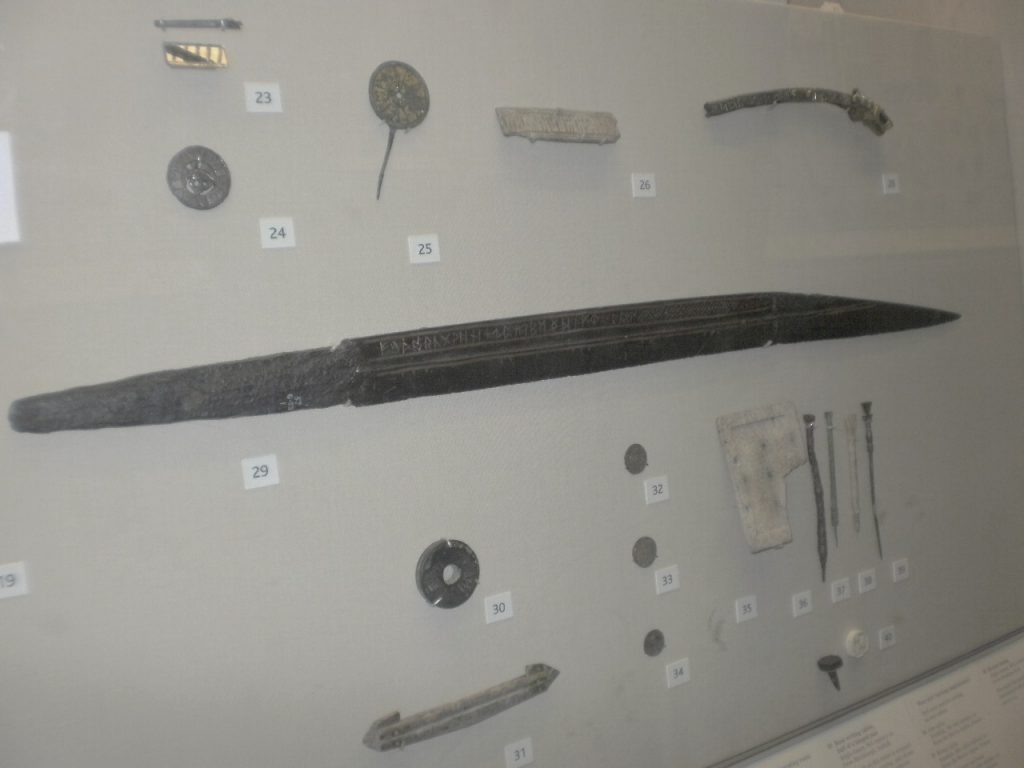
The Seax of Beagnoth from the British Museum, by S Marshall, CC BY-SA 4.0
In 1857 an extraordinary find was made: a 10th century Anglo-Saxon seax, almost 2 feet long, and inscribed with runes, was found by a labourer in the River Thames near Battersea. A seax is a large, single-edged knife and was characteristic of the Anglo-Saxons. The word is even thought to have given the Saxons their name.
‘Seax’ is in fact the generic Old English word for knife, but tends to be used by archaeologists to describe the larger iron single-edged knives which first appear in Anglo-Saxon graves of the seventh century. Later examples tend to be isolated finds, often from rivers, like this example. Seaxes were used for hunting and combat.
Detail of the futhorc inscription on the Seax of Beagnoth on display at the British Museum, BabelStone [CC BY-SA 3.0]
This particular seax was clearly a prestigious object. It is the only one found to have a full set of the Anglo-Saxon set of the runes, known as the futhorc, inscribed on the blade, along with the Anglo
-Saxon name “Beagnoþ.” It is not known if Beagnoþ was the sword-maker or its owner. Other seaxes have also been found with inscriptions, using either runes or Latin lettering.
Beagnoþ’s blade was originally inlaid with silver, copper and brass wire. A similar inlaid example was found deposited at Keen Edge Ferry in Berkshire, so close to Beagnoþ’s seax in shape, method of construction and decoration that they may have been from the same workshop.
The order of the runes does not match the usual sequence recorded elsewhere, and some of the individual runes are written slightly differently from usual too. It may be that the craftsman was not familiar with runes or else had problems inscribing the letters into the blade. However, all the runes from the futhorc are included.
It appears that the seax may have been deposited deliberately in the river, like other similar finds, but it is not known for certain why such valuable objects were treated in this way. It may have been for religious reasons, perhaps as protection at difficult crossing places on the river, based on pagan beliefs. At this period there may have been Viking or Scandinavian influences at work, and the law codes of King Cnut and Archbishop Wulfstan in the early 11th century, which forbade such rituals, certainly indicate that such practices were happening at this time despite widespread Christianisation.
The seax of Beagnoth can be viewed in the British Museum in London.
Saxon Princess Reconstruction, Kirkleatham Museum by Prioryman, CC BY-SA 3.0
One of the most spectacular Anglo-Saxon finds was in Street House in North Yorkshire, where a cemetery dating to the 7th century has been investigated.
The site was excavated between 2005-7, originally as part of an investigation into an Iron Age settlement. However, it soon became apparent that an Anglo-Saxon cemetery of significance was also beneath the soil. The site itself had evidence of human activity from the Neolithic through to Roman periods and the cemetery was an unanticipated delight.
The team led by Dr Steve Sherlock found 109 graves arranged in a square plan with the most spectacular finds in the centre. The high status jewellery found among the burials allowed accurate dating which placed it in the second half of the 7th century, with some finds dated 650-675 AD. This means that it was a “conversion” cemetery; a cemetery at the time of the conversion to Christianity with rapidly changing funerary practices being evidenced. Such sites have mostly been found in the south of Britain so this was even more unusual, and most excitingly it revealed the only known bed burial in the north of England. The original occupant of the bed burial in Grave 42 was a noble, possibly royal, female.
Princess Pendant, by Prioryman [CC BY-SA 3.0]
Grave 42 was near the centre of the cemetery. The bed is thought to be made of ash and it is 1.80m long and 0.80m wide with especially decorative iron work cleats holding it together and may have once had a canvas awning over it. The skeleton had dissolved entirely in the acidic soil, but the quantity and quality of the associated finds indicated the burial of a very high status individual. The jewellery consists of three gold pendants, two glass beads, one gold wire bead, and a fragment of a jet hair pin. The pendant, which became iconic of the find, is a shield-shaped jewel inlaid with 57 red garnets and a larger scallop-shaped gem in the centre, and is of exquisite craftsmanship. The design has been linked to early Christian belief as a symbol of rebirth through baptism but it is not clear whether the owner in this case was a Christian or not.
Beads from Grave 62, Photograph by Dave Currie, “An Anglo-Saxon Cemetery at Street House, North East Yorkshire”
As well as the bed itself, over 100 beads were excavated from sixteen graves, mostly of glass with one amber and some metal. There were few beads in each grave, reflecting a trend for smaller but higher quality jewellery at that period.
Grave 43 revealed some unique items: a gold triangular shaped pendant, three gold wire beads, two silver wire beads, four silver bulla, two glass beads and a silver annular brooch dateable to the third quarter of the 7th century. The triangular pendant reuses Iron Age beads as part of its construction, a particular feature of finds in Conversion Period cemeteries.
Jewelled brooch from the Street House Anglo-Saxon cemetery (grave 70) by Prioryman, CC BY-SA 3.0
Grave 70 uncovered a spectacular gold brooch, unique in the north, along with glass beads, potsherd, iron key set, glass fragment, a gold bicone bead, a gold cylinder and a small gold chain. The pendant is 44.5mm in diameter and was decorated with red gemstones, and has been repaired with a new suspension loop.
There was also an amulet of black annular twist glass bead, broken in two. Similar examples are known from at least six sites including two other cemeteries (Swallowcliffe Down and Shudy Camps) where there are bed burials. There were five graves that had amulets in a variety of materials including jet, glass and amber, and four of the five pieces were broken.
Iron Age gold coins were found in grave 21 with glass beads which had been formed into a necklace. This is unique, in that whilst coins are found in Anglo-Saxon graves, similar date coins have not been found to be adapted in this way.
The date and location of the cemetery encouraged speculation that the inhabitants may have known Abbess Hild of Whitby, who lived at around this time and was also of royal connection. Hild had also spent some time in East Anglia, where other bed burials have been found.
The cemetery appears to have been used for around 30 years, and to be based around the woman in the bed burial, which seems to have been the first grave dug. It is speculated by the team that she was “a female member of the local aristocracy, probably a princess and an outsider, whose personal status was strong enough to act as a catalyst for the site.” The site may therefore have been dedicated to her immediate household or family and ceased to be used after they had all died.
In this video, archaeologist Dr Steve Sherlock talks about his discoveries at Street House with Kirkleatham Museum curator Alan Pearce; the museum has an exhibition of finds from the excavations.