Category Archives: Famous Anglo-Saxons

Bede

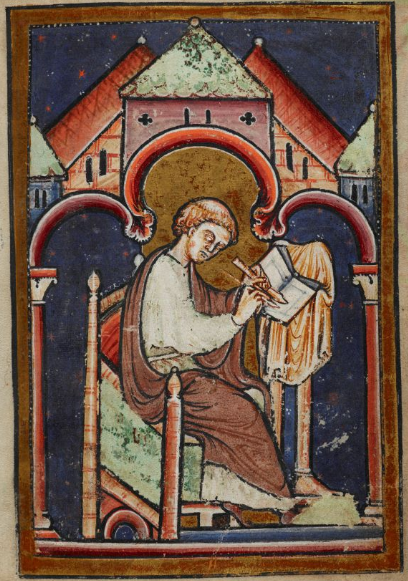
Scribe at writing desk from Bede’s Life of Cuthbert, MS26 f2r (c) British Library

Scribe at writing desk from Bede’s Life of Cuthbert, MS26 f2r (c) British Library

The Venerable Bede died on 25th May 735 CE at the 10th hour of the day. Most of what we know about him comes from his own writings, primarily the “Ecclesiastical History of the English People” which was completed in 731 CE.

He was born on the lands of monastery of Wearmouth around 673 CE. In 680 CE, at the age of seven, he was given to the Church as a child oblate (a person dedicated to God) under Benedict Biscop. The monastery at Jarrow was founded in 681 CE and he was sent there in the care of Abbot Ceolfrith. As an oblate he followed the rule of Benedict and the routine of work, prayer, study and sleep.

According to the “Life of Ceolfrith” when a plague visited the monastery all the monks were struck down except for Ceolfrith and a young boy who between them sustained the Rule and sang the offices daily until more monks were able to join them. As he obviously survived, the boy must have been Bede and he would have been about 14 at the time.

Bede was ordained as a Deacon at the age of 19 by John of Beverley, who was at that time Bishop of Hexham. The canonical age for ordination as a deacon was 25, so the early date and the presence of John indicates that Bede was already recognised as exceptional. He became a priest at 30, again ordained by John. In due course he became probably the most learned man in Europe.

Bede left Jarrow only twice, visiting Lindisfarne in 721 CE and York in 733 CE. He lived the life of a scholar-monk, delighting in learning, teaching and writing. In this, he benefited enormously from Benedict Biscop’s collection of books acquired on his many trips to the Continent. Among his pupils was Ecgberht, later Bishop of York (whose ordination was the reason for his trip in 733 CE); Ecgberht invited Bede to the ceremony for his elevation to Archbishop in 735 CE but Bede was already too frail to make the journey.

His most famous work is of course the “Ecclesiastical History”, but he also wrote a huge range of other works, some of which have been lost but others survive. He was an historian, poet, musician, scientist, theologian and hagiographer. His major early works include “On the Nature of Things” (De Natura Rerum) and “On Time” (De Temporibus), which established the basis for his future intellectual development.

“On the Nature of Things” aimed to refute superstition by the rational explanation of the nature of the universe. This included phenomena such as earthquakes, eclipses, and thunder and lightning. Bede also aimed to foster appreciation and admiration for the beauty of the natural order.

His preface says:

“In brief chapters, I, Bede, the servant of God,

Have lightly touched on the varied natures of things

And on the broad ages of fleeting time.

You who study the stars above,

Fix your mind’s gaze, I pray, on the Light of the everlasting day.”

“On Time”, as well as being a reflection on the divinely instituted order of time, also represented the new Christian genre of the computus manual for calculating the date of Easter – a genre which Bede himself played a very significant role in developing.

Both works were in the format of question and answer and could easily have been adapted for teaching.

In his later expanded work, “The Reckoning of Time” (De Temporum Ratione), Bede took up and promoted the ideas of Dionysius Exiguus and Isidore of Seville and embedded the concept of the “Years of Grace” or “Anno Domini” method of dating which led to it being widely adopted.

In the “Reckoning of Time” ch 32 Bede describes the Earth as a globe:

“It is not merely circular like a shield [or] spread out like a wheel, but resembles more a ball, being equally round in all directions.”

In addition to these scientific endeavours Bede is known for writing the “Lives of the Abbots”, a history of his own monastery. He also wrote two versions of the “Life of Cuthbert”, one in prose and one in verse.

In the “Ecclesiastical History” Bede shows himself to be a true historian, collating and analysing his sources and quoting his authorities. Five 8th century copies still remain and it was chosen by Alfred for translation as one of the books “most needful for men to know.”

Bede was buried at Jarrow and was later translated (relocated) in the early 11th century to Durham under slightly questionable circumstances; the monks of Durham stole his remains to bring to their church, being dissatisfied that Bede’s relics were held at Jarrow. He now lies in the Galilee Chapel beneath a quotation from his own writings:

“Christ is the morning star, who, when the night of this world is past, brings to his saints the promise of the light of life, and opens everlasting day.”

But perhaps we should finish with another poem, credited to Bede (although not known certainly) about final thoughts before death and which is known as Bede’s Death Song:

Bede's tomb at Durham Cathedral
Bede’s tomb at Durham Cathedral

“Before the journey that awaits us all
No man becomes so wise that he has not
Need to think about, before his going hence,
What judgement will be given to his soul
After his death, of evil or of good.”

Alcuin of York

Letter from Alcuin, Harley MS 208 f. 34r (c) British Library

Letter from Alcuin, Harley MS 208 f. 34r (c) British Library

The 8th century polymath studied at York and became a leading figure of Charlemagne’s Renaissance, before ending his career as Abbot of Tours.

He was born in Deira (approximately modern Yorkshire). Little is known about his parents, although his own writings suggest his family owned land in Yorkshire.  As a child he was handed over to the Minster community under the care of Ecgbert. He was always a promising scholar: it is said that he had mastered the Psalms by the age of 11 and showed a precocious interest in the works of Virgil. 

Alcuin was probably the most famous alumnus of the school at York. A lberht, the master of the school, sought learning and rare books during his travels to the continent. He used them to establish a curriculum at York which surpassed, in the range of subjects taught, all other schools in England and Western Europe at the time. This curriculum was based on the Trivium and Quadrivium subjects of Grammar, Rhetoric, Logic, and Astronomy, Geometry, Arithmetic and Music. Alcuin studied under A lberht, and took over as master of the school in 767 CE when A lberht became Archbishop, also inheriting his library.

After A lberht died, Alcuin was sent to Rome to collect the pallium for the new archbishop and on his return in March 781 CE, as we have previously discussed, he met Charlemagne. At this point Alcuin was not a famous scholar and Charlemagne was not an emperor, but they saw potential in each other. Within the year he had joined Charlemagne’s court and spent the rest of his life on the Continent, apart from a couple of visits home. He became Charlemagne’s chief adviser on religious and educational matters. 

As head of the palace school at Aachen, he established a great library.  As well as revising church liturgy and the Bible, Alcuin helped create the intellectual movement where schools of learning were attached to monasteries and cathedrals. This was under direction for Charlemagne, who had a great project in mind to restore learning, combined with a legislative programme for reform of the Frankish Church and society. To this end he gathered the greatest scholars available to help see it through. They collected classical texts, created books and studied writers such as Cicero and the Roman poets. According to J. A. Willis, 94% of classical Latin literature was lost in the period between the Fall of Rome and Charlemagne’s rise to power. The remaining 6% was saved by the scholars at Charlemagne’s court.

Alcuin, as the leading scholar of his time, wrote to Charlemagne that the king’s noble efforts had ‘brought about a rebirth of civilised standards in every kind of knowledge and useful erudition.’

Alcuin also left us his definition of the meaning of “Wisdom”:  ‘the knowledge of things divine and human’ which is sought by the whole people. In this search for wisdom, the scholar must debate with and learn from pagan, Jew and Byzantine alike, in his effort to catch a vision of a nobler, more truly Christian, society

He and Charlemagne were close, and in 796 CE the Emperor gave Alcuin the abbacy of St Martin at Tours, and this was where he finally died eight years later. Even after his retirement, Charlemagne would ask for Alcuin’s advice, invite him to visit and ask him to accompany the emperor on campaign.

Alcuin wrote endless letters as well as a famous poem about York. He retained a keen interest in events back home, writing about the Viking raid on Lindisfarne as well as providing advice and guidance.

Alcuin’s influence was profound. At court and later at Tours, he imported the York curriculum, reintroducing books and subjects which had been neglected for centuries but saved in Northumbria. His works covered every area of his time’s intellectual endeavour: grammar, astronomy, hagiography, biblical commentary and theology. His pupils came from all over the empire to study with the famous teacher, and went on to become abbots and bishops, including Rhabanus Maurus (Abbot of Fulda, Archbishop of Mainz) and Einhard (Charlemagne’s biographer).

Alcuin’s remarkable influence on contemporaries reflects not only his learning, piety, and prolific writing, but also the effects of his personality, especially his gift for friendship expressed in letters and poems. He inspired devotion from his students and corresponded with kings, abbots and bishops, as well as the Patriarch of Jerusalem. His letters were copied and preserved in monastic centres across Europe and his writings recopied in every century, until the age of print.    

And finally, he was an organised man – he even wrote his own epitaph:

“tu mihi redde vicem, lector, rogo, carminis huius

  et dic: ‘da veniam, Christe, tuo famulo.’

obsecro, nulla manus violet pia iura sepulcri,

  personet angelica donec ab arce tuba:

‘qui iaces in tumulo, terrae de pulvere surge,

  magnus adest iudex milibus innumeris.’

Alchuine nomen erat sophiam mihi semper amanti,

  pro quo funde preces mente, legens titulum.”

“Now I ask you, the reader of this poem, say:

‘O Christ have mercy on your servant here’

I pray that no hand violate the holy tomb

Until the Angel’s trumpet calls from heaven:

‘Arise from the dust of the earth, you who lie in this tomb.

For the Great Judge is here with countless throngs’

Alcuin was my name. I always loved wisdom.

Pray for me, as you read this.”