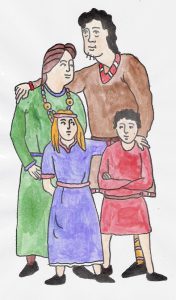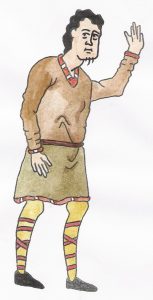
Leofwin is a typical ‘ceorl’, or freeman, living in the village of Prittewella, in the south east of England, by the Thames estuary.
Leofwin’s House
No Anglo-Saxon houses survive! But traces like postholes in the ground show their size and shape. They were squared off, and typically about 30ft x 15ft (10m x 5m). There’s evidence for wooden floors, with a cavity underneath, possibly for storage.
Walls were built either with upright planks slotted together, or by ‘wattle and daub’. Some homes may have had windows, but there was no glass. There was a central hearth for warmth and cooking, but chimneys did not appear until medieval times. The smoke simply seeped out through the thatch.
There may have been an ‘upstairs’ in Leofwin’s house, possibly a floor at each end reached by a ladder. Beds were wooden-framed. they probably consisted of a cloth bag stuffed with wool, perhaps, with blankets or fleeces on top. There may have been very little furniture: perhaps a trestle-table, a pair of benches, a chest, baskets, and some shelves. The thatched roof would be smoky and soot-blackened on the inside, ideal for curing meat.

Outside, there might be a number of smaller buildings associated with the houses: a midden or loo, sheds for tools, storage food and livestock. Evidence survives for many buildings with sunken earth floors: debate continues about their use. Some of the animals may have been brought indoors during the winter. Water had to be brought daily in buckets from the nearest stream or well. After dark, candles or the fire gave the family’s only light.
Leofwin’s village
Archaeology shows houses grouped together into villages, typically of up to ten families – ‘a tithing’. In later times, a village might boast a little wooden church.
Farmsteads
The tradition of free-standing farms dates from from pre-Roman times, through the Roman occupation, into Saxon and Medieval times, to the present day. There were probably a handful of scattered farmsteads within a hour’s walk of Prittewella.
Roman towns
Towns depend on trade and money, law and order to survive. After the Romans left Britain, no more money was minted, so their great towns and cities fell into ruin. The nearest to Leofwin were Caesaromagus, which the English called Celmeresforda, and Camulodunum, which they re-named Colneceastre. Even Londinium, known to the English as Lundenwic, lay mostly abandoned for a time.*
Saxon towns
From the 700’s onwards, English kings began minting money. With improved trade and a more sophisticated society, towns became possible again. In the late 800’s, King Alfred ordered the building of many new towns as military and economic power-bases, spurred on by the need for defence against the Vikings. By today’s standards, Anglo-Saxon towns and villages were tiny,** but nearly all of them have survived, with something like their Anglo-Saxon names, into the 21st century.
* Chelmsford, Colchester and London.
**The population of England was about one thirtieth of today’s!