Category Archives: Daily life in Anglo-Saxon England

Wildlife in Anglo-Saxon times

By Geoff Littlejohns, gesith

We can start this survey of wildlife in Anglo-Saxon times by mentioning some species which had lived in the British Isles in prehistoric times but for which there is no evidence by AD  450.  The Wild Horse and the Bison (or Wisent) became extinct in the British Isles at the end of the Paleolithic.  The Elk (known as ‘Moose’ in North America), a noble, wandering animal that requires a large feeding territory, has been considered to have become extinct in the Mesolithic but an elk bone from a Neolithic pit in Cambridgeshire was identified in 2018.  It was dated to around 2500BC.  Unless this animal bone was ritually significant enough to be worth importing, this bone indicates that a few Elk may have survived in Britain from the Mesolithic into the Neolithic. 

The magnificent Aurochsen, or Wild Cattle, had probably gone from these islands in the Bronze Age and our modern domestic cattle, including all the rare breeds, descend from imported stock in the Neolithic and later.  There is some debate over the survival of  Brown Bears as the Ancient Roman poet Martial made a reference to a savage ‘Caledonian Bear’ used to execute criminals in the Roman arena.  This is not strong enough evidence to support the assumption that Brown Bears were living in Scotland in Roman times as Martial may have chosen to assume that the bear came from a distant and cloudily romantic source.  To have proposed a more realistic origin for his bear in Italy or the Alps might have lessened the interest of his story.  There is no other evidence for bears in Roman Britain, but bear-lovers can live in hope that some future excavation in Scotland unearths some bear bones dateable to the Roman period.

Lynx in the Bavarian Forest National Park, Germany
Lynx in the Bavarian Forest National Park, Germany By Aconcagua (talk) – Own work, CC BY-SA 3.0

The Lynx is a species that was long considered to have died out in Britain at the end of the Mesolithic.  Roger Lovegrove in ‘Silent Fields’ (2007) updated this belief by stating that lynx may have survived in remote areas of Scotland and Yorkshire as late as the time of the Roman occupation.  More recent radiocarbon dating of bones discovered in a North Yorkshire cave have confirmed that lynx survived in that Upland district up to the 6th century AD and so into the Anglo-Saxon era.  Lynx may have survived longer in the Lake District as a 7th century Cumbric lullaby may be referring to lynx hunting there. The eastern Grampians in the Highlands of Scotland could have been supporting a lynx population in an even later period. 

Eurasian beaver near its dam
Eurasian beaver near its dam By Klaudiusz Muchowski CC BY-SA 3.0

With Beavers we are on more secure ground as several Anglo-Saxon place-names refer to them.  The name of Beverley indicates that a clearing associated with beavers, perhaps living along the River Hull.  Bevercotes, near the River Maun, is given in the Nottinghamshire English Place-names Survey as ‘The beaver cotes or dwellings’, with the assumption that the name referred to dams or other structures built by the local beavers. Well after the Anglo-Saxon period, Giraldus Cambrensis testified that beavers were living in the Teifi riverside in west Wales in AD 1188.  This however was their only dwelling place in England and Wales, although he claimed that they also lived along an unnamed river in Scotland.  These were relicts as populations, so we may assume that the distribution of beavers in the earlier Anglo-Saxon centuries would have been wider.  In fact some surprising discoveries recently found within entries in parish records suggest that beavers might have survived for a considerable time in remote places with little attention from humans.  They might have been surviving deep in wet woodlands until the 16th century.

Wild boar
Wild boar By Jerzy Strzelecki – Own work, CC BY-SA 4.0

Similarly Wild Boar were certainly living in England through the Anglo-Saxon centuries.  Eversden in Cambridgeshire and Eversley in Hampshire, for example, derive from Eofor, the Englisc for Wild Boar.  As with beavers, mediaeval evidence for boar indicate that they must have been present in earlier centuries.  Wild Boar were still being hunted vigorously in both the Forest of Pickering and the Forest of Dean in the mid 13th century.

Wolf in Bavarian Forest National Park, Germany
Wolf in Bavarian Forest National Park, Germany By Wikimedia Commons CC BY 2.0

Some sceptics have sought to throw doubt on the evidence for Wolves in Anglo-Saxon England.  That an outlaw was known as a ‘wolf’s-head’ does not necessarily prove that wolves still roamed the woods and moors of pre-Conquest England, any more than do the common names of Wulfstan, Wulfhere or Æþelwulf.  The dramatic mention of wolves in battle-poems may well be examples of poetic licence.  The names given to topographical features are more difficult to argue away. Wulf-hlið, hillside inhabited by wolves, Wulfsēað, wolf’s hole, Wulfslǣd, valley of wolves, strike me as convincing proof that wolves were common.  Nevertheless Rackham was not convinced.  He asked rhetorically;

‘who can tell which of the wolf-springs, wolf-hedges, wolf-leaps, etc. in Anglo-Saxon charters have some such metaphorical meaning and which are connected with actual wolves?’  (Rackham)

The balance of probability, however, surely lies with the likelihood that a wolf-pit or a wolf-hedge was referring to the deterrence of real wolves.  As with beavers and boar, the documented activity of wolves in mediaeval England indicates that they had survived through the earlier centuries.  Bounties were paid as rewards for the killing of wolves right up to the late thirteenth century.  The final record for wolves in mediaeval England came even later.  At Whitby in 1394-6 the monks recorded that they paid a large sum of 10s. 9d for ‘tawing 14 wolfskins’.  The wolf is a resilient animal, capable of travelling widely and so of moving, in Anglo-Saxon times, beyond the Highland zone where I presume they would have found a refuge.  Unfortunately its archaeological remains are usually impossible to distinguish from many domestic dogs.
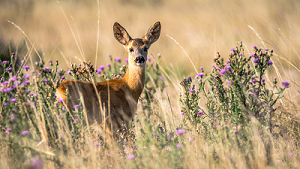
Roe Deer
Roe Deer by LubosHouska, CC0, via Wikimedia Commons

While Red Deer and Roe Deer were common in Anglo-Saxon England, the status of Fallow Deer is still debated.  It is likely that they were imported for religious rituals by the Romans, but then perished as the Roman Empire came to an end in Britain.  Fallow Deer were returned to Britain by the Normans who may have brought them in from Sicily.
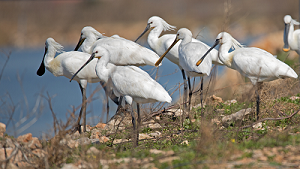
Flock of Spoonbills
Flock of Spoonbills by Artemy Voikhansky, CC BY-SA 4.0

The position of bird life is less problematic.  Bird species that were forced into extinction in the historically documented era – the Crane, the Spoonbill, the Great Auk, the Great Bustard, the White-tailed Eagle and the Osprey – were victims of the invention of firearms which made killing all too easy.  In Anglo-Saxon times the technology of bow & arrow and falconry did not allow people to inflict such havoc.  So the very recent natural return of the Osprey, Crane and Spoonbill to our islands has restored to us birds that would have been familiar to our ancestors and we should welcome, also, the translocations by ecologists that have restored the Great Bustard and the White-tailed Eagle, along with further Red Kite populations to the bird life of Britain.  Sadly the Great Auk cannot be reintroduced as human destructiveness killed off the last of the entire species in the mid-Atlantic in the mid 19th century.

This impression that the bird-life of Anglo-Saxon England must have been extraordinarily rich is confirmed by the presence of many species’ names in the Englisc (language of the Anglo-Saxons) word-hoard.  The surviving literature from before AD 700 includes the Gannet, Whooper Swan, White-tailed Eagle, Crane, Quail, Whimbrel, Kittiwake, Carrion Crow, Raven, Cuckoo, Woodpigeon, Swallow, Nightingale, Robin and Chaffinch.  Subsequent writings before the Middle English of Chaucer have pushed the list of bird names to just under a hundred.  Other bird names that are not recorded in the early lists clearly have their origins in Englisc and must have been used in Anglo-Saxon times but not recorded on surviving manuscripts.  The Redshank, Redstart, Yellow Hammer and the Godwit must derive from scanca, steort, amore and wiga.  Had the name of the Redshank been coined in the Modern English period, it would be probably now called the Red-legged sandpiper and the Redstart the Redtail.

The Re-wilding Movement began in North America with the intention of restoring as far as is feasible the splendour of the bio-diversity of the North American Pleistocene.  The present Re-wilding Movement in Britain, as far as I am aware, has not declared any purpose of reviving a species list quite as it was in historic or prehistoric times.  Instead its prime aim is to revitalize our landscapes and transform them into habitats for balanced populations of large herbivores and carnivores of once native (or similar) species.  Hence bison, konik ponies or elk could fulfil a role in an English re-wilded landscape. 

This means that re-wilders are not concerned with reviving a fauna that would be a strictly Anglo-Saxon one.  Nevertheless, we as Anglo-Saxonists, may wish to welcome the current efforts of re-wilders to restore lynx, beavers, wild boar, white storks and even wolves to parts of our archipelago.  Of course we would prefer to see re-wilding that showed concern for historic provenance, as it seeks to protect, enrich or restore landscapes.  A historically-mindful approach is perhaps particularly needed when we are engaged in large-scale tree-planting, but an English landscape that is rich in balanced wildlife must be a landscape that helps bring us closer to the lived experience of our Anglo-Saxon ancestors, dwelling as they did in the heart of a natural world. 

Read about the Anglo-Saxon Countryside
 

The Anglo-Saxon countryside

by Geoff Littlejohns, gesith

The condition of wildlife depends on the condition of its habitat and eco-system.  Before we can appreciate the richness and variety of wildlife in Anglo-Saxon times, we have to be aware of the variety of the English countryside. 

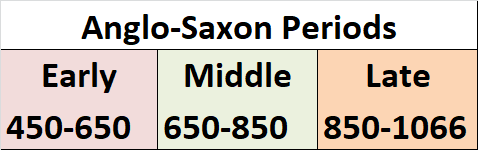
Chronologically we can draw distinctions between the Early, Middle and Late Anglo-Saxon periods and understand that the countryside would have been exploited at a different tempo and intensity in each of those periods. 

Period dates: Early 450-650; Middle 650-850; Late 850-1066

The wealth of local detail in Domesday Book allows us to bring together an image of much of the English countryside as it was in the Late period (AD 850-1066).  Oliver Rackham, in his magisterial study, “The History of the Countryside” (1986), used this Great Survey of 1086 to estimate that around 35% of the land recorded in Domesday was farmed as arable, around 15% held in wood or wood pasture, around 30% kept in pasture and around 20% left as waste – in other words, upland moors, scrub and fens. 

The details that appear in Domesday Book suggest that fertile land was relatively intensively exploited with the arable production of the ploughlands supported by the activities associated with hay meadows, water-mills, fish weirs and wood pasture.  A monetary economy meant that surplus agricultural production could be released to markets for trading.

For the Middle Anglo-Saxon period (AD 650-850) we rely on the evidence of place-names and of charters to provide an impression of conditions in the countryside.  We can assume that agriculture was less intensively organized and the countryside less populated than it was in the Late period.  Place-names such as ‘Barton’, with their reference to barley growing, indicate that specialization was already being undertaken.  Estates had formed and must have been producing surpluses so that the rural population was no longer struggling to survive at subsistence level.  Evidence from charters indicates that the Open-Field system was being introduced in some areas during the Middle period. 

For the Early Anglo-Saxon period (AD 450- 650) we have very little evidence to carry us beyond suppositions.  Pollen analysis can be misleading if evidence drawn from a limited number of sites is applied to draw general regional or national conclusions.   

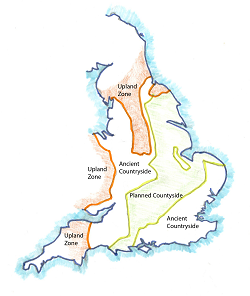
Map of Britain divided into landscape regions
Map of Britain divided into landscape regions (c) Geoff Littlejohns 2021

We should understand the variety within the Anglo-Saxon countryside not just in chronological but geographical terms.  Rackham was at pains to distinguish three distinct zones within the English countryside – the Highland zone, the Lowland ‘Planned Countryside’ and the Lowland ‘Ancient Countryside’.  The Highland zone encompasses the Peak District, Devon & Cornwall and all the northern areas which now lie within or close to our National Parks.  To quote Oliver Rackham, ‘although not all of high elevation, this is the land of moors, dales, ancient oakwoods and a mountain way of life.’  (Rackham 1986 p4)   In these areas, as in nearly all Wales, the human population would have been very low, transhumance with livestock undertaken regularly and arable-agriculture small-scale and unreliable.  With little surplus extracted from the soil or livestock, local farming would have been largely at subsistence level. 

One of the key themes within Rackham’s work is his stress on the long-running distinction in lowland England between two contrasting types of countrysides.  The division was observed long ago by F.W. Maitland in his ‘Domesday Book and Beyond‘ (1897).  The ‘Planned Countryside’ of today is the countryside redrawn in the 18th and 19th century Enclosure Movement, a landscape now of isolated farm-houses standing within regular fields enclosed by blackthorn and hawthorn hedges.  Before the great enclosures swept over this zone of the English countryside, the landscape would, however, have been totally different in appearance and arrangement.  Nucleated villages would have been surrounded by two, and later three, vast open-fields, each subdivided into selions, or strips, allocated, and regularly reallocated, to various members of the village community.  The fields are known as ‘open’ because no hedges marked out their iinternal subdivisions.  The agricultural tasks and routines of the villagers would have been closely organized and regulated with crops rotated each year among the open-fields.  The fallow seasons would have been strictly enforced to allow for grazing by villagers’ livestock over the ground left fallow for that year.  Beyond the open-fields, wastes could provide for more grazing.  We can discover traces of the long strips of the mediaeval open-field system in the ridge and furrow patterns that are still there set on the ground within the later grass-covered grazing enclosures.

The Open-field system never covered all the regions of England.  The ‘Planned Countryside’ of the Open-fields stretched across England from the East Riding and Vale of York in the north southwards over the East Midlands to reach Dorset on the south coast.  The 18th & 19th century Enclosure Acts undid the open-fields over around 4½ million acres which covered one-seventh of England’s land surface.  Earlier enclosures had destroyed open-fields in some other areas, such as in County Durham and the Suussex coastal plain.

The other English lowland zone where open-fields do not seem to have been maintained systematically Oliver Rackham christened ‘the Ancient Countryside’.  He wrote lyrically about the appearance of this type of countryside;

‘On the one hand, as in Essex or Hertfordshire, we have the England of hamlets, medieval farms in hollows of the hills, lonely moats and great barns in the clay-lands, pollards and ancient trees, cavernous holloways and many footpaths, fords, irregularly-shaped groves with thick hedges colourful with maple, dogwood and spindle – an intricate land of mystery and surprise.’ (Rackham 1986 p4)

He described the Ancient Countryside as the product ‘of at least a thousand years of continuity and most of it has altered little since 1700.’  (Rackham p5)

This remarkable description raises interesting questions for Anglo-Saxonists.  When did these two contrasting landscapes arise?   Was the division of lowland England into two contrasting zones as much a feature of Anglo-Saxon England as it was in later periods?  Can we work out when the open-field system began or decide just how ancient Rackham’s ‘Ancient Countryside’ was?  The open-field system was undoubtedly in operation during the High Middle Ages of post-Conquest England as manorial records confirm, but can it be dated back to Anglo-Saxon times?  

Oliver Rackham was confident that the open-field system did go back beyond the Late Anglo-Saxon to the Middle period.  He found evidence for this in place-names and in the charters.  His analysis of certain Englisc (the language of the Anglo-Saxons) words found in charters also indicates that the difference between ‘Ancient Countryside’ and ‘the Planned Countryside’ was already becoming a feature of the English landscape in the Middle Anglo-Saxon period.  He looked at gāra, furh, æcer,  furlang, hēafod, hlinc and foryrþ.

He found that gāra, or ‘gore’ in later English, was mentioned five times as often in extant charters from sites within Planned Countryside as from those from within Ancient Countryside while furh, orfurrow’, appeared eight times as often in what was to be Planned Countryside.  Æcer, ‘acre’ and furlang, ‘furlong”, units of measurement in the open-field system, also appeared more abundantly in areas of Planned Countryside.  Hēafod probably referred to a ‘headland’ in the open-fields.  As with the other key words it appeared more abundantly within charters relating to Planned Countryside.  Hlinc which may have identified baulks and ridges in the open-fields was again more frequent in Planned Countryside while foryrþ, ‘fore-earth’, has a similar distribution.  Rackham provided a table of his findings that made clear the number of occurrences of these key words with the different areas where they were abundant.  (Rackham p174)

Eric Kerridge in his ‘The Common Fields of England‘ (1992) also found evidence for an open-field system in the Middle period.  Acording to Kerridge, the earliest reference to the common fields can be found in the ‘Dooms’ of King Ine who ruled over the West Saxons between AD 688 and AD 726.

‘Gif ceorlas gærstun hæbben gemænne othe other gedalland to tynanne and hæbben sume getyned hiora dæl sume næbben and etten hiora gemænan æceras othe gærs gan tha thonne the thæt geat agan and gebete tham othrum the hiora dæl getynedne hæbben thone æwerdlan the thær gedon’.

(‘if churls have common meadow or other deal-land to fence and some have fenced their deal, some never, and their common plough-acres or grass be eaten, go they then that own that gap and make amends to them others that           have fenced their deal for damage that there be done.’

The words ‘gemænne’ and ‘ gedalland’ arekey here‘Gemænne’ translates as ‘held in common’ and ‘gedalland’  as ‘divided-up land’.  This indicates that at the time the charter was written the commonly-held land of the open-fields was being divided up and dealt out in strips to the churls.  Kerridge concluded that;

‘the evidence plainly shows that the introduction of common fields in (but not throughout) England started before 726 and had run much or most of its course by about the year 1000.’   (Kerridge p22)    

If the open-field system had its beginnings in the Middle Anglo-Saxon and the distinction between Planned and Ancient countrysides was already visible then, we can ask how the countryside in the Early Anglo-Saxon period was similarly or differently organized.  Rackham declared that as far as he knew there was not the slightest evidence that open-fields existed in the Roman period.  David Hall in ‘Medieval Fields‘ (Shire 1982) confirmed this view;

‘Aerial photography and excavation prove that strip fields are later than all Roman (and earlier) sites.  More surprisingly, strips overlie early and middle Saxon sites as well.  The early Saxon settlement pattern is not at all like that of the medieval nucleated village.  Sites are are limited to light soils. … The settlements are small … There is no evidence of subdivided fields associated with them.’  (Hall p45/6)

Hall argued that the Early Anglo-Saxon farmed sites were deserted some time in the eighth and ninth centuries AD and the settlements moved into nucleated villages at the same time.  He used the word ‘catastrophic’ to apply to what may have been imposed changes;

‘thus there are two “catastrophic” events happening in the middle Saxon period: a resiting of villages and the laying out of subdivided fields.’   (Hall p46)

He pointed out that there was no evidence of continuity as open-field furlong boundaries appeared not to have the slightest relationship with earlier landscape features.

This assessment provides support for Rackham’s view of the nature of the coming of the Open-fields.  He suggested that the agricultural landscape for this zone of lowland England was suddenly and comprehensively transformed in a rapid process that affected social life as much as it did the lay-out of fields and hedgerows.  It was as momentous a change as the 18th century Enclosure Movement that swept away the open-fields.

‘From the Dark Ages onwards, a “De-Enclosure Movement” flooded like a tide. … The English Midlands were submerged so widely and for so long that now little remains of the pre-open-field agricultural landscape. … Open-field with its rapid spread has all the marks of a Dark Age invention. … It appears also to have been part of a social revolution, in which people took to living in villages instead of the earlier hamlets and farmsteads.’  (Rackham p178)

It is perhaps regrettable that Rackham used the term ‘Dark Age’ as the great changes in agricultural organization and settlement would seem to come in the age when literacy (and thereby light) had returned. This was the period when powerful kingships were being formed, buttressed by clerical authority and organization.  At a local level the new power and authority were being reflected and secured by the establishment of large concentrated estates. 

Why did these enormous changes appear to have affected the lowland zone of the Planned Countryside and not the zone of Ancient Countryside?  The explanation may of course lie in the nature of soils, altitude and localized climatic conditions.  We may, however, wonder whether the changes may not be related to the expansion of the great kingdoms of Wessex, Mercia and Northumbria.  The Ancient Countryside is not situated in one contiguous block but includes parts of Yorkshire, Lancashire, the West Midlands, western Wessex, the Thames Valley, Surrey & Kent and parts of East Anglia.  South Essex has no history of open-fields. 

This Ancient Countryside may not have been all of one piece.  Kerridge looked at East Anglia and Kent.  He found that there were some common fields set up here but stressed that they had not been imposed in a single moment of reorganization as;

‘they arose less from the planned and orderly distribution of lands amongst service-tenants and more from the haphazard division of large family holdings into smaller ones.  And this would seem to accord with what we know of the manner in which the Germanic peoples first settled the land in those places.  It seems to have been more by infiltration and less by conquest than it was in           Wessex and the Midlands.  (Kerridge p46)

Kerridge’s statement surely implies that what we may be seeing in the Ancient Countryside of Essex, Sussex, Kent and East Anglia, in the heaths, woodlands and irregular fields of those areas, is a lasting heritage of the Early Anglo-Saxon settlement of our country, one that was so entrenched that it was impossible for the fragile kingships of Middle and Late Anglo-Saxon England to break it down and to enforce reorganization in those areas.  Features of that landscape may possess not just a thousand years of continuity but date back five hundred more years to the earliest years of our ancestors’ settlement. 

As for the other regions of Ancient Countryside, in parts of Yorkshire, Lancashire, Derbyshire, the West Midlands and western Wessex, the particular landscape may reflect their marginal geographical position as they all lie close alongside the upland zone or may reflect a historic reality in which the Anglo-Saxon push westwards in the fifth and sixth centuries ran out of manpower, making settlement and farming inevitably more dispersed and tenuous.  I imagine that both factors were and have been at work.

Whatever may have been the case, the Ancient  Countryside of lowland England was not the creation of the Romano-British.  Rackham observed;

‘After the Roman period there seems to come a break in the organization of fields.’  (Rackham  p164)

Prehistoric field-organization also appears to be quite different from the pattern of any of the farmed landscape we have now.

The variety of the landscapes of England both in time and place can make it misleading to draw conclusions about the distribution and survival of the wild-life living within them.  An animal long extinct within the relatively intensively farmed Planned Countryside might have survived well in other zones.  In the Early Modern period Wild Cats and Pine Martens seem to have been flourishing in the Upland zone of England and perhaps in the Ancient Countryside as well.  What may have become extinct in the closely farmed Planned Countryside of open-fields could certainly have flourished centuries longer where game-keeping and vermin control were less eagerly practised.

Read about Anglo-Saxon Wildlife