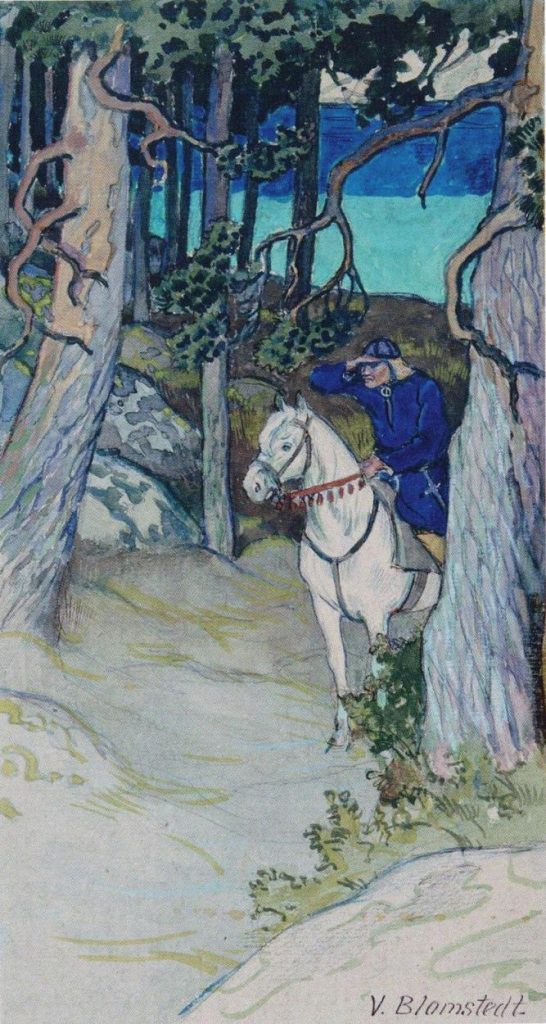
Death of St Chad, 2nd March 672

Chad (Ceadda) of Mercia died on 2nd March 672 AD. He was one of four brothers with distressingly similar names: the other three were Cedd, Cælin and Cynebill. Bede described them as “famous priests of the Lord.”
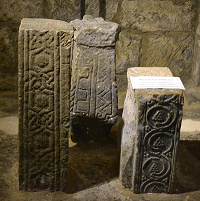
Chad was a disciple of Aidan and studied in Ireland. After the death from plague of his brother Cedd in 664 AD, Chad succeeded him as Abbot of Lastingham (North Yorkshire) which Cedd had founded. The church at Lastingham retains some wonderful stone cross fragments in its ancient crypt. The village itself boasts wells to Chad, Cedd and Owin.
It was a significant year for the Christian Church as King Oswiu held a great Synod at Whitby to discuss standardising the church under either the Irish or Roman rule. Oswiu had also chosen Bishop Wilfrid to be the Bishop of York, but Wilfrid went abroad to be consecrated and in his extended absence Oswiu appointed Chad to the bishopric of York in his place.
This resulted in confusion with the boundaries between Chad’s authority and that of Wilfrid until Theodore, Archbishop of Canterbury, deposed Chad from York in 669 AD and restored Wilfrid to the that Bishopric. Initially Chad returned to Lastingham, but it was not long before he was appointed to be the Bishop of Mercia and of Lindsey.
The Irish tradition that he followed caused some difficulties, for example as to whether he should ride or walk as he travelled to evangelise. Bede explains how Theodore was not particularly impressed with this behaviour and ended up physically placing the reluctant bishop onto the back of a horse!
“And, seeing that it was the custom of that most reverend prelate to go about the work of the Gospel to several places rather on foot than on horseback, Theodore commanded him to ride whenever he had a long journey to undertake; and finding him very unwilling to omit his former pious labour, he himself, with his hands, lifted him on the horse; for he thought him a holy man, and therefore obliged him to ride wherever he had need to go.”
Among his many activities, Chad established the See at Lichfield near Tamworth and a monastery at Barrow in Lincolnshire.
Bede tells us about the miracles that followed Chad’s death:
“Chad died on the 2nd of March, and was first buried by St. Mary’s Church, but afterwards, when the church of the most holy prince of the apostles, Peter, was built, his bones were translated into it. In both of which places, as a testimony of his virtue, frequent miraculous cures are wont to be wrought. And of late, a certain distracted person, who had been wandering about everywhere, arrived there in the evening, unknown or unregarded by the keepers of the place, and having rested there all the night, went out in his perfect senses the next morning, to the surprise and delight of all; thus showing that a cure had been performed on him through the goodness of God. The place of the sepulchre is a wooden monument, made like a little house, covered, having a hole in the wall, through which those that go thither for devotion usually put in their hand and take out some of the dust, which they put into water and give to sick cattle or men to drink, upon which they are presently eased of their infirmity, and restored to health.”
Death of Owin, 4th March 672

Athelthryth, the founder of Ely Abbey was served by a faithful steward called Owin. He served in her household for many and saw her through her many adventures but finally decided to leave the secular world and retire to the monastic life. He presented himself at Lastingham Monastery (North Yorkshire) in the guise of a humble labourer who wished to devote his remaining years to the service of the church. Chad (see 2nd March) recognised and welcomed him into the little community.
The Liber Eliensis tells us that Owin was a distinguished man as well as a monk of great merit. The writer describes how he came to Lastingham following Athelthryth’s entry into the spiritual life:
“For after the adoption by Athelthryth, this distinguished queen, his lady, of the monastic life, he so completely stripped himself of worldly things, after which people used to think he hankered, that he approached the monastery of Ceadda [Chad}, Bishop of the Mercians, clothed solely in a habit, and with a hatchet and an adze in his hand, and made it clear that he was not entering the monastery for an easy life, as some do. There, on the strength of the reverence of his devotion, he was accepted among the brothers and became a great friend of the saintly bishop, and heard above him the arrival of the heavenly host before Ceadda’s death.”
Bede adds to this that “for as he was less capable of meditating on the Holy Scriptures, he the more earnestly applied himself to the labour of his hands.” However, the Liber Eliensis says Owin was originally a monk and teacher who entered Athelthryth’s household and returned to his monastic calling after she herself took the veil.
Owin was also the monk who heard the singing of the heavenly host which came to Chad and announced that the day of his death was at hand. Bede describes the occasion:
“Which voice he said he first heard coming from the south-east, and that afterwards it drew near him, till it came to the roof of the oratory where the bishop was, and entering therein, filled the same and all about it. He listened attentively to what he heard, and after about half an hour, perceived the same song of joy to ascend from the roof of the said oratory, and to return to heaven the same way it came, with inexpressible sweetness.”
Chad then told Owin to call the monks together and the bishop then announced the message he had received and encouraged the brothers in their devotions.
Owin remained at Lastingham until his death on 4th March 672 AD. He continued to work as a handyman for many years, cutting wood, mending walls and fences, and doing it to the glory of God, the ideal Benedictine of whom it is said:
“In the handiwork of their craft is their prayer.”
Feast Day of Billfrith the Anchorite, 6th March

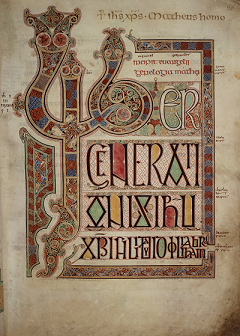
On 6th March is celebrated the Feast Day of Billfrith, commemorating the man named as the goldsmith who decorated the Lindisfarne Gospels.
The four people who created the Gospels were all monks and Simeon of Durham describes the contribution of three of them in his History of the Church of Durham (12th century) as follows:
“Moreover, the book which we have mentioned is preserved even to this present day in the church which is privileged to possess the body of this holy father; and, as has already been remarked, it exhibits no trace of having sustained injury from the water. There is no doubt that this is to be ascribed to the merits of St. Cuthbert himself, and of those other individuals who were employed in its production; that is to say, bishop Eadfrid of holy memory, who wrote it with his own hand in the house of the blessed Cuthbert; and his successor the venerable Athelwold, who directed that it should be adorned with gold and gems ; and the holy anchorite Bilfrid, whose skilful hand carried out the wishes of Athelwold, and executed this beautiful piece of workmanship, for he was a master in the art of the goldsmith. These persons, influenced alike by their affection for this confessor and bishop beloved of God, left in this work a monument to all future ages of their devotion towards him.”
In addition Aldred translated the Gospels into Old English in a gloss which can still be read today on the manuscript. In a colophon to his manuscript he also attests:
“And Billfrith the anchorite forged the ornaments which are on the outside, and bedecked it with gold and with gems, and also with gilded silver – pure wealth.”
Our focus today is on Billfrith the Anchorite and goldsmith who created the casing for the Gospels. As they were intended for ceremonial use, the external casing was as important as the contents. Sadly this original casing has not survived and we have only the echo of Billfrith’s labours through the writings of Simeon, Aldred and others.
If we can’t see what Billfrith made we can at least see another gospel case which has survived, which might give us a slight idea of Billfrith’s work. This is the surviving case for the gospel book belonging to Judith of Flanders, wife of Tostig Godwinson, and therefore dating to the 11th century. In total Judith had four gospel books made and she bequeathed them to various religious foundations on her death. Very few such cases have survived, because their materials were valuable and could be taken apart and re-used. It is difficult to know whether Judith’s case was made in England, like its text, or whether it was added to the book on the Continent later.
Death of Queen Emma, 6th March 1052

6th March 1052 saw the death of Emma of Normandy, twice anointed as Queen of England. She was the wife of two Kings of England, Athelred Unrede (or “ill advised”) and Cnut (Canute), and the mother of two Kings of England, Harthacnut and Edward the Confessor.
Emma was the daughter of Richard I, Count of Rouen. Her mother Gunnor was of Danish descent. The support of Normandy was invaluable to Athelred of England, and in 1002 he married her to secure Norman support against Viking raids, as the Vikings had been using Norman harbours to launch their attacks on England. It was unusual for an English King to marry a foreign woman, and her Danish ancestry may not have made her popular, but nevertheless she played a queenly role at her husband’s court.
Following Athelred’s defeat by Swein in 1013 Emma took her sons Alfred and Edward with her to safety in Normandy, and Athelred joined his family there later.
Cnut succeeded to the throne in 1016 after defeating Edmund Ironside (Athelred’s son by his first marriage), and decided he needed a wife. The Encomium Emma Reginae tells us (at some length) all about this project and how its outcome was received. It also describes Emma’s thoughtfulness to ensure the succession of her sons rather than any other sons of Cnut:
“Everything having been thus duly settled, the king lacked nothing except a most noble wife, such a one he ordered to be sought everywhere for him, in order to obtain her hand lawfully, when she was found, and to make her the partner of his rule, when she was won Therefore journeys were undertaken through realms and cities and a royal bride was sought; but it was with difficulty that a worthy one was ultimately found, after being sought far and wide. This imperial bride was, in fact, found within the bounds of Gaul, and to be precise in the Norman area, a lady of the greatest nobility and wealth, but yet the most distinguished of the women of her time for delightful beauty and wisdom, inasmuch as she was a famous queen In view of her distinguished qualities of this kind, she was much desired by the king, and especially because she derived her origin from a victorious people, who had appropriated for themselves part of Gaul, in despite of the French and their prince. Why should I make a long story of this? Wooers were sent to the lady, royal gifts were sent, furthermore precatory messages were sent. But she refused ever to become the bride of Knutr, unless he would affirm to her by oath, that he would never set up the son of any wife other than herself to rule after him, if it happened that God should give her a son by him For she had information that the king had had sons by some other woman, so she, wisely providing for her offspring, knew in her wisdom how to make arrangements in advance, which were to be to their advantage. Accordingly the king found what the lady said acceptable, and when the oath had been taken, the lady found the will of the king acceptable, and so, thanks be to God, Emma noblest of women, became the wife of the very mighty King Knutr. Gaul rejoiced, the land of the English rejoiced likewise, when so great an ornament was conveyed over the seas Gaul, I say, rejoiced to have brought forth so great a lady, and one worthy of so great a king, the country of the English indeed rejoiced to have received such a one into its towns. What an event, sought with a million prayers, and at length barely brought to pass under the Saviour’s favouring grace! This was what the army had long eagerly desired on both sides, that is to say that so great a lady, bound by a matrimonial link to so great a man, worthy of her husband as he was worthy of her, should lay the disturbances of war to rest What greater or more desirable thing could be wished than that the accursed and loathsome troubles of war should be ended by the gentle calm of peace, when equals were clashing with equals in might of body and boldness of heart, and when now the one side and now the other was victorious, though at great loss to itself, by the changing fortunes of war?”
Emma and Cnut were married in 1017 and Emma outlived her second husband as well. Despite her best endeavours she was confronted with her step-son Harald Harefoot (son of Alfgifu of Northampton) who took the throne and attempted to take her treasure too. She was supported by Earl Godwin and had to send to Normandy for her sons by Athelred who were in exile there. The elder of the two, Alfred, was captured and blinded, dying from his wounds at Ely. Meanwhile Harald exiled Emma to Flanders. Harthacnut later prosecuted Godwin and Bishop Lyfing for the death of Alfred.
When Harald died Emma’s second step-son Harthacnut took the throne and Emma was restored to a meaningful role. This was when she commissioned the Encomium Emma Reginae, quoted above, to defend her career and reputation.
Harthacnut was also short-lived and so Emma’s son Edward (the Confessor) became King in 1042. He was not, however, fond of his mother and in 1043 he deprived her of her lands and treasure, as we read in the Anglo-Saxon Chronicles:
“And this year, fourteen days before Andrews-mass [16th Nov.], the king was advised to ride from Gloucester, and Leofric the earl, and Godwine the earl, and Sigwarth [Siward] the earl, with their followers, to Winchester, unawares upon the lady [Emma]; and they bereaved her of all the treasures which she possessed, they were not to be told, because before that she had been very hard with the king her son; inasmuch as she had done less for him than he would, before he was king, and also since: and they suffered her after that to remain therein.”
Emma died in Winchester on 6th March 1052 and despite her best efforts, left an imperfect reputation. Anglo-Saxon Queens were at the least pragmatists and in this case arguably Emma was an opportunist. Her options were limited and it seems that a quiet retirement in a nunnery appealed to her when her first husband died.
Death of Eosterwine, 7th March 786

7th March is the day we remember an abbot of Wearmouth and relative of Benedict Biscop, its founder.
The story of Eosterwine (b. 650 AD) is primarily found in the “Life of St Ceolfrith” and Bede’s “Lives of The Holy Abbots of Wearmouth and Jarrow”. He originally served as a warrior under King Ecgfrith but at the age of twenty-four he became a monk at Wearmouth. He was ordained as a priest in 679 AD and in 682 AD he was appointed abbot by Biscop to rule during his own absence. This is Bede’s description of him in the “Lives of the Abbots”:
“This man therefore undertook the government of the monastery in the ninth year after its foundation, and continued it till his death four years after. He was a man of noble birth; but he did not make that, like some men, a cause of boasting and despising others, but a motive for exercising nobility of mind also, as becomes a servant of the Lord. He was the cousin of his own abbot Benedict; and yet such was the singleness of mind in both, such their contempt for human grandeur, that the one, on entering the monastery, did not expect any notice of honour or relationship to be taken of him more than of others, and Benedict himself never thought of offering any; but the young man, faring like the rest, took pleasure in undergoing the usual course of monastic discipline in every respect. And indeed, though he had been an attendant on King Egfrid, and had abandoned his temporal vocation and arms, devoting himself to spiritual warfare, he remained so humble and like the other brethren, that he took pleasure in threshing and winnowing, milking the ewes and cows, and employed himself in the bakehouse, the garden, the kitchen, and in all the other labours of the monastery with readiness and submission. When he attained to the name and dignity of abbot, he retained the same spirit; saying to all, according to the advice of a certain wise man, “They have made thee a ruler; be not exalted, but be amongst them like one of them, gentle, affable, and kind to all.” Whenever occasion required, he punished offenders by regular discipline; but was rather careful, out of his natural habits of love, to warn them not to offend and bring a cloud of disquietude over his cheerful countenance. Oftentimes, when he went forth On the business of the monastery, if he found the brethren working, he would join them and work with them, by taking the plough-handle, or handling the smith’s hammer, or using the winnowing machine, or anything of like nature. For he was a young man of great strength, and pleasant tone of voice, of a kind and bountiful disposition, and fair to look on. He ate of the same food as the other brethren, and in the same apartment: he slept in the same common room as he did before he was abbot; so that even after he was taken ill, and foresaw clear signs of his approaching death, he still remained two days in the common dormitory of the brethren. He passed the five days immediately before his death in a private apartment, from which he came out one day, and sitting in the open air, sent for all the brethren, and, as his kind feelings prompted him, gave to each of them the kiss of peace, whilst they all shed tears of sorrow for the loss of this their father and their guide. He died on the seventh of March, in the night, as the brethren were leaving off the matin hymn. He was twenty-four years old when he entered the monastery; he lived there twelve years, during seven of which he was in priest’s orders, the others he passed in the dignity of abbot; and so, having thrown off his fleshly and perishable body, he entered the heavenly kingdom.”
He died at the early age of thirty-six, on 7th March, having fallen victim to a widespread and deadly pestilence. He is not well known outside the local area but Bede was at pains to point out that his promotion was not due to his relationship to Biscop – raising the question that perhaps there was a perceived case to answer.
Feast Day of Felix, 8th March

8th March is the feast day of Felix, Bishop to the East Angles under King Sigeberht.
He served for 17 years at Dommoc (Dunwich) and died around 647 AD. He was the author of the “Life of St Guthlac” which he wrote at the request of King Alfwald of East Anglia. Otherwise his life is obscure.
Bede tells us that he was from Burgundy and met King Sigeberht while the latter was in exile in Frankia. When Sigeberht succeeded to the throne after the death of Eorpwald, Felix accompanied him to East Anglia and was made Bishop at Dommoc, being the first Bishop in East Anglia. He also assisted the King in setting up a school for boys to teach them literature.
The Anglo-Saxon Chronicle also reports that he baptised King Cenwalch of Wessex in 646 AD; this was while Cenwalch was in exile, having been driven from his kingdom by King Penda of Mercia. He was at King Anna’s court for three years during which time he was converted, with Anna standing as his godfather.
Felix died the following year, ending his days in peace, according to Bede.
As with many saints his adventures did not end then. His remains were desecrated in a Viking raid, rescued by monks from Ramsey and transported through the mists and fogs of the fens back to safety. Ramsey was always enthusiastic in its collection of relics and would have been thrilled to win the saint from the grasp of Ely.
The Liber Eliensis (Book of Ely) tells us that:
“he departed this life in peace at Dummoc in the twelfth year of King Anna’s reign.
Carried from there, he was buried at Soham which is a vill by a mere. This place, moreover, is said to be at the approach to the Isle of Ely. There used to exist there a large and well-known monastic house, in which a considerable community of monks, assembled by a venerable prince called Lutting, observed the order of a holy rule under an abbot, Warferth. Indeed ones reads in an old English source that Saint Felix was the original founder of the old monastery at Soham and of the church at Redham. But a cruel and impious tribe of pagans, coming from Denmark and running wild over all the regions of England, devastated the aforesaid monastery – and everything in the vicinity – encircling it with iron weaponry and fire, and reduced it thereafter to an unpopulated waste. Hence, after the place had been for a very long time without divine worship, in the time of King Cnut the remains of the most holy confessor Felix were translated to the monastery of Ramsey and reburied with the honour that befitted them.”
The writer adds that it was Felix that had baptised King Anna and all his household as well as the province of East Anglia.
Feast Day of Bosa, 9th March

9th March is the Feast Day of Bosa of York, a Northumbrian educated at Whitby under Abbess Hild and is listed by Bede as one of the five bishops of “singular merit and sanctity” trained by Hild, the other four being Hedda of Winchester, Oftfor of Worcester, John of Beverly, and Wilfrid II of York (a different Wilfrid from the turbulent one at Ripon and Hexham). Later Bosa became the Bishop of York following the removal of that pesky Wilfrid I. Bede tells us in summary:
“In the year 678, a comet appeared; Bishop Wilfrid was driven from his see by King Egfrid; and Bosa, Eata, and Eadhed were consecrated bishops in his stead.”
Ecgfrith and Wilfrid had argued and Ecgfrith banished Wilfrid and Wilfrid’s honours were redistributed. Bosa became Bishop of Deira at York, Eata became the Bishop of Bernicia at Lindisfarne, and Eadhed served as the first sole Bishop of Lindsey which Ecgfrith had recently taken from Wulfhere. The three men were ordained at York by Theodore, the Archbishop of Canterbury.
Bosa and Wilfrid played tag with the Bishopric of York for a few years until Wilfrid was removed for good in 691 AD. Bosa then served undisturbed as Bishop until his death around 704/705 AD.
Bosa is not well known, although he worked and served with great men. He was responsible for the education of Acca, later Bishop of Hexham, according to Bede:
“Bishop Acca himself was a most expert singer, as well as most learned in Holy Writ, most pure in the confession of the catholic faith, and most observant in the rules of ecclesiastical institution; nor did he ever cease to be so till he received the rewards of his pious devotion, having been bred up and instructed among the clergy of the most holy and beloved of God, Bosa, bishop of York.”
Bede referred to Bosa as a man of great humility and sanctity. His successor was John of Beverley.
He was included in the liturgical calendar for York in the 8th century.
Death of Heiu, 12th March

It is recorded in an early 20th century “Dictionary of Saintly Women” (by Agnes Dunbar) that St. Heiu died on 12th March, in the 7th century. Her footprint on the sands of memory is faint. Bede mentions her in passing in relation to Abbess Hild:
“After this she [Hild] was made abbess in the monastery called Heruteu, which monastery had been founded, not long before, by the religious servant of Christ, Heiu, who is said to have been the first woman that in the province of the Northumbrians took upon her the habit and life of a nun, being consecrated by Bishop Aidan; but she, soon after she had founded that monastery, went away to the city of Calcacestir [thought to be Tadcaster, presumably based on the Roman name of Calcaria for Tadcaster], and there fixed her dwelling.”
Hartlepool was a double monastery, home to both men and women, and ruled over by an abbess. These monasteries originate in the Irish tradition taught by Aidan, and which was followed at this time in Northumbria until the Synod of Whitby in 664 AD agreed to move to the Roman tradition. Based on what has been reconstructed of Hild’s timeline it would appear Heiu may have founded the monastery in the early 640s, with Hild taking up the role of abbess around 649 AD. When the monastery was founded, the peninsula of Hartlepool was probably uninhabited and covered with thick forest. The presence of a monastery would have resulted in the establishment of a settlement and its location on a promontory overlooking a bay would have been attractive for trade as well as for fishing.
In August 2018 an archaeological excavation near the Hartlepool church uncovered between 50 – 100 skeletons of adults and infants. They were dated to between 700-800 AD, and considered to be probably of Christian origin. Excavations have also uncovered monastic cells and evidence for silver working.
The village of Healaugh, three miles from Tadcaster, is thought to be on the site of Heiu’s second foundation, derived from the name Heiusleg, meaning “Heiu’s place”. In 1842 a broken tombstone was discovered about six foot below the surface in the graveyard with an inscription on it which seemed to show two names MADUG and HEIU. The style is said to be similar to the namestones found at Hartlepool in 1833.
After this she vanishes, despite what must have been an immensely significant contribution to the religious life of the early church in Northumbria. Here’s to Heiu: first Northumbrian nun, first abbess of a double monastery in the Anglo-Saxon kingdoms and apparently a lover of peace and quiet, away from the madding crowd.
Death of Indract, 12th March 854

Indract, abbot of Iona, was attacked and killed near Glastonbury on 12th March 854 when the brass on his staff was mistaken for gold.
William of Malmesbury explains that Indract and his companions had been on pilgrimage to Rome and were returning home through southern England:
“They desired visiting Glastonbury, out of respect to St. Patrick [whose relics were there]; and filled their scrips with parsley and various other seeds, which they proposed carrying to Ireland, but their staves being tipped with brass, which was mistaken for gold, they were murdered for the supposed booty”.
It is believed that the attack took place at Shapwick, near Glastonbury and Indract was then buried at Glastonbury. His remains were placed near the altar of the church and could be visited until the church itself was destroyed by fire in the 12th century.
Abbot Indract is also recorded by the Annals of Ulster as moving the relics of St Columba from Iona to Ireland.
Alcuin and Charlemagne meet at Parma, 15th March 781

In 781 AD Alcuin of York was despatched to Rome to confirm that York should remain an Archbishopric. On his way home he stopped at Parma on 15th March and there he met Charlemagne. It seems the two men immediately made friends.
Later when Charlemagne was beginning to build a centre for learning at his court, ushering in the Carolingian Renaissance, he collected together as many leading scholars as he could at Aachen, and among them he persuaded Alcuin to leave York and come to tutor his sons and the other boys at court.
Their relationship flourished. Alcuin even had a nickname for Charlemagne, “David”, while he referred to himself as (Horatius) “Flaccus” – better known to us today as Horace. Alcuin wrote to Charlemagne that the king’s noble efforts had ‘brought about a rebirth of civilised standards in every kind of knowledge and useful erudition.’
His definition (Epistolae IV) of Wisdom was ‘the knowledge of things divine and human’ which is sought by the whole people. In this search for wisdom, the scholar must debate with and learn from pagan, Jew and Byzantine alike, in order to catch a vision of a nobler, more truly Christian, society. His library therefore extended beyond the traditional corpus of Christian texts to include a wide range of Classical volumes, inherited from the famous library at York Minster, which he described in his poem about York:
“Where books are kept
Small roofs hold the gifts of heavenly wisdom;
Reader, learn them, rejoicing with a devout heart.
The Wisdom of the Lord is better than any treasures
For the one who pursues it now will have the pathway of light.”
Alcuin was always quick to emphasise the debt he owed to his own teacher Alberht of York, who had travelled to the Continent in search of new books and new subjects of study. The range of subjects that Alberht taught included the seven liberal arts – the trivium of grammar, rhetoric and dialectic and the quadrivium of astronomy, arithmetic, geometry and music. However, he went beyond these and also taught natural history, history, chant, verse composition, computus and biblical exegesis. Such a programme was beyond anything required for a standard Christian framework of learning..
Meanwhile, Alcuin and Charlemagne continued to develop their own programme under what has been called the “Carolingian Renaissance” and book copying and production was essential to its success. To support this project Alcuin was instrumental in developing Carolingian Miniscule as a faster and simpler written form enabling production to be made more efficient. The new script was disseminated first from the royal court at Aachen, and later from the scriptorium at Tours, where Alcuin retired to serve as abbot (796-804 AD).
While Alcuin clearly admired Charlemagne greatly, he was not afraid to rebuke him for his violence towards the pagan Saxons (in “Old” Saxony). He reminded Charlemagne that while he could force pagans to be baptised, he could not force them to believe. It was a testament of their friendship that he could criticise the Emperor in such a direct way and remain a leading member of his court.
Death of King Harold Harefoot, 17th March 1040

On 17 March 1040 King Harold Harefoot died suddenly at the age of 24, having been King of England for 4 years and 16 weeks.
Cnut had originally intended England to be go to his other son, Harthacnut, and Denmark to go to Harold, but Harold had seized his opportunity 2 weeks after his father’s death in November 1035. Events were summarised in the Anglo-Saxon Chronicle as follows:
“1035: This year was Harald chosen king over all, and Hartha-Cnut forsaken, because he stayed too long in Denmark; and then they drove out his mother Aelfgyfe [Emma], the queen, without any kind of mercy, against the stormy winter: and she came then to Bruges beyond sea; and Baldwin the earl there well received her, and there kept her the while she had need.”
While Harthacnut was out of the country Harold obtained the support of the Witan and a majority of the Danes in England and was confirmed king at a meeting at Oxford. However, the Archbishop of Canterbury refused to crown him, and forbade any other bishop to do so. In protest Harold refused to attend church services while he remained uncrowned.
Further controversy haunted the short reign of Harold. Athelred’s sons, Alfred and Edward, were in exile in Normandy following the defeat of their father by Swein Forkbeard in 1016. They sailed for England at the news of Cnut’s death. Edward was turned back at Southampton by the townspeople, but Alfred was less fortunate. In 1036 he came to visit his mother, Emma of Normandy, who had been sent to live in Winchester by Harold, but on the way he was met by Earl Godwin, a previous supporter of Emma. Godwin had apparently changed his mind and become a supporter of Harold. He deceived Alfred by promising to help him gain the throne, but then Alfred was seized and his men almost all butchered. Alfred was taken to the monastery in Ely and blinded. He died there soon after, and his death was a source of antagonism between Godwin and Edward the Confessor, Alfred’s brother, in later years.
Following these events, Emma was forced into exile in Flanders under the protection of Baldwin and was joined there by Harthacnut. They gathered a fleet of warships to invade England but the death of Harold made it possible for his Harthacnut to enter England peacefully.
“1040: This year king Harold died at Oxford, on the 16th of the kalends of April [17th March] and he was buried at Westminster. And he ruled England four years and sixteen weeks ; and in his days sixteen ships were retained in pay, at the rate of eight marks for each steersman, in like manner as had been before done in the days of king Cnut. And in this same year came king Hardacnut to Sandwich, seven days before midsummer. And he was soon acknowledged as well by English as by Danes ; though his advisers afterwards grievously requited it, when they decreed that seventy-two ships should be retained in pay, at the rate of eight marks for each steersman. And in this same year the sester of wheat went up to fifty-five pence, and even further.”
Harold was buried at Westminster. His grieving brother Harthacnut dug him up again and threw his body in a sewer where it was rescued by a fisherman and taken for honourable burial at St Clement Danes.
Death of King Edward “the Martyr”, 18th March 978
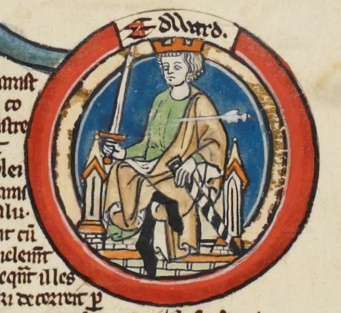
On 18th March 978 AD at the gates of Corfe Castle King Edward (later called “the Martyr”) was killed, and conspiracy theories abound.
Edward was the eldest son of Edgar the Peaceable and Athelflad “the Fair”, although the status of his mother remains murky. It is not clear if she and Edgar were actually married. Edgar’s next relationship was with Wulfthryth, described as a nun whom he seduced. She was the mother of Edith and both of them became abbesses at Wilton. Finally Edgar definitely married Alfthryth, the daughter of Ordgar, a powerful Devon thegn, and even crowned her as queen. Alfthryth was the mother of Edmund (who died young in 971 AD) and Athelred (later called “Unrede” after he became king).
When Edgar died unexpectedly in 975 AD Athelred was still too young to succeed so Edward was given the crown, and Edgar’s widow Alfthryth was confirmed in possession of Dorset. She and her young son settled at Corfe.
In March 978 AD Edward was in the area of Corfe and sent a message that he would be calling on his family for a spot of tea and perhaps an anachronistic crumpet or two.
Alfthryth’s retainers were awaiting the young king at the gate when he arrived with a small retinue. Still sitting in the saddle he was handed a drink (not, it has to be admitted, tea) and then he was attacked and stabbed. His horse bolted in panic and with Edward’s foot caught in the stirrup he was dragged along the ground after it to his ultimate demise. His body was buried at Wareham without honour and his half-brother, Athelred, eventually succeeded to the throne after an interregnum of about a year. He was crowned in May 979 AD following the translation of Edward’s body to Shaftesbury for a more fitting burial.
The Anglo-Saxon Chronicle recorded:
“No worse deed than this was ever done by the English nation since they first sought the land of Britain. Men murdered him, but God hath magnified him. He was in life an earthly king. He is now after death a heavenly saint.”
Earl Alfgar exiled, 19th March 1055

On 19th March 1055 Westminster a council met to decide the fate of Earl Alfgar, son of Earl Leofric of Mercia.
In July 1054 Earl Siward of Northumbria had died along with his eldest son, Osbearn, fighting King Macbeth of Scotland. Siward left only an infant son to follow him. Clearly the child could not be entrusted with the earldom and a regency was not considered appropriate in such a violent and difficult region. So the council needed to choose who was to become the next Earl.
There were a couple of candidates.
The first was Alfgar, son of Earl Leofric of Mercia and Godgifu. Alfgar had been in charge of East Anglia following the exile of the Godwin family in 1052, having been granted it in place of Harold Godwinson. However, the Godwins were now back in England, Harold had taken back East Anglia until the death of his father in 1053, at which point it was returned to Alfgar and Harold took over his father’s lands and titles.
With Godwin power on the rise again, and the King’s wife being a Godwin herself, the council chose the second candidate, Tostig Godwinson.
Alfgar was not impressed and appears to have made his feelings known, Although there are no details of what he actually said or did, the Anglo-Saxon Chronicle records that:
“Then, within a little time after [Siward’s death], was a meeting of the witan in London, and Aelfgar the earl, Leofric the earl’s son, was outlawed without any kind of guilt;”
Although the E and F versions tell it a little differently:
“they outlawed Aelfgar the earl, because it was cast upon him that he was a traitor to the king and to all the people of the land. And he made a confession of it before all the men who were there gathered; though the word escaped him unintentionally. And the king gave the earldom to Tostig, son of earl Godwine, which Siward the earl before held.”
Alfgar did not take things lying down. He went to Ireland and raised a fleet, then came across to Wales where he allied with Gruffydd ap Llewellyn and attacked Hereford, looting and killing. The description of the attack provides insights into the influence of Norman nobles prevalent under Edward the Confessor – and Earl Ralph, the Norman in question, gets a rather bad press from John of Worcester:
“Earl Ralph, the cowardly son of king Edward’s sister, having assembled an army, fell in with the enemy two miles from the city of Hereford, on the ninth of the calends of November [24th October]. He ordered the English, contrary to their custom, to fight on horseback; but just as the engagement was about to commence, the earl, with his French and Normans, were the first to flee. The English seeing this, followed their leader’s example, and nearly the whole of the enemy’s army going in pursuit, four or five hundred of the fugitives were killed, and many were wounded. Having gained the victory, king Griffyth and earl Algar entered Hereford, and having slain seven of the canons who defended the doors of the principal church, and burnt the monastery built by bishop Athelstan, that true servant of Christ, with all its ornaments, and the relics of St. Ethelbert, king and martyr, and other saints, and having slain some of the citizens, and made many other captives, they returned laden with spoil.”
Harold Godwinson was sent to broker peace, which he achieved, and Alfgar was restored to his lands again.
In 1057 Alfgar’s father Leofric died and Alfgar succeeded him to the Mercian Earldom. However, it appears he was driven out again in 1058, as John of Worcester tells us:
“Algar, earl of Mercia, was outlawed by king Edward for the second time, but, supported by Griflyth, king of Wales, and aided by a Norwegian fleet, which unexpectedly came to his relief, he speedily recovered his earldom by force of arms.”
He had four children: Burgheard, who died in 1060 at Reims on the way home from Rome, Edwin, Earl of Mercia, Morcar, Earl of Northumbria, and a daughter Ealdgyth, who married Gruffydd ap Llewellyn and then Harold Godwinson (not to be confused with Edith Swan-neck, Harold’s common law wife).
It is not known exactly when Alfgar died but it is thought it was before 1066.
Death of Cuthbert, 20th March 687

St Cuthbert, who died on 20 March 687 AD, is often called the patron saint of Northern England.
Little is known about his early life: he was born around 634 AD and supposedly raised by a widow called Censwith. Bede wrote a “Life of Cuthbert”, saying that in his early years, until he was about eight, he enjoyed playing with other children and “took delight in mirth and clamour”. It was one day, according to Trumwine who was a friend of Cuthbert’s and told Bede about the incident, that a small child told Cuthbert that he should stop playing foolish games as he was destined to be a priest and teacher of virtue.
Although Cuthbert changed his ways he nevertheless developed a painful swelling in his knee until he could no longer walk. At this point he was visited by a man on horseback who advised him how to prepare a poultice which cured the condition. Cuthbert realised the visitor was an angel and after this encounter became devoted to the study of the scriptures. Miracles ensued: his prayers saved some ships bringing timber to a monastery; he had a vision of Bishop Aidan entering Heaven; and he discovered a parcel of food when he was hungry and far from any human habitation.
He went to the Abbey at Melrose to enter the monastic life. After some years the Abbot Eata received land at Ripon to build a monastery and Cuthbert was one of the monks sent there so establish the new foundation. Cuthbert’s job was to welcome strangers who visited the monastery, and in this role he looked after a young man who arrived one night, In the morning the lad had vanished without trace leaving three white loaves behind and Cuthbert realised he had entertained another angel.
When suffering from pestilence he was made well by the prayers of his brothers, although he was left with a constant discomfort. Upon his recovery the Abbot Boisil, Cuthbert’s mentor, told him that he himself would die in seven days and asked Cuthbert to study and meditate on St John’s Gospel with him until the time came. Bede comments that:
“After their seven days’ study was completed, Boisil died of the above-named complaint [the pestilence]; and after death entered into the joys of eternal life. They say that, during these seven days, he foretold to Cuthbert every thing which should happen to him: for, as I have said before, he was a prophet and a man of remarkable piety.”


Cuthbert continued to preach, traveling around the villages, including the most remote and disadvantaged. Cuthbert remained devoted to the Gospel of John and carried a copy with him as he travelled; it is held at the British Library, retaining its original binding and is the oldest intact European book.
During this time the Abbess Abbe (sister of King Oswiu) asked Cuthbert to visit her, and during his visit it was noticed that he would go out alone at night.
“Now one night, a brother of the monastery, seeing him go out alone followed him privately to see what he should do. But he when he left the monastery, went down to the sea, which flows beneath, and going into it, until the water reached his neck and arms, spent the night in praising God. When the dawn of day approached, he came out of the water, and, falling on his knees, began to pray again. Whilst he was doing this, two quadrupeds, called otters, came up from the sea, and, lying down before him on the sand, breathed upon his feet, and wiped them with their hair after which, having received his blessing, they returned to their native element.”
Cuthbert is also remembered for bringing in special laws to protect the eider ducks and other seabirds nesting on the islands; eider ducks are known as “cuddy ducks” in the north east of England, “Cuddy” being the nickname for Cuthbert, and the ducks are still numerous around the islands where he lived.
Cuthbert continued his preaching and teaching, as well as experiencing a number of new miracles, including putting out a fire by prayer and casting out a devil. His reputation grew accordingly. Eventually he was transferred to Lindisfarne, where he served for a number of years instructing and leading the monks. Eventually he was given permission to retire to one of the nearby Farne islands where he lived as a hermit supported by the monks who visited and took care of him. Even while he was secluded he was able to perform miracles including curing the sick through the application of a linen girdle that had belonged to him and predicting the death of King Ecgfrith.
Meanwhile Archbishop Theodore decided Cuthbert should become Bishop of Lindisfarne, although Cuthbert resisted fiercely. After a couple of years however he returned to his island, feeling that he had not much longer to live.
Bede reports the words of a priest called Herefrid, who attended Cuthbert at the end of his life and provides a personal testimony of Cuthbert’s final days:
“He was brought to the point of death,” said he, “after having been weakened by three weeks of continued suffering. For he was taken ill on the fourth day of the week; and again on the fourth day of the week his pains were over, and he departed to the Lord.”
Herefrid then goes on to describe Cuthbert’s illness, and adds:
“I warmed some water and washed his feet, which had an ulcer from a long swelling, and, from the quantity of blood that came from it, required to be attended to. I also warmed some wine which I had brought, and begged him to taste it; for I saw by his face that he was worn out with pain and want of food. When I had finished my service, he sat down quietly on the couch, and I sat down by his side.”
Cuthbert wanted to be buried on the island but the monks persuaded him to let them take his body back to Lindisfarne after his death and he eventually agreed. In his final hours Herefrid sat with him and talked a little more, and reported Cuthbert’s final advice to his monks, finishing:
“For I know, that, although during my life some have despised me, yet after my death you will see what sort of man I was, and that my doctrine was by no means worthy of contempt.”
Herefrid finished his account explaining:
“When his hour of evening service was come, he received from me the blessed sacrament, and thus strengthened himself for his departure, which he now knew to be at hand, by partaking of the body and blood of Christ; and when he had lifted up his eyes to heaven, and stretched out his hands above him, his soul, intent upon heavenly praises, sped his way to the joys of the heavenly kingdom.”
Herefrid then told the monks who were with him what had happened and they signalled across to Lindisfarne by holding up two candles to let the rest of the community know. The monks there were singing Psalm 59, the very one the monks on Farne had been singing at the same time.
Cuthbert was brought back to Lindisfarne and buried by the altar. But his adventures were not yet over, although Bede could not know what was to happen in the future.
Following the Viking raids on Lindisfarne the community took Cuthbert with them when they left their monastery and he travelled about the north east for more than 100 years until he was finally laid to rest at Durham where his tomb can be visited today and some of the items buried with him are on display. His remains survived the Norman occupation and rebuilding of the cathedral as well as Henry VIII’s commissioners. Close to Cuthbert’s tomb in Durham Cathedral’s Galilee Chapel lies Bede, his hagiographer.
20th March is also the Feast Day of Herbert of Derwentwater, a priest whom Bede says visited Cuthbert every year. When Cuthbert told Herbert that they were meeting in life for the last time, Herbert prayed that the two of them should enter heaven together. His prayers were heard, and accordingly he died at the same time and date as his dear friend.
Attack on York, 21st March 687

On 21st March 867 AD the Northumbrians attacked York, which had been held by the Danes since the previous year.
The Northumbrians had deposed King Osberht in favour of Alle just before the invasion, and both men died fighting in the Northumbrian attack. It was not a successful venture from the Northumbrian point of view – there was great slaughter inside the city and out, and they were forced to make peace with the Danish.
Little is known of either king, but Osberht may in fact have been in power for quite a few years, possibly from as early as 849 AD until his deposition in 866 AD. He apparently succeeded Athelred II, and given naming conventions in royal families, the implication is that they were of different dynasties. However, the Os- name was familiar among earlier Northumbrian kings and so Osberht may have been from a rival family previously in power under the likes of Oswulf (d. 759 AD), or Osred (d. approx. 790 AD). Roger of Wendover notes that there was an eclipse of the sun in the same year that Osberht succeeded, around 1st October, which was shorthand for “dire warnings”.
Osberht confiscated lands from the monastery at Lindisfarne, which would not have been popular with the the church, and this perhaps indicated his need for wealth to reward his men.
Alle was in fact the last independent king of Northumbria. Simeon of Durham claims he ruled for 5 years, but other chronicles vary in reporting his rule from 4 years to 1 year. This may be due to his reigning jointly with Osberht for a while and perhaps Northumbria broke into its constituent parts of Deira (Alle) and Bernicia (Osberht) for these few years.
It was said that Alle was not of royal blood, although his name was the same as the first recorded King of Deira and father of Edwin, King of Northumbria. His family may have believed in nominative determinism. In Scandinavian sources Alle is credited with throwing Ragnarr Lothbrok in a snake pit, and Ragnar’s sons with torturing Alle to death through the blood eagle in revenge; there is no genuine evidence for either incident.
The two kings were at war when the Danes arrived, and like a feuding family at a wedding, what someone may or may not have said about our Doreen became insignificant in the face of the external threat. They united against the common enemy and marched on York.
Roger of Wendover describes the battle and aftermath:
“In the same year [867 AD], on All Saints’ Day, the cruel army of Danes migrated out of the country of the East-Angles to the city of York. At this time too there was the greatest dissension among the Northumbrians, for the people had expelled their lawful king Osbert from his kingdom, and had raised to the throne a usurper named Ella, who was not of the royal lineage; but by divine providence, on the advance of the Danes, Osbert and Ella, for the good of the commonweal, made peace among themselves, and then with united forces approached the city of York; on which the Danes straightway fled, and determined to defend themselves within the city walls. The Christian kings pursued, made a very fierce attack on the enemy, and cast down the city walls. At length they entered the city, and engaged in battle with the pagans to their own exceeding loss; for in that fight, which was fought on Palm Sunday, there fell the kings Osbert and Ella, and with them eight nobles, with an immense multitude of inferior rank. The most cruel victors after this ravaged the entire country of the Northumbrians as far as the mouth of the river Tyne, and subdued it to themselves. The kings of the Northumbrians being slain, a certain man of the English nation named Egbert next governed that kingdom, for six years, in subjection to the Danes.”
Battle of Merton (Meretun), 22nd March 871

On 22nd March 871 AD we come to the final battle of that year against the Vikings in which King Athelred of Wessex participated. The men had already fought the battles of Englefield, Ashdown, Basing and Reading.
The Anglo-Saxon Chronicle tells us that:
“King Aethelred and Aelfred his brother fought against the [Viking] army at Meretun; and they were in two bodies, and they put both to flight, and during a great part of the day were victorious; and there was great slaughter on either hand; but the Danes had possession of the place of carnage: and there bishop Heahmund was slain, and many good men: and after this battle there came a great army in the summer to Reading.”
The site of the Battle of Meretun is not confirmed, although there are a number of candidates. The most quoted options are for either Martin in Hampshire or Marden in Wiltshire. Although it is not certain what caused Athelread’s death it is a possibility that he died from wounds or infection following the battle. We do know he was buried at Wimborne, which is fairly close to Martin and so this may be an indicator. In addition a 10th century charter refers to Martin as “Mertone” which is closer to “Meretun” than perhaps some of the alternatives. However, in the interests of balance, it must be remembered that other site options are available for discussion.
John of Worcester summarises for us:
“Again, after two months had elapsed, king Ethered with his brother Alfred fought against the Pagans, who were in two divisions at Merton, and for a long time they had the advantage, having routed the enemy ; but the Pagans rallied, and gained the victory, remaining masters of the field of death, after great slaughter on both sides.
The same year, after Easter, on the ninth of the calends of May [23rd April], king Ethered went the way of all flesh, having governed his kingdom bravely, honourably, and in good repute for five years, through much tribulation: he was buried at Winborne, where he waits the coming of the Lord, and the first resurrection with the just. On his death, the before named Alfred, who had hitherto, while his brothers were alive, held only a subordinate rank, at once succeeded to the throne of the whole kingdom, to the entire satisfaction of all the people.”
Following another battle at Wilton in May, King Alfred of Wessex paid the Vikings to go away. An uncertain future lay ahead and Alfred’s chances of retaining his throne probably seemed slender indeed.
Feast Day of Athelwold of Farne, 23rd March

After the death of Cuthbert (see 20th March) St Athelwold lived on Farne as a hermit for 12 years and died in 699 AD. His feast day is 23rd March.
Before coming to Farne he was a monk at Ripon, so a good Yorkshireman. Seeking solitude he moved on to the little hermit’s cell on Farne following Cuthbert’s death in 687 AD. On arriving at the cell he discovered it in a terrible state of repair and open to the weather, so he covered the gaps in the wall by nailing up a calf skin.
He was also a miracle worker according to Bede, who relates a story told him by one who was present:
“I will relate one miracle of his, which was told me by one of these brothers for and on whom the same was wrought: viz. Guthfrid, the venerable servant and priest of Christ, who, afterwards, as abbot, presided over the brethren of the same church of Lindisfarne, in which he had been educated.”
Guthfrid told Bede about an occasion when he and two other monks went to Farne to visit Athelwold for advice. On their way back to Lindisfarne a severe storm blew up and they feared for their lives.
Guthfrid went on to say:
“After long struggling with the wind and waves to no effect, we looked behind us to see whether it was practicable at least to recover the island from whence we came, but we found ourselves on all sides so enveloped in the storm, that there was no hope of escaping. But looking out as far as we could see, we observed, on the island of Farne, Father Ethelwald, beloved of God, come out of his cavern to watch our course; for, hearing the noise of the storm and raging sea, he was come out to see what would become of us. When he beheld us in distress and despair, he bowed his knees to the Father of our Lord Jesus Christ, in prayer for our life and safety; upon which, the swelling sea was calmed, so that the storm eased on all sides, and a fair wind attended us to the very shore. When we had landed, and had dragged upon the shore the small vessel that brought us, the storm, which had ceased a short time for our sake, immediately returned, and raged continually during the whole day; so that it plainly appeared that the brief cessation of the storm had been granted from Heaven at the request of the man of God, in order that we might escape.”
After twelve years Athelwold died and was buried on Lindisfarne, in the Church of St. Peter, near to Cuthbert’s remains. His successor was Felgeld, a man of about 70 years of age at the time Bede was writing.
Athelwold didn’t leave Cuthbert’s side. According to Baring Gould:
“His [Athelwold’s] bones were afterwards taken up in the time of the Danish ravages, 875, and were translated to Durham in 995, and more honourably enshrined in 1160.”
Feast Day of Hildelith of Barking, 24th March

24th March is the day we remember Hildelith, Abbess of Barking, from the early 8th century. Barking was a double monastery founded by Athelburh, sister of Eorcenwald, King of Kent. Little is known of Hildelith’s life but what is known indicates the extensive academic and literary culture which she fostered at her Abbey. She communicated with the leading scholars of her time such as Bede, Aldhelm and Boniface. Goscelin wrote a hagiography of her life.
Bede says that in AD 676:
“HILDELITH, a devout servant of God, succeeded Ethelberga in the office of abbess, and presided over that monastery many years, till she was of an extreme old age, with exemplary conduct, in the observance of regular discipline, and in the care of providing all things for the public use. The narrowness of the place where the monastery is built led her to think that the bones of the male and female servants of Christ, which had been there buried, should be taken up, and translated into the church of the blessed mother of God, and interred in one place; whoever wishes to read it, may find in the book from which we have gathered these things, how often a brightness of heavenly light was seen there, and a fragrancy of wonderful odour smelled, and what other miracles were wrought.”
It was in this place that a blind woman was afterwards miraculously cured.
Baring Gould places her death around 720 AD, although admits the date is not known for certain, and describes her life as follows:
“Hildelitha was one of the first virgins of the English nation who consecrated herself a spouse to Christ, going abroad to a French monastery, there being, at that time, none in England. When S. Erkonwald had founded the monastery of Chertsey for himself, and the convent of Barking, in Essex, for his sister Ethelburga, he sent to France for S. Hildelitha, and committed his sister to her care, to be by her instructed in monastic discipline. Thus S. Ethelburga herself, who was the first abbess of Barking, was a disciple of S. Hildelitha, though she died before her, and was succeeded by her in the government of the community.
Bede highly commends the piety of this saint, and that she was highly esteemed by others we may gather from S. Aldhelm having addressed to her his poetical treatise on virginity, and from mention of her in one of the epistles of S. Boniface, where he relates what great things he had learned of her.
S. Hildelitha departed to our Lord in a good old age, but the date of her death is undetermined.”
Aldhelm’s “De Virginitate” was dedicated to Hildelith and the nuns at Barking, and Boniface referred to her in his correspondence to Abbess Eadburg, explaining that Hildelith had told him about a vision seen by a monk of Much Wenlock; so Hildelith was in communication with Boniface as one of his network of correspondents. The ODNB adds:
‘Aldhelm’s remarks imply that these nobly born women were remarkably well educated in the scriptures and in patristic literature. …[A]lthough little is known of Hildelith’s life, it is clear that she enjoyed intimate contact with the outstanding scholars of the time, and may herself be presumed to have achieved a respectable degree of education.’
For more about her influence, read this article by Diane Watt of the University of Surrey
Theodore of Tarsus ordained as Bishop, 26th March 668

On 26th March 668 AD Pope Vitalian ordained Theodore of Tarsus, at the age of 66, to the episcopate. Theodore was to become the influential and successful Archbishop of Canterbury who arrived in Kent in 669 AD and died in 690 AD at the age of 88.
According to Bede he was the first Archbishop whom all the churches obeyed, providing unity, stability, scholarship and structure to a struggling church decimated by plague and emerging from arguments about Roman vs Irish liturgy.
The See at Canterbury had fallen vacant on the death of Deusdedit on 14th July 664 AD. King Eorcenberht of Kent died around the same time and his son did not find a replacement for the Archbishop for quite a while. Eventually Wigheard was chosen and sent to Rome, along with gifts, to request his pallium. Unfortunately Wigheard died while he was in the Eternal City, along with most of his companions, due to plague.
The Pope looked around for a suitable replacement and selected Hadrian, but Hadrian suggested an alternative: Andrew. Andrew in turn was very infirm and unable to accept the position so the Pope went back to Hadrian again. Hadrian offered another suggestion: Theodore.
Theodore was certainly a suitable candidate, renowned for his learning and piety. However, he was not young; he was already 66 years old. The Pope only agreed to his ordination if Hadrian would accompany Theodore to Britain.
Theodore was then ordained on 26th March and the group set out for Britain on 27th May, travelling in a leisurely fashion and making lengthy visits to various religious houses and people on the way. It seems to have taken him some time to get to Canterbury; the pilgrimage to Rome was usually a journey of around 3-4 months.
According to Bede he was well received:
“669 AD: THEODORE arrived at his church the second year after his consecration, on Sunday, the 27th of May, and held the same twenty-one years, three months, and twenty-six days. Soon after, he visited all the island, wherever the tribes of the Angles inhabited, for he was willingly entertained and heard by all persons; and everywhere attended and assisted by Hadrian, he taught the right rule of life, and the canonical custom of celebrating Easter. It was the first archbishop whom all the English church obeyed. And forasmuch as both of them were, as has been said before, well-read both in sacred and in secular literature, they gathered a crowd of disciples, and there daily flowed from them rivers of knowledge to water the hearts of their hearers; and, together with the books of holy writ, they also taught them the arts of ecclesiastical poetry, astronomy, and arithmetic. A testimony of which is, that there are still living at this day some of their scholars, who are as well versed in the Greek and Latin tongues as in their own, in which they were born.”
Theodore’s and Hadrian’s teachings were especially important to the church as they arrived not long after the Synod of Whitby which had concluded Northumbria should follow Roman tradition instead of the Irish, and there was considerable work to do in bringing all the religious communities under one set of teachings.
Theodore’s rule as Archbishop was long and he remained a widely respected leader. It was he who physically lifted Chad up onto a horse when he wanted to walk everywhere. He also was embroiled in the long-running disagreements over Bishop Wilfrid’s influence.
Feast Day of Alkelda, 28th March

St Alkelda (Alchhild) has her feast day on 28th March. It was alleged that, around 800 AD, she was strangled by two Viking women while travelling between Middleham and Giggleswick in North Yorkshire. It is not clear who she was, why she was killed or even if she existed.
Alkelda was said to be buried at Middleham and the well there was attributed with healing properties. Apparently the church had extensive renovation in 1878, at which time a primitive stone coffin containing ancient remains was discovered in the vicinity of the area in which tradition claimed St. Alkelda was buried. A doctor declared these remains to be female. The church itself is however dated only to the 13th century.
Traditionally a nearby spring has been assumed to provide a possible conflation of a personal name “Alkelda” with the Old English (halig celde), or Old English combined with the Old Norse (halig kelda), for Holy Well; both Middleham and Giggleswick have wells. The related place name of “hallikeld” is used in two locations in the Vale of York, not far from Middleham. There is Hallikeld Springs at Melmerby and Halley Keld at Sawdon. There was also a local wapentake called Hallikeld. The use of a Norse word in the name indicates a 9th-10th century influence. Furthermore another local well has provided evidence of votive offerings dating to the pre-Roman period, so it is possible the holiness of the well dates back equally far.
However, modern place name studies do not generally support this theory. It is now suggested that the name of Alkelda derives from the Old English name “Alchhild” and dates to the 7th century. The use of her name locally implies a high status, for example an abbess. If she was abbess of a local monastery at either Middleham or Giggleswick, one or other of the wells may have become associated with those establishments and holiness. Unfortunately there is no supporting evidence for such a person at that time. The first historical reference to Alkild in Middleham was in 1389 in a grant from Richard II for the people of Middleham to hold a Fair on St Alkild’s feast day.
There are depictions of St Alkelda’s martyrdom on stained glass windows in both the Giggleswick and Middleham Churches, the only churches dedicated to her. The date of 800 AD usually given of St Alkelda’s death seems unlikely as there were probably few if any Danes in or around Middleham much before 866 AD. Bede tells us that in the 7th century there were very few monasteries or convents for women, which makes an earlier date unlikley.
Most early minor saints were not canonized and the prefix ‘St’ was added to their names by the local people; St Alkelda’s saintly status seems to be of this kind.
Viking attack on Paris, 29th March 845

In March 845 AD Ragnar allegedly led a Viking fleet into France raiding up the Seine, attacking Rouen.
On 29th March, Easter Sunday that year, they arrived at Paris with a fleet of longships and plundered the city. It was early in the raiding season and the attack was not expected. However, the Franks drew up defences on both banks of the river. This was of little concern to Ragnar, who attacked the smaller of the two forces, defeated it and took 111 prisoners. These unfortunates he hanged on an island in the Seine in full view of the second force on the other bank.
Despite the Danes being miles from the sea, and therefore perhaps more than usually vulnerable, the Franks were unable to defend the city. Charles the Bald paid the Danish to leave, handing over more than 2,500 kg of gold and silver. This was the first of 13 payments by the French to the Danes. On their way back the Danes pillaged several coastal sites including the Abbey of St Bertin.
Charles was heavily criticised for this payment but in practice he was facing conflict with his brothers over control of the remains of the wider Carolingian Empire, along with rebellion in the provinces and disaffected nobles. Paying off the Danes gave him space to deal with his other challenges, and in fact the agreement held for 6 years.
During the siege of Paris many of the Danes had died of plague which only subsided following a fast which they undertook on the advice of a Christian prisoner. Prayers to the Norse gods had previously proved ineffective.
In the same year, a fleet of longships sailed up the Elbe and ravaged Hamburg in an attack which destroyed the town, including its church, school and library. A Viking fleet was also present in Moorish Spain; 150 ships had been ravaging in the Garonne and then appeared in northern Spain off the coast of the kingdom of Asturias. They were driven off and after a couple of weeks enter the Guadalquivir and attacked and took Seville. However Abd al-Rahman II was a far more effective deterrent than Charles and the Vikings were soon overcome. It was said that the Moors took so many captives that the city gallows were not sufficient and the palm trees “bore strange fruit”. However, the Moors also wanted to redeem the captives taken by the Vikings so some diplomacy was called for and Abd al-Rahman sent an embassy to their king (it is unclear if this was the Danish or Norwegian king) and it appears trading links were established.
Feast Day of Osburga, 30th March
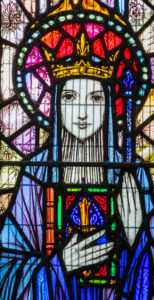
St Osburga of Coventry is commemorated on 30th March but she is a woman shrouded in mystery, including where and when she lived. One source claims she founded the first Anglo-Saxon nunnery in the 9th century of which little is known. There is a brief mention of an early nunnery at Coventry in a 14th century manuscript, and also that Cnut destroyed the old minster at Coventry. This could have coincided with his campaign in Warwickshire on 1016.
St Osburga was included in the dedication of a new Benedictine monastery at Coventry in 1043.
“Leofric, earl of Chester, and Godiva his wife founded the great Benedictine monastery of Coventry in 1043, it being consecrated on 4 October by Archbishop Eadsige. The church was dedicated to the honour of God and His Blessed Mother, and also of St. Peter the Apostle, and of the Holy Virgin St. Osburg and of All Saints. It was endowed by the founder with one-half of the town in which the monastery was situated, and with twenty-four lordships, fifteen of which were in this county, four in Leicestershire, two in Northamptonshire, and one each in Worcestershire, Gloucestershire, and Cheshire. Among the witnesses to this foundation charter were Edward the Confessor, the archbishop of Canterbury, the bishops of Worcester and Lichfield, the abbots of Winchcombe and Pershore, and the earls Godwin, Harold, Siward, and Ordgar. The king confirmed to this abbot and his successors sac and soc and toll and all other liberties.” [A History of the County of Warwick: Volume 2, London, 1908.]
There are records of the local people venerating Osburga in the 15th century but little else is known, despite the obvious affection and devotion of the people for a long period.
So Osburga remains a mystery, despite her popularity for a number of centuries.