Discovery of the Bamburgh Hoard, 1st January 2009

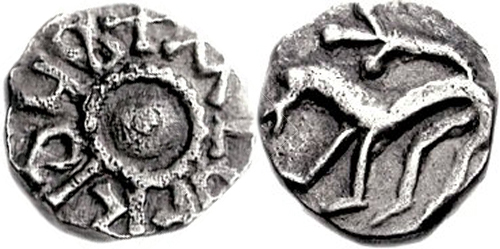
On Thursday 1st January 2009, a hoard of stycas was discovered at Bamburgh Castle in Northumberland. There were around 77 copper-alloy coins in the find, identified as 9th century stycas issued in the Kingdom of Northumbria, and dated to 810-867 AD.
Initial investigation revealed traces of organic remains on some coins along with carbon, perhaps from fire. The coins were embedded within a material, identified as grass, sedge or rush. However the corrosion from the coins had preserved, in a few rare cases, traces of cloth. The coins may have been contained by a cloth bag as well as the grass.
The majority of those coins on which inscriptions can be read can be identified as issues of Athelred II of Northumbria. Northumbria at this period was chaotic and Athelred had two reigns – 843-844 AD and 844-852 AD, the intervening period of no more than a year being filled by one Raedwulf who was killed fighting the Vikings. Both Athelred’s reigns are represented in the hoard. Athelred was succeeded by Osberht, and it is possible one of the coins in the Hoard is his, but it is not certain as the name may be that of the moneyer. There are also coins issued by Archbishop Wigmund of York, who ruled 837-854 AD.
Overall it is believed the Hoard dates to around the end of Athelred’s reign or the beginning of Osberht’s reign, placing it more narrowly around 850-860 AD.
By the reign of Osberht, the styca had replaced the sceatta as the most common form of currency in Northumbria. While both the styca and the sceatta depict the name of the monarch on the obverse, the sceatta was a base silver currency portraying a quadruped on the reverse whereas the styca was a base copper currency which denoted the name of the moneyer on the reverse.
J.R.R. Tolkien, born 3rd January 1892

John Ronald Reuel Tolkien was born on 3rd January 1892 in South Africa to English parents. He served as the Rawlinson and Bosworth Professor of Anglo-Saxon and Fellow of Pembroke College, Oxford, from 1925 to 1945 and Merton Professor of English Language and Literature and Fellow of Merton College, Oxford, from 1945 to 1959.
While he may be best known as the author of fantasy classics such as “The Lord of the Rings”, to those interested in Anglo-Saxon history he is also celebrated for his work in understanding and promoting the literature and culture of the period. Perhaps there is no better example than his lecture in 1936 called “Beowulf: The Monsters and the Critics” which was recognised as a turning point in the interpretation of this literary masterpiece. His vision was subsequently validated by the excavations at Sutton Hoo in 1939 which demonstrated that the people of that period were a sophisticated and wealthy culture trading internationally.
Battle of Reading, 4th January 871
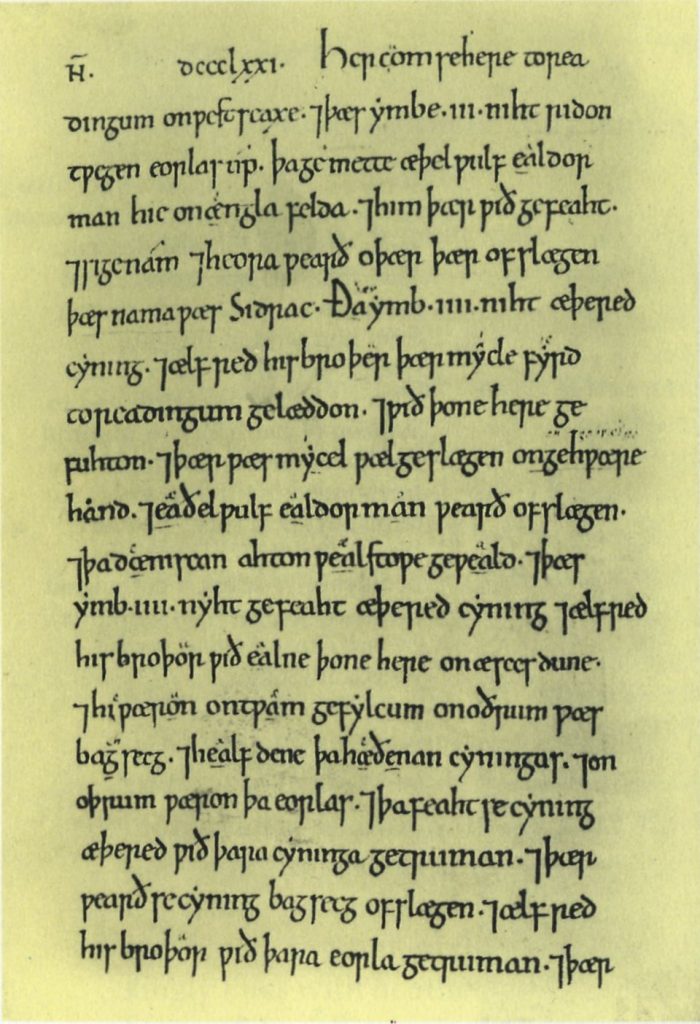
British Library Cotton Tiberius B i.
Following their victory at the Battle of Englefield on 31st December, the Anglo-Saxons clashed with the Viking invaders once more, this time at Reading on 4th January 871 AD.
King Athelred of Wessex and his brother Alfred arrived to relieve Athelwulf, the ealdorman who had led the Englefield troops.
Asser’s account of the battle says that when Athelred and Alfred arrived at Reading first of all, they “cut to pieces and overthrew the heathen whom they found outside the fortifications.” However, they were unable to contain the enemy.
And yet worse was to come, as John of Worcester explains:
“Four days afterwards [after Englefield], king Athelred and his brother Alfred, joining their forces and marshalling the army, came to Reading. When they had succeeded in getting to the gate of the citadel, by slaying and putting to rout all the Pagans whom they found outside, the Pagans did not exert themselves the less, rushing out like wolves from all the gates, and doing battle with all their might; and both sides fought long and fiercely.
But, oh misery! the Christians at last turned their backs, and the Pagans gained the victory, and remained masters of the field of death. The said ealdorman Aethelwulf was among the number of the slain.”
As the Anglo-Saxon Chronicle added, “the Danish-men had possession of the place of carnage.”
Athelweard the Chronicler adds in his account a further detail about Athelwulf:
“At length four days after their meeting, Ethelred arrives with his army; an indescribable battle is fought, now these, now those urge on the fight with spears immoveable; duke Ethelwulf falls, who a short time before had obtained the victory: the barbarians at last triumph. The body of the above-named duke is privately withdrawn, and carried into the province of the Mercians, to a place called Northworthig, but Derby in the language of the Danes.”
So Athelwulf was a Mercian, rather than from Wessex. The two kingdoms were not fully integrated at this point (that really only happened in the first quarter of the 10th century after the death of Athelflaed, Alfred’s daughter and Lady of the Mercians) but they had interests in common.
Death of Edward the Confessor, 5th January 1066

On 5th January 1066 Edward the Confessor died without an heir, and so the Witan chose Harold Godwinson to be his lawful successor. He was duly anointed and crowned the following day.
However, Harold only became king as a result of Edward’s failure to provide an heir, or nominate a clear, adult, successor. There are a number of theories about this:
- Firstly, Edward chose to remain celibate for religious reasons.
- Secondly, he was unable to have children; certainly there are no records of other children fathered earlier in his life before his marriage.
- Thirdly, he was unable to marry until very late (he was in his forties) due to his precarious position as an exile, and so by the time he did marry, he was no longer able to have children.
- Fourthly, he deliberately didn’t produce an heir to snub his wife, Edith, and her father Earl Godwin of Wessex.
- Fifthly, he may have been gay.
- Sixthly, his wife Edith was unable to have children.
None of these theories are well evidenced. The only thing we do know is that there was a lack of an heir.
Regardless of his ability or desire to father an heir, it is hard to know what reason Edward could offer for failing to name a successor in good time. The problem was widely recognised and worried over for a long time before his death. While famously William of Normandy claimed to have been promised the throne (not really within Edward’s remit as the final decision had to be agreed by the Witan), it would appear Edward did have a habit of offering to make someone his successor. He seems to have also promised it to Magnus of Norway to prevent him from invading, which was the tenuous justification used by Harald Hardrada in September 1066.
King Edward did recall Edward the Exile from Hungary in an attempt to address the pending crisis. Edward was the son of Edmund Ironside, half-brother of Edward the Confessor, which made Edward the Exile the King’s nephew. Sadly the Exile died almost as soon as he landed in England, and his son Edgar the Atheling was too young to be seen as a serious successor in 1066, being only around 15 years old and not in a position to meet the threat of invasion.
The Witan’s choice of Harold Godwinson may have been inevitable, but at least he represented proven military ability and had social networks among the noble families at a time when both factors were critical.
Discovery of the Vale of York / Harrogate Hoard, 6th January 2007

On 6th January 2007 metal detectorists David and Andrew Whelan discovered the Harrogate (Vale of York) Hoard.
It was buried in 927 AD and contains 617 silver coins, which were tightly packed into a Frankish silver cup. As well as coins it contains complete ornaments, ingots (bars) and chopped-up fragments known as hack-silver (67 objects in total as well as the 617 coins). It shows the diversity of cultural contacts in the medieval world, with objects coming from as far apart as Afghanistan in the East and Ireland in the West, as well as Russia, Scandinavia and continental Europe.
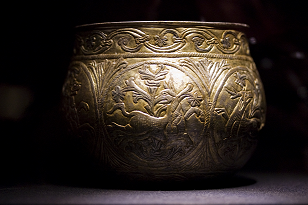
The silver cup was made around the middle of the 9th century. It was apparently intended for use in church services, and was probably either looted from a monastery by Vikings, or given to them in tribute. Most of the smaller objects were hidden inside this vessel, which was itself protected by some form of lead container. As a result, the hoard was extremely well-preserved. It also includes a rare gold arm-ring.
According to historian Michael Wood it can be identified firmly as a Viking hoard through its contents, which emphasise the vast trading routes that were used:
“There’s a Viking arm-ring from Ireland, there’s coins minted as far away as Samarkand and Afghanistan and Baghdad. And this gives you a sense of the reach of the age; these Viking kings and their agents and their trade routes spread across western Europe, Ireland, Scandinavia. You read Arab accounts of Viking slave dealers on the banks of the Caspian Sea; Guli the Russian – so-called because of his Russian hat, and he was Irish this guy, you know! – dealing in slaves out there on the Caspian, and those kind of trade routes; the river routes down to the Black Sea – through Novgorod and Kiev and these kind of places; you can see how in a very short time, coins minted in Samarkand, say, in 915, could end up in Yorkshire in the 920s.”
At this time in Britain the Anglo-Saxons had completed a series of relatively successful campaigns under Edward the Elder against the Danelaw leaders. Edward died in 924 AD and now his eldest son Athelstan became king. Athelstan was known as “King of the Anglo-Saxons” until 927, in which year he became “King of the English” following his conquest of the last remaining Viking Kingdom in York.
The hoard therefore relates to this pivotal moment, the early beginning of what eventually became England. It was buried soon after 927 AD because it contains one of the silver coins that Athelstan issued to celebrate that victory. The coin has on it a totally new regnal title, never used before: ‘Athelstan Rex totius Britanniae’ meaning “Athelstan, King of all Britain”.
The hoard was declared Treasure and was valued at £1,082,000 by the independent Treasure Valuation Committee.
Feast Day of Saethryth, 7th January

7th January is the Feast Day of a rather obscure saint called Saethryth. Bede describes her as “a daughter of the wife of Anna, King of the East Angles” and records that with another natural daughter of Anna, she took the veil at a monastery in Frankia:
“for at that time, but few monasteries being built in the country of the Angles, many were wont, for the sake of the monastic conversation, to repair to the monasteries of the Franks or Gauls; and they also sent their daughters there to be instructed, and delivered to their heavenly bridegroom, especially in the monasteries of Brie, Chelles, and Andelys.”
This would make Saethryth the half sister of Anna’s other, legitimate, daughters Seaxburh (who married King Eorcenberht of Kent), Athelthryth (a.k.a Athelthryth / Etheldreda / Audrey, wife of Ecgfrith of Northumbria and founder of Ely Abbey), Athelburh and son, Jurmin.
It appears Saethryth was installed at the monastery of Faremoutiers-en-Brie, Gaul under its foundress Saint Burgundofara, and was the first double monastery in Gaul, with both men and women serving there under its Abbess. Saethryth became the third Abbess there, succeeding her half-sister Athelburh, and succeeded in turn by her niece Eorcengota, daughter of Seaxburh.
The East Anglian princesses seem to have all become saints and clearly were very important in the foundation of a number of monasteries, but for the most part little information has survived about most of them.
Saethryth played her part too, and died in the mid- to late 7th century, usually dated around 660-664 AD. While we don’t know more detail of her life, it is appropriate to recall the influence and impact of royal women on the development of the Christian faith in Anglo-Saxon England and the Continent, through marriage, the establishment of religious communities and in some cases missionary work.
Battle of Ashdown, 8th January 871
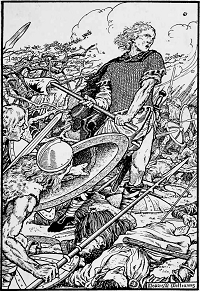
After the battles at Englefield (31st December) and Reading 94th January), King Athelred and Alfred his brother met the Vikings once more on 8th January 871. The battle was duly recorded in the Anglo-Saxon Chronicle:
“King Aethelred and Aelfred his brother fought against the whole army at Aescesdune; and they were in two bodies: in the one were Bagsecg and Halfdene, the heathen kings, and in the other were the earls. And then king Aethelred fought against the division of the kings, and there king Bagsecg was slain; and Aelfred his brother against the division of the earls, and there earl Sidroc the elder was slain, earl Sidroc the younger, and earl Osbearn, and earl Fraena, and earl Harald; and both divisions of the army were put to flight, and many thousands slain: and they continued fighting until night.”
In his biography of Alfred, Asser gives us lots of detail. We might want to be a little cautious in accepting it at face value given the purpose of the biography was to glorify Alfred, but nevertheless, it may not have been too far from the mark given it was in living memory of the event.
Let’s take a look and some extracts from that work. In the first section we get a little more detail of the shield wall deployment, and the story about Alfred leading his men straight into battle without the King, his brother Athelred, who was at prayers and refused to break off in the middle of mass.
“The heathen, forming in two divisions, arranged two shield-walls of similar size; and since they had two kings and many ealdormen, they gave the middle part of the army to the two kings, and the other part to all the ealdormen. The Christians, perceiving this, divided their army also into two troops, and with no less zeal formed shield-walls. But Alfred, as I have been told by truthful eye-witnesses, marched up swiftly with his men to the battle-field; for King Athelred had remained a long time in his tent in prayer, hearing mass, and declaring that he would not depart thence alive till the priest had done, and that he was not disposed to abandon the service of God for that of men ; and according to these sentiments he acted. This faith of the Christian king availed much with the Lord, as I shall show more fully in the sequel.”
Whether Athelred was wise is another matter; but perhaps he had already agreed with Alfred to have him lead the first attack. Asser tells us that they certainly had agreed that Athelred would lead the attack against the kings, and Alfred should go against the earls. Whatever the case, Alfred was unable to wait, either due to following an agreed plan, his own impetuosity or pressure from the enemy.
“Then Alfred, though only second in command, could no longer support the advance of the enemy, unless he either retreated or charged upon them without waiting for his brother. At length, with the rush of a wild boar, he courageously led the Christian troops against the hostile army, as he had already designed, for, although the king had not yet arrived, he relied upon God’s counsel and trusted to His aid. Hence, having closed up his shieldwall in due order, he straightway advanced his standards against the foe.”
Athelred joined him once he has finished his religious observance. The men of Wessex were forced to fight up-hill, to their disadvantage. The battle centred around a thorn tree and was fiercely contested but Asser tells us that eventually Wessex had the victory, although at great cost of life.
“But here I must inform those who are ignorant of the fact that the field of battle was not equally advantageous to both parties, since the heathen had seized the higher ground, and the Christian array was advancing up-hill. In that place there was a solitary low thorn-tree, which I have seen with my own eyes, and round this the opposing forces met in strife with deafening uproar from all, the one side bent on evil, the other on fighting for life, and dear ones, and fatherland. When both armies had fought bravely and fiercely for a long while, the heathen, being unable by God’s decree longer to endure the onset of the Christians, the larger part of their force being slain, betook themselves to shameful flight. There fell one of the two heathen kings and five ealdormen; many thousands of their men were either slain at this spot or lay scattered far and wide over the whole field of Ashdown. Thus there fell King Bagseeg, Ealdorman Sidroc the Elder and Ealdorman Sidroc the Younger, Ealdorman Osbern, Ealdorman Fraena, and Ealdorman Harold; and the whole heathen army pursued its flight, not only until night, but until the next day, even until they reached the stronghold from which they had sallied. The Christians followed, slaying all they could reach, until it became dark.”
The precise location of the battle site is not known but it was close enough to Reading where the Vikings had based themselves for them to manage a retreat. The battle was won but the war was by no means over. Some suggestions are that it was on or near Lowbury Hill near the Ridgeway, and ancient track crossing the Downs.
With the death of Bacsecg, the surviving Viking leader, Halfdan Ragnarsson, now led the invaders through the coming campaign.
Death of Beorhtwald, Archbishop of Canterbury, 9th January 731
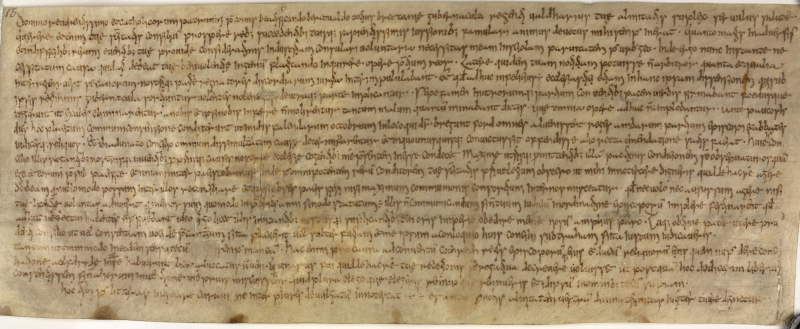
9th January is the day we remember Beorhtwald, Archbishop of Canterbury who died on this day in 731 AD.
Two years after the death of Theodore, the Turkish-born Archbishop sent by the Pope to reform the English church, Beorhtwald was elected to the primacy on 1st July 692 AD. Kent had been in turmoil prior to this and so this may be the reason for the delay in electing a replacement for Theodore. Eventually Wihtred won the throne in 691 or early 692 AD, enabling the election to proceed. However, there is another possible factor in the delay which we will discuss shortly.
Beorhtwald was the first native Archbishop of Canterbury in a continuous line until today (there had been two previous Anglo-Saxon holders of the role, Wigheard and Deusdedit, but not in a continuous line). He appears to have been born in Kent, and was formerly the abbot of Reculver, which had been founded in 669 AD by King Egbert.
The Chronicle of Glastonbury Abbey describes Beorhtwald as being the first Anglo-Saxon Abbot of Glastonbury too, serving there for 10 years before moving to Reculver. It also describes him as the nephew of King Athelred of Mercia (ruled 675-704 AD).
Although we don’t know exactly when Beorhtwald became Abbot of Reculver, he is named as such in a charter in which King Hlothhere of Kent granted land at Westanae in the Isle of Thanet, Kent, and at Sturry, Kent, to Abbot Beorhtwald and his monastery; this was dated May 679 AD, at Reculver and is the earliest surviving single-sheet Anglo-Saxon charter.
He was consecrated by Godwin, bishop of Lyons, on 29th June 693 AD and received his pallium from Pope Sergius I. He was also provided with 2 letters of privilege from the pope, presumably to emphasise his role with the kings of the various Anglo-Saxon kingdoms, not all of whom were supportive.
He worked with Wihtred to develop the legal text known as the Law of Wihtred, dating to around 695 AD. The sole surviving document is found in the Textus Roffensis, and is the third in a series of Kentish Law Codes contained in the Codex which was collated in the 12th century. It was signed by Beorhtwald as Archbishop as well as Gebmund, the bishop of Rochester, and deals primarily with church and religious issues, defining penalties for giving gifts to pagan idols, working slaves on the Sabbath and for any foreigner or stranger who leaves the track and does not draw attention to himself by blowing his horn. Beorhtwald was also able to secure exemption for taxation for the church in the Laws, and later he was able to have agreed other privileges in a document from 699 AD.
Beorhtwald’s tenure saw the establishment of the Bishopric of Sherborne, consecrated the first Bishop of Selsey and the final conversion of pagan West Sussex.
However, much of his time in office was taken up with the matter of Bishop Wilfrid, and indeed this may have been a contributory factor in the delay of his original election. Despite Beorhtwald allegedly being the nephew of Athelred of Mercia, Wilfrid was Athelred’s Bishop and it is not clear which candidate he supported for the Archbishopric. Certainly Wilfrid was of the opinion he should have been elected.
Beorhtwald followed the approach of his predecessor Theodore with regards to Wilfrid. He opposed Wilfrid in his quest to add back dioceses to the Bishopric of York which had been split off by Theodore. At the Council of Austerfield in 702 AD Beorhtwald presided over the meeting and was described by Wilfrid’s biographer, Stephen of Ripon, as one of Wilfrid’s enemies who tried to deprive him of all his offices and possessions. The Council instructed Wilfrid to retire to Ripon and give up his Bishopric. Wilfrid was not happy with the outcome and appealed to the Pope. Three years later Wilfrid was given the Bishopric at Hexham instead.
Beorhtwald’s surviving correspondence contains other items of interest as well as papal matters. In one he writes to the Bishop of Sherborne asking him to intercede with the Abbot of Glastonbury to ransom a slave. Another letter, this time from the Bishop of London is of interest as the oldest surviving example of a “letter close” in Western Europe; a letter close is a sealed legal document, ensuring that only the intended recipient should read it in the first instance. The letter, dating to around 703-705 AD, also reveals that Wessex had been threatened with excommunication.
Beorhtwald held the See for 37 years, dying on 9th January 731 AD. His feast day is 9th January but his cult never really seems to have been very active.
There was a verse epitaph dedicated to him which may have been placed above his original tomb. The Corpus of Anglo-Saxon Stone Sculpture records that in the sixteenth century Leland transcribed a number of verse texts from an eighth-century manuscript collection from England and these included the epitaph of Beorhtwald. The epitaph was in elegiac couplets and consisted of twenty-two verses. The inscription contains the interesting information that Beorhtwald had his monument made himself (‘artificum manibus fecerat ipse sibi’) while he was still living, although the inscription was composed and executed after his death. The monument must therefore have been something more than a simple tomb. The author of the epitaph asks for the prayers of the archbishop. It was probably produced after the construction of the new Canterbury Cathedral when the original epitaph had been lost.
Death of Benedict Biscop, Abbot of Jarrow, 12th January 689

12th January is the Feast Day of Benedict Biscop, founder of the twin monasteries of Monkwearmouth and Jarrow. He was a great traveller, visiting Rome on a number of occasions and amassing an enviable collection of manuscripts which became a famous library. This collection was used by Bede to write his many works of theology, science, mathematics and history.
Although he is best known as the founder of Monkwearmouth-Jarrow double monastery, he was previously abbot of SS Peter & Paul at Canterbury.
Born under the name of Biscop Baducing he was a member of a noble Northumbrian family. He served in the household of King Oswiu and then around 652 AD he decided to go to Rome on pilgrimage. He set off south and arrived at Canterbury where he met another young man intending to go to Rome; this was Wilfrid, later the Bishop of Hexham, Ripon and York. The two young men were sent off together by King Eorcenberht of Kent but separated at Lyons, with Biscop going ahead.
He made a second trip to Rome around 664 AD, when he became a monk at Lérins and took the name of Benedict. He studied there for two years then returned to Rome. By now it was 667 AD and Wigheard arrived from Britain as the Archbishop-Elect of Canterbury, hoping to collect his pallium from the Pope. Unfortunately he caught the plague instead and died. The Pope therefore appointed an alternative Archbishop, Theodore of Tarsus, and Benedict was sent back to Britain with him. They left Rome on 27th May 668 AD and arrived in Canterbury a year later.
In Canterbury, while Theodore took stock of the state of the English Church, Benedict took on the abbacy of the Church of SS Peter & Paul in Canterbury until Hadrian could join them the following year.
Benedict’s next move was to go back to Rome to pick up some books. These were to help him establish a monastic foundation, and when he returned home he went to Northumbria and established a monastery at Monkwearmouth on lands granted by King Ecgfrith, around 673 AD. He was soon joined by a monk called Ceolfrith, who later succeeded him as abbot.
Benedict set to work establishing his monastery, bringing in Frankish stonemasons and glaziers to help him build it. It was completed around 675 AD so Benedict and Ceolfrith set out for Rome to pick up more books and art work; they were creating an enviable library which would be of benefit to scholars, the most well-known of whom was Bede. Bede had joined the monastery as a seven year old boy around 680 AD and never left it as he tells us himself:
“Bede, the servant of God, and priest of the monastery of the blessed apostles, Peter and Paul, which is at Wearmouth and Jarrow; who being born in the territory of that same monastery, was given, at seven years of age, to be educated by the most reverend Abbot Benedict, and afterwards by Ceolfrid; and spending all the remaining time of my life in that monastery, I wholly applied myself to the study of Scripture, and amidst the observance of regular discipline, and the daily care of singing in the church, I always took delight in learning, teaching, and writing.”
When Benedict and Ceolfrith got back to Northumbria they had with them a man called John, the precentor of St Peter’s in Rome, who came to teach the monks the techniques of liturgical chant.
The abbey was hugely successful and King Ecgrith endowed a second monastery at Jarrow with Ceolfrith as abbot in 681 AD, just after Bede joined the monastery.
In 685 AD Benedict made his final trip to Rome and came back with more books and treasures.
He died on 12th January 689 AD among his monks after an illness which gradually paralysed him over the three years following his return from Rome. Thanks to his efforts, his monasteries were the centre of learning and scholarship across Western Europe.
Death of King Athelwulf of Wessex, 13th January 858

King Athelwulf of Wessex died on 13th January 858 AD. He was Alfred’s father, and had taken his son to Rome when Alfred was still a young child.
He was succeeded by four of his sons in turn, each dying without adult sons of their own to take the throne, until finally his youngest son, Alfred, unexpectedly became king.
Athelwulf was the son of King Ecgberht of Wessex and traced his descent through the line of Ine, an early King of Wessex. His mother Redburga was a Frankish princess who may have been an illegitimate daughter of Charlemagne, and Athelwulf was born in the early 800s, possibly while Ecgberht was still in exile in Frankia.
He ruled as sub-king in Kent from 825 AD and succeeded his father in Wessex in 839 AD. He married Osburh, daughter of Oslac, a Hampshire ealdormann, and she may have been his second wife. This is suggested based on the age range of Athelwulf’s sons.
Athelwulf was the first West Saxon king to succeed his father for over 100 years, providing much needed stability. However, he was less aggressive than his father had been and preferred to make alliances where possible. This did not prevent him from annexing part of Berkshire in the 840s however. He married his daughter Athelswith to the Mercian King Burghred in 853 AD and the allies attacked Powys driving out King Cyngen. In this year he also sent four year old Alfred to Rome where he met the Pope and Alfred later claimed he was consecrated by him as King.
More urgently Athelwulf faced increasing Scandinavian raids. An attack on Southampton in 840 AD was driven off, but his men lost a fight at Portland in the same year and Athelwulf lost a battle at Carhampton in 843 Ad. His men drove off a fleet at the mouth of the River Parrett in 848 AD and his son Athelstan, sub-king in Kent, defeated another fleet at Sandwich using a navy. However the Vikings over-wintered at Sheppey in 851 AD and a large force moved in to attack London which was then part of Mercia. Athelwulf and his son Athelbald defeated the host at Aclea, where according to the Anglo-Saxon Chronicle they
“made the greatest slaughter among the heathen army that we have heard reported to the present day, and there got the victory.”
In 855 AD Athelwulf went to Rome with Alfred, presumably feeling the kingdom was safe to leave for a while; this proved ill advised. He dedicated a tenth of his lands to God and the Church and this may have upset his nobles who then supported his son Athelbald in rebellion.
He married again on his way back from Rome, cementing the family relationship with Charles the Bald, king of the Franks, by marrying his teenage daughter Judith on 1st October 856 AD. This was almost certainly a strategic alliance to support a military agreement. However, it also raised the possibility of more children to contest the throne, and with Judith anointed as queen (not the practice in Wessex) this may have made the possibility more real.
Athelbald rose in rebellion, supported by some key figures among the nobility as well as the Bishop of Sherborne. Athelwulf was unable to gather enough support to win his throne back and had to reach a compromise with his son, accepting the smaller kingdom of Kent for his rule and leaving Wessex to Athelbald.
He died at Steyning in West Sussex on 13th January 858 AD, and was buried there. Alfred later had him reburied at Winchester. His reputation has not always been very positive, coming between Ecgberht who established the Wessex hegemony, and Alfred. However, his achievements were significant. He withstood the Viking attacks in 851 AD, created a viable fleet and no doubt inspired his successors to achieve and retain the independence of the last kingdom to stand against the invading Vikings.
Feast Day of King Ceolwulf of Northumbria, 15th January

15th January is the Feast Day of Ceolwulf of Northumbria, King and Saint. Fairly unusually he didn’t die in battle or while feasting.
The Northumbrian kingdom in the 8th century was chaotic, and Ceolwulf’s reign was difficult.
He was the son of Cuthwine, and brother of Cenred (sometimes called Coenred). He was able to claim descent from the dynastic founder Ida through his family line as described in the Anglo-Saxon Chronicle:
“Ceolwulf succeeded to the kingdom, and held it eight years, and Ceolwulf was the son of Cutha, Cutha of Cuthwin, Cuthwin of Leodwald, Leodwald of Ecgwald, Ecgwald of Aldhelm, Aldhelm of Ocga, Ocga of Ida, Ida of Eoppa.”
Cenred had usurped the throne in 716 AD from Osred, and then was assassinated by Osric, who was Osred’s brother. When Osric died after a short but uneventful reign, Ceolwulf succeeded to the throne in 729 AD as described by Bede:
“immediately after Easter, that is, on the 9th of May, Osric, king of the Northumbrians, departed this life, after he had reigned eleven years, and appointed Ceolwulf, brother to Coenred, who had reigned before him, his successor; the beginning and progress of whose reign were so filled with commotions, that it cannot yet be known what is to be said concerning them, or what end they will have.”
He features in the Irish Annals as Eochaid and may have been educated there. He was certainly a learned and pious man. Bede dedicated his Ecclesiastical History to him:
“TO THE MOST GLORIOUS KING CEOLWULPH, BEDE, THE SERVANT OF CHRIST AND PRIEST
FORMERLY, at your request, most readily transmitted to you the Ecclesiastical History of the English Nation, which I had newly published, for you to read, and give it your approbation; and I now send it again to be transcribed and more fully considered at your leisure. And I cannot but recommend the sincerity and zeal, with which you not only diligently give ear to hear the words of the Holy Scripture, but also industriously take care to become acquainted with the actions and sayings of former men of renown, especially of our own nation. For if history relates good things of good men, the attentive hearer is excited to imitate that which is good; or if it mentions evil things of wicked persons, nevertheless the religious and pious hearer or reader, shunning that which is hurtful and perverse, is the more earnestly excited to perform those things which he knows to be good, and worthy of God. Of which you also being deeply sensible, are desirous that the said history should be more fully made familiar to yourself, and to those over whom the Divine Authority has appointed you governor, from your great regard to their general welfare.”
Given the breakdown in royal control at the beginning of the century, a thoughtful and scholarly king would have been much appreciated by Bede and his fellow monks. And it seems Ceolwulf took inspiration from Bede’s work. He made generous grants of land to the Church, much to the consternation of his nobles; it appears that their resentment was behind the increasing number of attacks on the members of religious communities. Even Bede expressed concerns about the impact such gifts were having on stability in the kingdom. In 731 AD Ceolwulf was deposed and forcibly tonsured but was restored within a few months.
Northumbria was divided into four bishoprics: York (Bishop Wilfrid the Younger); Lindisfarne (Bishop Athelwold); Hexham (Bishop Acca); and Whithorn (Bishop Pectelm). In 735 AD York was made an Archbishopric under Ceolwulf’s relative Egbert.
Finally in 737 AD Ceolwulf abdicated in favour of his cousin, Eadbert, and entered the monastery at Lindisfarne. Eadbert seems to have been Archbishop Egbert’s brother. On entering the monastery Ceolwulf gave many gifts, perhaps the most popular being a dispensation for the monks to drink beer and wine instead of just water or milk, according to Baring Gould:
“There he passed the last thirty years of his life in study and happiness. He had, while king, enriched this monastery with many great gifts, and obtained permission for the use of wine and beer for the monks, who, up to that time, according to the rigid rule of ancient Keltic discipline, had been allowed no beverage but water and milk.”
Ceolwulf lived in Lindisfarne until around 764/5 AD when he died. Simeon of Durham records the death:
“AD 764. Deep snow hardened into ice, unlike anything that had ever been known to all previous ages, covered the earth from the beginning of winter till nearly the middle of spring; by the severity of which the trees and shrubs for the most part perished, and many marine animals were found dead. Also, in the same year, died Ceolwulf, formerly king, at this time a servant of our Lord Jesus Christ, and a monk.”
Feast Day of Bishop Wulfstan of Worcester, 19th January

19th January is the Feast Day of St Wulfstan, 2nd Bishop of Worcester by that name, the last surviving English pre-Conquest Bishop who died in 1095. He is the patron saint of vegetarians.
Wulfstan was born around 1008 at Itchington in Warwickshire and his family were closely connected with the church in Worcester. It is possible he was the nephew of another Wulfstan, also Bishop of Worcester and later Archbishop of York, who is thought to have been Wulfstan’s mother’s brother.
In 1033 Brihtheah became the Bishop of Worcester and Wulfstan joined his household. The two may also have been related as half-brothers. Wulfstan decided to become a monk, and was appointed Prior by 1055, when Ealdred was Bishop. Ealdred went on to become Archbishop of York in 1061 so the See of Worcester became vacant and in 1062 Wulfstan was elevated to the Bishopric by King Edward the Confessor.
Initially Wulfstan had to combat the ongoing influence of Ealdred in the diocese, as Ealdred was still extracting money from it and this continued until the Normans took power. He was closely associated with Harold Godwinson, later King Harold. However, following the Norman invasion Wulfstan demonstrated loyalty to William of Normandy and Lanfranc, the Norman Archbishop of Canterbury and managed to keep his position unlike the other church leaders of England. Later legend said that when he was ordered to surrender his episcopal staff, he stuck it into the tomb of King Edward, declaring that as Edward had appointed him, only Edward could take it from him. At a synod in 1070 Wulfstan was able to demand back the money and lands Ealdred had appropriated and which had transferred to the King after Ealdred’s death. The case was adjourned until a new Archbishop could be appointed at York to defend it, and then it was heard. John of Worcester describes the judgement:
“All the groundless assertions by which Thomas and his abettors strove to humble the church of Worcester, and reduce her to subjection and servitude to the church of York, were, by God’s just judgment, entirely refuted and negated by written documents, so that Wulfstan not only recovered the possessions he claimed, but, by God’s goodness, and the king’s assent, regained for his see all the immunities and privileges freely granted to it by its first founders, the holy king Ethered, Oshere, sub-king of the Hwiccas, and the other kings of Mercia, Cenred, Ethelbald, Offa, Kenulf, Edward the Elder, Athelstan, Edmund, Edred, and Edgar.”
Wulfstan was energetic in protecting Worcester’s rights and in particular was concerned to commission a revised cartulary containing details of all the possession of the cathedral as well as its losses. While supporting tradition he was nevertheless keen to examine new ideas and began to build a new cathedral in the Romanesque style, although it was recorded that he wept when everything finally moved across from the old cathedral. He also supported the tradition of writing in Old English for homilies and religious texts. He preached against the slave trade and defended Worcester during the civil war after William of Normandy’s death by praying for a miracle which stopped the invading army so the defenders were able to slaughter them.
When Wulfstan died in 1095 he was the only English-born bishop left in England. Eadmer the historian described him as “the one sole survivor of the old Fathers of the English people” and he was consulted by Anselm, the later Archbishop of Canterbury, on matters of English custom.
His chaplain, Coleman, wrote a “Life of Wulfstan” after his death in Old English, although only a later Latin translation survives, made by William of Malmesbury in the 12th century. Coleman records various stories about Wulfstan’s youth which he used to tell to encourage the boys he was teaching through his own failings and overcoming of difficulties. For example, one was about being overcome by sexual desire for a girl and how after their lovemaking he was overcome by remorse. He hid away and as he lay there regretting his actions, he fell asleep. As he lay there he was surrounded by a bright cloud which he realised was heavenly love and after which experience he was free of sexual temptation.
Coleman also recorded his simplicity and his wit and charm. Wulfstan was teased by Geoffrey of Coutances for wearing lambskin instead of richer furs.
“Wulfstan replied neatly that Geoffrey and other men well versed in the way of the world should wear the skins of crafty animals, but he was conscious of no shiftiness in himself and was happy with lambskin. Geoffrey pressed the point, and suggested he could at least wear cat. But ‘Believe me,’ answered Wulfstan, ‘the Agnus Dei [Lamb of God] is more often chanted than the Cattus Dei.’”
The reason he is the saint of vegetarians relates to another story about him, when he was distracted at his prayers by the smell of goose roasting for his dinner, his favourite dish. He immediately vowed he would never eat meat again (although he did eat fish for festivals).
Following his death John of Worcester tells us that:
“God suffered no man to remove from his finger the ring with which he had received episcopal consecration, that the holy man might not appear to forfeit his engagement to his people, to whom he had often foretold that he would never part with it during his life, nor even on the day of his burial.”
Battle of Basing, 22nd January 871
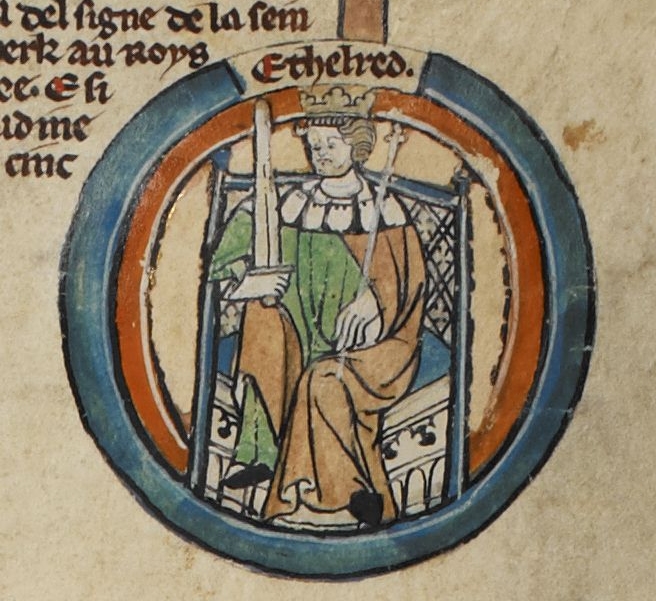
22nd January 871 AD saw the Battle of Basing, two weeks after the Anglo-Saxon victory at Ashdown (see 8th January).
The Anglo-Saxon Chronicle described the events:
“And about fourteen days after this [Battle of Aescesdune], king Aethelred and Aelfred his brother fought against the army at Basing, and there the Danes obtained the victory.”
John of Worcester expands this only enough to say it was a “long engagement” but Simeon of Durham goes further:
“After the lapse of fourteen days, the most excellent king Ethelred, disregarding that the year of jubilee* is one of forgiveness, aided by the trusty help of his brother, called together the army, collected the spoils, and divided arms and many gifts among his comrades. These princes of the people were well aware that states would be happy, if either those persons who loved wisdom were in power, or if it came to pass that their rulers applied their minds to wisdom. The Angles and Danes again met in battle, and applying their utmost strength, the Danes nearly obtained the victory.”
Perhaps we shouldn’t entirely rely on Simeon in this instance as he was writing in the 12th century. Another chronicler writing in the 10th century also concludes with the Anglo-Saxon Chronicle that in fact the Danes had the victory. Athelweard says:
“Fourteen days after, they again took courage and a second battle was fought at a place called Basing: the barbarians came and took part over against them; the fight began, and hope passed from the one side to the other; the royal army was deceived, the enemy had the victory, but gained no spoils.”
Although opinion favours the Danes it would appear it was far from a rout. 871 is sometimes called “The Year of Battles” precisely because there was not a decisive victory for either side for some time.
The location of the battle is not known specifically, although Basing was around the area now known as Old Basing in Hampshire, and close to the royal centre of Winchester. The settlement at Old Basing is considered to be a pre-cursor to Basingstoke and was recorded in Saxon charters.
Marriage of Edith of Wessex and Edward the Confessor, 23rd January 1045

Edith and Edward the Confessor married on 23 January 1045 AD. They were not close in age, with a gap of almost 20 years between them, but this was a strategic marriage and not a love match. Edith was also consecrated Queen.
The marriage produced no children (see 5th January), and after Edward’s death in 1065 Edith’s brother sat on the throne of England.
Relationships between Edward and the Godwins were complicated. Edith’s father Earl Godwin had been involved in the death of Edward’s brother Alfred. It is not clear to what extent Edward was willing to marry Edith or whether he was forced into it by the need for Godwin support.
Six years after their marriage the nation experienced the “crisis” of 1051 when the Godwins were exiled by Edward and accused of rebellion. Edith herself was sent to the nunnery at Wilton and Edward confiscated her lands. However, the family was restored to favour the following year and Edith returned to court and her position of influence. The restoration of Edith did, however, seem to represent a change in their relationship with Edith becoming a trusted adviser and witness to many of Edward’s charters.
On Edward’s deathbed he called her a “loving and dutiful daughter” so it seems they were not romantically involved. After Edward’s death Edith commissioned the “Vita Edwardi Regis” (The Life of King Edward) in his honour (and also to promote her own reputation). It has been suggested she was trying to save face regarding the lack of children. After Edith died in 1075 the couple were laid to rest together in Westminster Abbey.
Death of Eadgyth of Wessex, 26th January 946

Eadgyth of Wessex died on 26th January 946 AD and was eventually laid to rest in Magdeburg in modern Germany. In 2008 her coffin was discovered, with her body inside.
Eadgyth was one of the many half-sisters of King Athelstan, who arranged strategic marriages for them as part of his diplomatic strategy. The marriages themselves indicated the power and influence he wielded among his contemporaries; Eadgifu had already married Charles the Simple, King of the West Franks, and Athelstan supported them when Charles was deposed in 923 AD. Charles’ enemy Hugh the Great also married a sister, Eadhild in 926 AD and Alfgifu married another Continental prince, who may have been Conrad of Burgundy or a sibling. Another unnamed sister married Sihtric, the Viking King of York also in 926 AD.
In 928 AD Henry the Fowler had approached Athelstan with the suggestion of the arrangement, as he was looking for a West Saxon princess to marry his eldest son. Henry was the Duke of Saxony and had recently made himself King of Germany. Athelstan agreed to make an alliance with the House of Saxony and offered two sisters to Henry’s son Otto for him to make a choice. Otto chose to marry Eadgyth rather than her sister, describing her as a woman “of pure noble countenance, graceful character and truly royal appearance.” The other sister, Alfgifu then married a different prince, possibly Conrad of Burgundy.
Otto already had a son with a woman about whom almost nothing is known and who does not seem to have been a formal wife. Eadgyth and Otto had two children. Their son Liudolf pre-deceased his father while their daughter Liutgarde married Conrad of Lorraine.
At the time that Otto and Eadgyth married it was not known how powerful Otto would later become. Otto succeeded his father in 936 AD and the couple founded the monastery at Magdeburg in the following year. Eadgyth is credited with the spread of the cult of St Oswald in Germany.
Eadgyth’s death was early and unexpected, and Otto did not remarry until 951 AD. She was buried at the monastery in Magdeburg but later moved to the Cathedral.
In 2008 her tomb was opened during archaeological work at the cathedral and a body discovered. Until then it had been thought the tomb did not contain any actual remains, and so an examination of the teeth was carried out which indicated that the individual’s childhood matched the historical records of Eadgyth’s known whereabouts in Wessex and Mercia. It was announced that they were believed to belong to Eadgyth and that they therefore represented the oldest known remains of a member of the English royal family at that time. She was reinterred in Magdeburg in 2010.
Unconfirmed discovery of the remains of King Edward the Martyr, 26th January 1931

On 26th January 1931 John Wilson-Claridge and his gardener, Bert Richards dug up a lead casket which they claimed contained the skull and bones of King Edward the Martyr.
Edward the Martyr was the successor of King Edgar on 8th July 975, and he reigned for three years before being assassinated at Corfe Castle on 18th March 978. It is alleged that this was under the guidance of his stepmother Elfrida in order to allow her own son Athelred (later called “Unrede” meaning “Ill-advised”) to take the throne.
Edward’s remains had a difficult time. Initially they were taken to a cottage then buried at Wareham “without royal honours” according to the Anglo-Saxon Chronicle. It was a year before they were translated to Shaftesbury and treated with the respect due to them. In return many miracles were attested and his shrine became very popular.
The Dissolution of the Monasteries came to Shaftesbury in the 16th century and the Abbey was dissolved in 1539 and the shrine was dismantled. The relics were then lost.
In 1931 the discovery of bones was made in the grounds of the house owned by the Claridge family, which had been built over the location of the west end of the Abbey church. Two osteology reports on the bones proved inconclusive, and did not agree. The bones remained with John Wilson-Claridge until he sold the house and left the bones behind, although he claimed a “rent” for them. Later the house was sold again and he had the bones moved to a bank vault.
The Saint Edward Brotherhood, an Orthodox Christian monastery established in Brookwood Cemetery in Surrey in 1982, negotiated taking the bones to install in a shrine. They were eventually enshrined in 1988 at their church. Following a lengthy and complex court case in 1995 it was finally agreed that they should remain there.
Regardless of the provenance of the bones themselves, the Brotherhood maintains the shrine in memory of the king.
Death of Charlemagne, 28th January 814
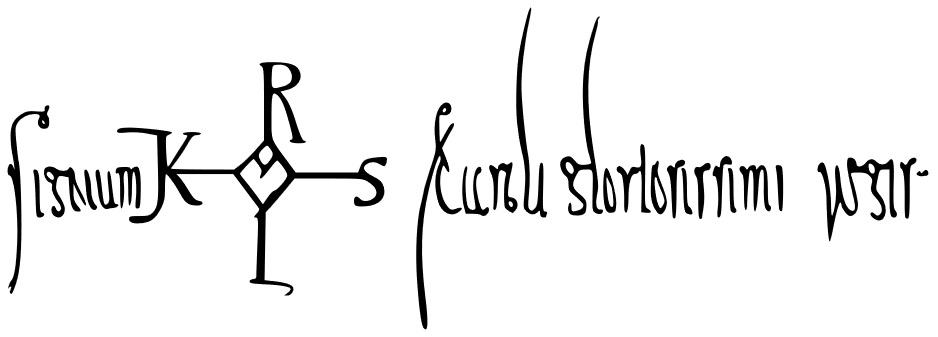
28th January 814 AD saw the death of Charlemagne, on whom many a later king modelled himself. Unusually for people of this period, we have a description of his appearance. According to Einhard, he was six feet four inches tall, and built to scale. He had beautiful white hair, animated eyes, a powerful nose…a presence ‘always stately and dignified.’ He was temperate in eating and drinking, abominated drunkenness, and kept in good health despite every exposure and hardship.
Charlemagne’s name was “Charles” and the “Magnus” (“Great”) was added to distinguish him from other Charleses, especially his own son. However, the title became incorporated into his name from the 9th century onwards and so we know him today as Charlemagne.
Charlemagne was the grandson of Charles Martel who was the effective ruler of Frankia, although not the actual king. His son Pepin the Short succeeded him and took the title of King, and so Pepin’s son Charlemagne, in turn succeeded in 768 AD along with his brother Carloman II.
The brothers did not get on well but Carloman died, possibly in suspicious circumstances, in 771 AD. Charlemagne pursued an aggressive military policy, overwhelming Saxony and ruthlessly driving out pagan practices over a period of 30 years. In Lombardy (in Italy) the Pope requested his support and Charlemagne responded by annexing the kingdom and taking the title “King of the Franks and Lombards”. He imposed full control on Bavaria, theoretically a client kingdom but one which acted too independently for Charlemagne’s tastes. He therefore held a show trial of the Bavarian Duke Tassilo III, had him condemned for disloyalty and imprisoned him in a monastery. Finally he fought the Avars (in Hungary) and sacked the royal residence after which the Avars seem to disappear from history.
The result of the military campaigning was vast wealth which supported the Carolingians (as his dynasty is called) for a generation. The seizure of the treasures of these kingdoms allowed Charlemagne to be generous to those he wanted to reward, further binding loyalty and establishing control.
In 794-5 AD Charlemagne founded his new capital at Aachen and endowed it with riches. Gradually Aachen became a political and administrative focus, although the king and his court still travelled as traditionally had been the case. However, the establishment of a fixed location for much of the administration and politics of the dynasty had a profound effect.
Charlemagne also obtained the title of Emperor on 25th December 800 AD being anointed by the Pope, allegedly in a “surprise” ceremony. Although it was no more than an honorific, Charlemagne eventually had this title recognised by the Emperor of Byzantium in 812 AD.
Charlemagne’s influence cannot be doubted. Offa of Mercia corresponded with him about tunics and trade. The Carolingian Renaissance which grew from Charlemagne’s hegemony was in a large part influenced by the Anglo-Saxon Alcuin of York, who was recruited by Charlemagne to help lead his programme of enhancing education and literacy. Following the political upheaval of the preceding years, Charlemagne’s project saw the emergence of developments in art, literature, theology and ideas which some more recent authors have claimed restored civilisation and justice to a barbarian Europe. Charlemagne was unpopular with the Enlightenment scholars for his support of the church and earlier humanists believed that there was no learning or erudition before their own time (15th century). From the 20th century however the term “Carolingian Renaissance” began to be applied more widely and the contribution of Charlemagne’s project was more readily appreciated.
When Charlemagne died in 814 AD he was succeeded by his son Louis the Pious who marched to Aachen and seized control.
Feast Day of Gildas, 29th January
29th January is the Feast Day of St Gildas Sapiens – the author of “The Ruin of Britain” (De Excidio Britanniae), the British invective against sinful British kings and mercenary Anglo-Saxons.
Gildas probably wrote in the 6th century, and despite his apocalyptic depiction of the state of his country he was clearly the product of a Christian and sophisticated educational upbringing. He is widely misquoted, and his motive in writing was not to record history but to put pressure on the kings of the time. Nevertheless he offers a unique insight into the period, and providing his motives are kept in mind, can show us a picture of this confusing and poorly recorded era.
It is probable that Gildas was a leading figure of his time, whose work was intended to influence society, especially the rulers. Nowadays focus tends to be on his depiction of the Anglo-Saxon “Adventus” (Arrival). Dating the document has proved challenging despite apparent evidence based on the death of King Maelgwn (549 AD), whom Gildas addresses in his letter of denunciation. Gildas also claims to be writing 44 years after the Battle on Mons Badonicus (Mount Badon) but again the date of this battle is unconfirmed. Finally his death is quoted as being 570 AD in the Annales Cambriae but unfortunately this is not reliable dating either.
The writing demonstrates that Gildas was well-read and well-educated, being written in elegant but complex Latin. This in turn implies an education system functioning under Roman-style structures and so potentially places him earlier rather than later. As well as the Excidio Gildas is credited with writing a Penitential for monasteries, and also some fragments of ecclesiastical letters on church affairs.
All of this leads us to conclude that Gildas was writing in the 5th/ 6th century.
What did he actually say?
The Excidio purports to describe the disasters affecting Britain as punishment for the people’s ungodliness. Ironically it is often noted that a very similar approach was taken by Wulfstan in his “Sermon of the Wolf to the English People” in the early 11th century against the Viking invasions; and in fact Wulfstan did quote Gildas in one of his other sermons.
Although Gildas was not interested in writing history, he does provide incidental information about Romano-British religious life and practice and the impact of the Germanic arrivals. He starts with a history before focusing on his lengthy rant against the rulers of the Britons, but here is a sample of the historical part:
“24. For the fire of righteous vengeance, caused by former crimes, blazed from sea to sea, heaped up by the eastern band of impious men; and as it devastated all the neighbouring cities and lands, did not cease after it had been kindled, until it burnt nearly the whole surface of the island, and licked the western ocean with its red and savage tongue. In this assault, which might be compared to the Assyrian attack upon Iudaea of old, there is fulfilled in us also, according to the account, that which the prophet in his lament says:—-
They have burnt with fire thy sanctuary in the land,
They have defiled the tabernacle of thy name;
and again,
O God, the gentiles have come into thine inheritance,
They have defiled thy holy temple,
and so forth. In this way were all the settlements brought low with the frequent shocks of the battering rams; the inhabitants, along with the bishops of the church, both priests and people, whilst swords gleamed on every side and flames crackled, were together mown down to the ground, and, sad sight! there were seen in the midst of streets, the bottom stones of towers with tall beam cast down, and of high walls, sacred altars, fragments of bodies covered with clots, as if coagulated, of red blood, in confusion as in a kind of horrible wine press: there was no sepulchre of any kind save the ruins of houses, or the entrails of wild beasts and birds in the open, I say it with reverence to their holy souls (if in fact there were many to be found holy), that would be carried by holy angels to the heights of heaven. For the vineyard, at one time good, had then so far degenerated to bitter fruit, that rarely could be seen, according to the prophet, any cluster of grapes or ear of corn, as it were, behind the back of the vintners or reapers.
25. Some of the wretched remnant were consequently captured on the mountains and killed in heaps. Others, overcome by hunger, came and yielded themselves to the enemies, to be their slaves for ever, if they were not instantly slain, which was equivalent to the highest service. Others repaired to parts beyond the sea, with strong lamentation, as if, instead of the oarsman’s call, singing thus beneath the swelling sails:
Thou hast given us like sheep appointed for eating,
And among the gentiles hast thou scattered us.
Others, trusting their lives, always with apprehension of mind, to high hills, overhanging, precipitous, and fortified, and to dense forests and rocks of the sea, remained in their native land, though with fear.
After a certain length of time the cruel robbers returned to their home.”
The Epistle section addressing the kings directly also provides a direct expression of Gildas’ opinions with much quoting of Bible sources and comparisons to the kings and tyrants of old.
Marriage of King Sihtric of York, 30th January 926

King Athelstan had a number of half-sisters whom he married strategically (see 26th January).
On 30th January 926 AD an unnamed sister was married to Sihtric, the Viking King of York who succeeded Raegnald around 921 AD. It is not clear if the marriage was consummated as Sihtric died in 927 AD.
The Anglo-Saxon Chronicle records that:
“AD 925. This year king Edward died, and Aethelstan his son succeeded to the kingdom. And St. Dunstan was born: and Wulfhelm succeeded to the archbishopric of Canterbury. This year king Aethelstan and Sihtric king of the North-humbrians came together at Tamworth, on the third of the kalends of February [30th Jan.]; and Aethelstan gave him his sister.”
It is suggested much later by Roger of Wendover (13th century) that this particular sister of Athelstan was Edith of Tamworth who founded the monastery at Tamworth and retired to Polesworth to become a nun:
“A.D. 925. Ethelstan, king of the English, honourably married his sister Eathgita to Sithric, king of the Northumbrians, a man of Danish origin; who for love of the damsel renounced paganism and embraced the faith of Christ; but not long afterwards he repudiated the blessed virgin, and, abjuring Christianity, restored the worship of idols, and miserably ended his life shortly after his apostasy.
The holy damsel thereupon, having preserved her virginity, abode at Pollesbury [Pollesworth], persevering in good works unto the end of her life, devoting herself to fasting and watching, alms-giving and prayer; and after a praiseworthy course of life she departed out of this world on the 15th of July at the same place, where unto this day divine miracles cease not to be wrought.”
It seems she was the only full-sister of Athelstan, based on the writings of William of Malmesbury (12th century) and her identity as Edith of Polesworth is speculative, and not to be confused with the half-sister Eadgyth who married Otto of Germany. It would appear this first daughter of Edward the Elder was overlooked in much the same way as her brother was following Edward’s second marriage, and may have been sent away to the court of Mercia with Athelstan. Although a number of sources equate the bride of Sihtric with Edith of Polesworth this cannot be absolutely confirmed.
In any case, Sihtric died shortly afterwards and Athelstan invaded York instead. The fate of the widow remains unknown for certain.