Category Archives: Events in Anglo-Saxon times

On This Day in November

Death of Queen Mathilda, 2nd November 1083

Statue of Matilda of Flanders
Matilda of Flanders by Jean-Jacques Elshoecht, Tom Hilton [CC BY 2.0]

2nd November 1083 saw the death of Mathilda of Flanders, the wife of William of Normandy.

She was the daughter of Count Baldwin V of Flanders, and through him she could trace her ancestry back to Alfred of Wessex and Charlemagne. Born in the early 1030s (the year is not known for certain), she grew up in Bruges and may possibly have met Emma, twice Queen of England through marriages to Athelred Unrede and Cnut, when she was in exile during the reign of Harold Harefoot. Emma remained at Baldwin’s Court until 1040.

Orderic Vitalis praised Mathilda’s intelligence and learning; it is possible she learned Latin although she did not learn to write. (Reading and writing were very separate activities at this time, and some copyists could not read, which may account for some of the errors in medieval manuscripts.) She was also graceful and devout, but it seems she had an independent streak. As a princess she would have been expected to be married off to support a dynastic alliance. However, according to the Annals of Tewkesbury Abbey, it would seem that she fell for an English nobleman, Brihtric Meaw of Gloucester, and declared she wished to marry him. Brihtric turned her down and it is sad to say that she exacted revenge later.

A marriage with William Duke of Normandy was proposed and although her father tried to persuade her, Mathilda was not interested due to his illegitimacy. There is an apocryphal story of William attacking her on her way back from Mass, and either beating her or raping her, but it seems unlikely that anything quite so outrageous would have been allowed to pass by her father without strong reprisals. However, in the end Mathilda changed her mind and agreed to marry the Norman Duke. It is interesting William was known for remaining faithful to Mathilda for their entire marriage and never fathering a bastard himself, behaviour which was considered unusual for nobles of the time.

Their marriage was unconventional in other ways; they required Papal dispensation due to alleged consanguinity as they were first cousins once removed, although not through a direct bloodline. However, it is most likely they went ahead and married around 1050 without Papal approval despite this meaning their children would be considered illegitimate. They witnessed a charter together in 1051 with their infant son Robert. The dispensation was not given until around 1059.

Their sons were Robert, Richard, William “Rufus” and Henry; their daughters probably Constance, Matilda, Adeliza (Adelaide), Cecilia and Adela, although the definitive names and numbers of all the daughters is not entirely clear.

The marriage seems to have been successful and generally loving. When William was seriously ill shortly before 1066, Mathilda became distraught and offered 100 shillings at the altar of Coutances Cathedral for his recovery. This did not mean they were always in agreement and stories of violent arguments were recorded.

The Godwin family was exiled from England in 1051, and it was during this time that it is later alleged that Edward offered the succession to William. Godwin found refuge in Baldwin’s court in Flanders and was able to enlist support to return to England in 1052.

According to Eadmer of Canterbury (an 11th century ecclesiastic), in 1064 Harold Godwinson arrived at William’s court to visit, and probably to negotiate the release of, his brother Wulfnoth and his nephew Haakon Sweynson, who had been hostages there for some years. They had originally been hostages at Edward’s court during the events of 1051 to secure Godwin’s good behaviour, and seem to have been taken to Normandy when the Norman members of Edward’s court returned there in 1052 following the reinstatement of Godwin and his sons. Mathilda is likely to have met Harold during his visit and allegedly Harold discussed the possibility of his marrying one of their daughters with her, resulting in William becoming jealous of the time they spent together.

Prior to the invasion of 1066, Mathilda secretly built a longship for William which she fitted out and named “Mora”. William was thrilled and immediately made it his flagship and promised Mathilda the revenues of Kent once he was successful in his enterprise. During his absence Mathilda was left to govern Normandy, so firm was William’s faith in her abilities. Their daughter Adela was born soon after the Battle of Hastings, the first of their children to have “royal blood” due to William’s enhanced status as king.

Once her husband had subdued the English sufficiently he felt it was safe to bring Mathilda to England to be crowned as Queen, and this was done at Easter 1068. Although English Queens had been crowned before as consorts of kings, Mathilda was the first to be crowned and anointed separately from her husband.

Mathilda heard pleas with William in court and gave judgements with him, as she had previously done in Normandy as duchess, and witnessed numerous royal charters. William also left her to hear lawsuits about land disputes in his place.

The year of her coronation, 1068, was also the year of the Revolt of the Earls in the north. William rode north, building a castle at Nottingham and two in York (Clifford’s Tower remains today). According to tradition Mathilda followed him and give birth to Henry at Selby in Yorkshire, south of York.

Also in 1068 we meet again Mathilda’s first love, Brihtric. According to the records of the Abbey at Tewkesbury:

“Hayward’s son, Earl Algar, inherited the patronage of Cranbourn and Tewkesbury, and on his death it passed to his son Berthric, or, according to the Isham MS., Britricus Meawe. This Britric, while on an embassy in Flanders, refused the hand of the Earl’s daughter Matilda, who was subsequently the wife of William Duke of Normandy, the conqueror of England. When the lady became Queen of England in 1068 she had Britric’s manors confiscated, and he died in prison at Winchester. Thus Tewkesbury passed into the hands of the Normans.”

However, Brihtric’s lands were closely linked with Gytha, widow of Godwin and mother of Harold Godwinson, so it is possible he supported her rebellion at Exeter, which would have given William reason enough to take his land.

In 1069 William sent Mathilda back to Normandy for safety and to manage his affairs while he remained in England.

In 1072 their son Richard was killed in a hunting accident in the New Forest while still relatively young, probably in his teens. She had already lost her daughter Agatha (the girl supposedly betrothed to Harold Godwinson and later to Alfonso, King of Leon). By 1079 her husband and son Robert were at each other’s throats, causing her great unhappiness. She rather unwisely supported Robert with money and advice against William and was found out. He forgave her eventually but she no longer argued Robert’s case and her retainer who had been involved in the affair was executed. The rift was not healed until 1080.

Mathilda was always a generous benefactor to the church and when she died had relatively little personal wealth, having given much of it away. Part of her epitaph reads:

“She was the true friend of piety and soother of distress, enriching others, indigent herself, reserving all her treasures for the poor; and by such deeds as these, she merited to be a partaker of eternal life, to which she passed November 2  1083.”

Feast Day of Rumwold, 3rd November
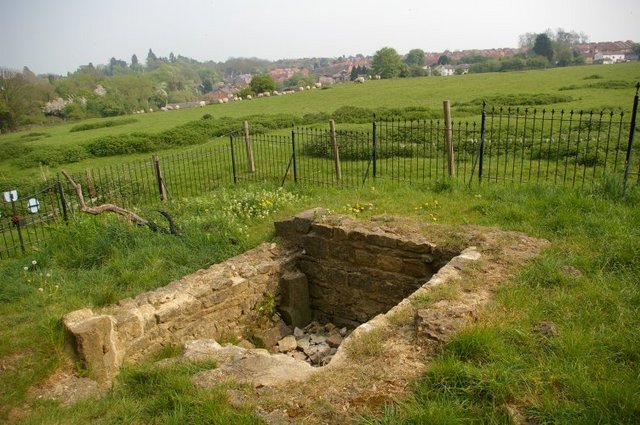
St Rumwold's Well, Buckinghamshire
St Rumwold’s Well, Buckingham, by Fractal Angel [CC BY 2.0]

3rd November is the Feast Day of Rumwold, an Anglo-Saxon saint who is not well known. This may be because he only lived for 3 days.

According to Alban Butler:

“His father was king of Northumberland, his mother a daughter of Penda, king of the Mercians. He was born at Sutthun, and baptized by Widerin, a bishop, the holy priest Eadwold being his godfather. He died very young on the 3rd of November and was buried in Sutthun by Eadwold. The year following his remains were translated by Widelin to Brackley in Northamptonshire, and on the third year after his death to Buckingham where his shrine was much resorted to out of devotion. The 28th of August was celebrated at Brackley, probably the day of the translation of his relics.”

However, there was also an 11th century hagiography (Saint’s Life) about the child which provides more information.

The Vita S. Rumwold claims that he was born as the grandson of Penda and the son of a Northumbrian king, which is already difficult to square with the known facts. Ahlfrith of Northumbria did indeed marry Cyneburh, daughter of Penda, but he was King of Deira under his father Oswiu. When he disagreed with Oswiu he was replaced by his brother Ecgfrith.

The baby was miraculously able to speak from birth, repeating at least three times “I am a Christian”, demanding baptism and Holy Communion, and preaching to those around him about Wisdom and the Trinity. He then predicted his own death and finally instructed that he be laid to rest in Buckingham (after spending time at King’s Sutton or Brackley).

The Vita explains:

“in a pleasant field, filled with lilies and roses, the servants and soldiers eagerly spread out the camp and the tents, and soon the queen gave birth to the son longed for by many, and sanctified by God. When the baby was born, he immediately cried out with a loud voice: “I am a Christian, I am a Christian, I am a Christian!”. To this Widerin and Eadwald, two priests, responded: “Thanks be to God”. The child went on and said: “I worship God the three in one. I confess and adore the Father and the Son and the Holy Spirit”. The priests and parents and all who were present marvelled and began singing the ‘Te Deum Laudamus’. At the end of the hymn, the child asked to be made a catechumen by the priest Widerin, to be held aloft for the preliminary rite of the faith by Eadwald, and to be named Rumwold.”

It then describes his requirements for the care of his remains:

“Rumwold required that his body remain at his birth place for one year, and then at Brackley for two years and finally be taken to Buckingham where it should rest for all time.”

His feast day is recorded in 10th century liturgical calendars so was known by then, although he seems to disappear from most calendars after 1066, indicating a general lack of support for his cult.

He was also commemorated in Sweden, where he is mentioned in fragments of a 12th century missal and a breviary. It seems likely that the English missionary work in Sweden in the 11th century may have exported his story before it faded away in England, and the prayers probably therefore derive from English ones.

An 11th century list of saints’ resting places includes Rumwold:

“THonne resteth sancte Rumwold on thaere stowe, the is gehaten Buccyngaham, neah thare ea Usan“

“There rests saint Rumwold in the place that is called Buckingham, near the river Ouse“

Rumwold’s bones remained at Buckingham until the 16th century. He also had an altar dedicated to him at King’s Sutton (his birthplace), which was an important ecclesiastical centre in Anglo-Saxon times and also a royal vill.

The Vita ends:

“There and in many places, when invoked, St Rumwold bestows favours upon those who ask, giving sight to the blind, making the lame to walk, and granting deliverance to the sick weighed down by various ailments, with the consent of our Lord Jesus Christ Who, in the unity of the Trinity in the Trinity of unity, lives and is glorified as God, one with the omnipotent Father and the Holy Spirit, throughout infinite ages, AMEN.”

The 17th century antiquary, Thomas Fuller, who researched the story of Rumwold, said at the end:

“Reader, I partly guess by my own temper, how thine is affected with the reading thereof, whose soul is much divided betwixt several actions at once:

1 To frown at the impudency of the first inventors of …

2 To smile at the simplicity of believers in …

3 To sigh at the well-intended devotion abused by …

… such improbable untruths

4 To thank God we live in times of better and brighter knowledge”

However, following the events of 1066 a number of Vitae were produced due to Norman disbelief in the stories they were told and this would tie in with the date of this Vita. In addition, by stressing the links between the various locations of the story, the Minster may have been trying to protect its income by asserting its spiritual authority. Finally the similarity of Rumwold’s story with that of a young Jesus at the Temple is unlikely to be coincidental. Medieval vitae were less concerned with “fact” and more with spiritual learning, which such stories could promote.

Death of Clarus, 4th November 894
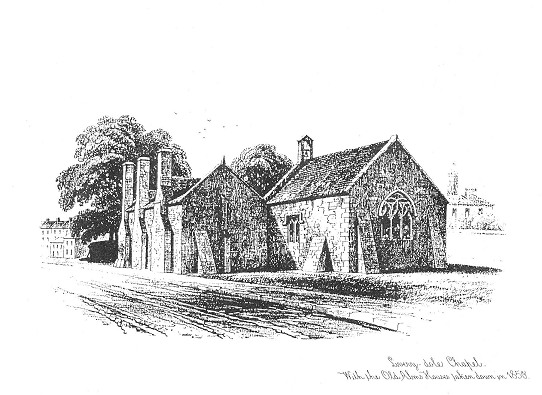
The Old Livery Dole, Exeter
Image: Livery Dole Chapel with the old alms-houses taken down in 1850. Picture from W. Spreat of Exeter [Public domain]

The British priest Clarus was martyred on 4th November 894 AD.

According to a British Martyrology, from 1761:

“On November 4th 894 AD in the territory of Rouen in Normandy, the martyrdom of St. Clarus, a British priest, eminent for sanctity retiring into a wilderness, to avoid the solicitations of an unhappy woman, who was inflamed with an impure love for his person, was murdered by two ruffians, at her suggestion; and so fell a martyr of purity.”

Alban Butler expands a little:

“THIS saint was an Englishman by birth, of very noble extraction, was ordained priest, and leaving his own country led many years an angelical life in the county of Vexin in France. He often preached the truths of salvation to the inhabitants, and died a martyr of chastity, being murdered by two ruffians, employed by an impious and lewd lady of quality, about the year 894. He is named in the Roman and Gallican Martyrologies, and honoured with singular veneration in the diocess of Rouen, Beauvais, and Paris. The village where he suffered martyrdom, situate upon the river Epte (which separates the Norman and French Vexins) nine leagues from Pontoise, and twelve from Rouen, bears his name, and is become a considerable town by the devotion of the people to this saint. His rich shrine is resorted to by crowds of pilgrims, who also visit a hermitage which stands upon the spot which was watered with his blood near the town. Another town in the diocess of Coutances in Normandy, which is said also to have been sanctified by his dwelling there before he retired to the Epte, is called by his name St. Clair.”

Although he was an Englishman based in France, there is a chapel dedicated to him in Exeter in the Livery Dole.

Feast Day of Birstan, 4th November

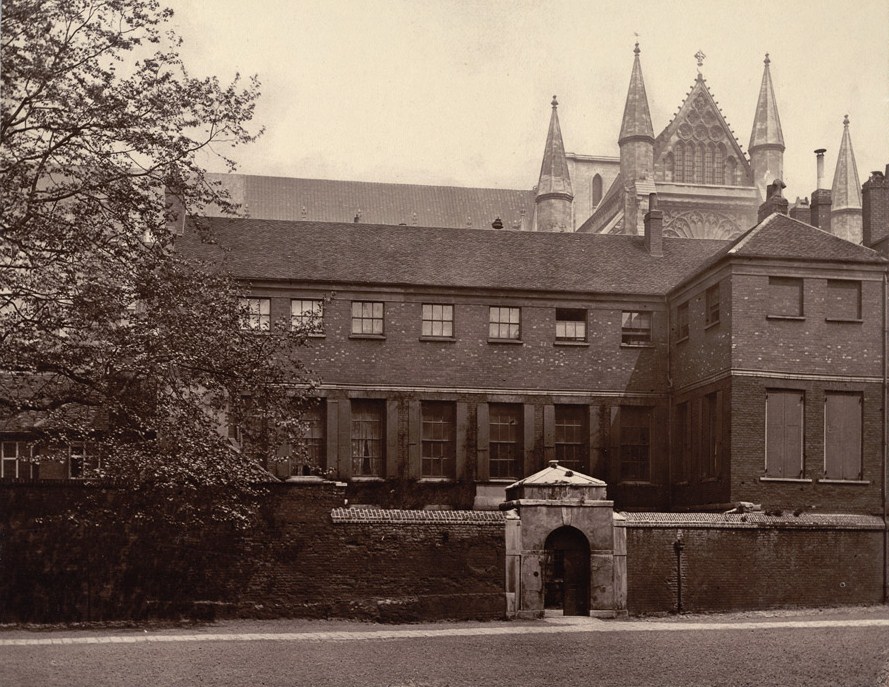
Winchester Cathedral
Winchester Cathedral, Author: Antony McCallum WyrdLight.com [CC BY 3.0]

4th November is the Feast Day of St Byrnstan (Birstan or Brinstan), the Bishop of Winchester from 931-934 AD.

He succeeded Frithestan as Bishop, as Alban Butler tells us:

“He was raised for his eminent sanctity to that see in 931, on the resignation of the pious bishop Frithestan, who died the following year. It was his daily custom to wash the feet of a number of poor whom he served at table; he also every day said mass, and at night repeated the psalms for the faithful departed. He died the 4th of Nov. 934.”

Prior to his elevation to the bishopric, Byrnstan was a mass priest in the household of King Athelstan and was put in place of Frithestan who had been a critic of the king. Frithestan meanwhile lived another year.

Byrnstan may have founded St. John’s Hospital in Winchester but other than a reputation for piety little is known about him beyond the fact that he continued to witness the king’s charters. He died on 1st November, according to the Anglo-Saxon Chronicle although his feast day is 4th November.

His rise in popularity was really due to the promotion of his cult by Athelwold in the 10th century following a vision in which he appeared to his successor and declared:

“I am Birstan, former Bishop of this town” and pointing with his right hand, “This is Birinus, who first preached here,” and with his left, “This is Swithun, particular patron of this church and city”.

Byrnstan was clearly unhappy at his lack of recognition in the city and Athelwold duly reinstated the veneration of the saint as an equal to the other two.

Feast Day of Leonard, 6th November

Ruins in Museum Gardens, York
Museum Gardens, York (c) PWicks 2014

6th November is the Feast Day of St Leonard of Limoges (or Noblac), a Frankish saint with a slight connection to York.

Leonard was born to noble Frankish parents in the 5th century at the court of King Clovis I (466-511 AD), who also acted as his sponsor at his baptism. He and his brother Liefhard studied at Miscy under Maximus; eventually Liefhard left to establish a monastery while Leonard went to Limoges and settled into a hermit’s life in the nearby forest.

The forest was sometimes used by the king for hunting and during one such hunt the queen, who was staying with the king at the nearby royal residence, went into labour with their child. She had great difficulty with the birth and Leonard was able to ensure the safe delivery of the baby. The king rewarded him by giving him as much of the forest as he could ride around in one night. Kings should really know better where saints are concerned! Leonard was duly grateful and founded a monastery there, called Noblac in recognition of the nobility of the gift. He ruled the community there until his death.

Leonard is the patron saint of prisoners, as he is said to have obtained permission for the release of every prisoner whom he visited whom he judged capable of benefitting from release.  It is said that prisoners who invoked him from their cells saw their chains break before their eyes. Many came to him afterwards, and he often gave them land to clear and farm, so that they could live honestly.

He turned down the offer of a bishopric, preferring a more reclusive life.

He died in 559 AD.

A Vita (Life) was written in the early 11th century and his veneration became popular in the 12th century, so his story was really only promoted at the very end of the Anglo-Saxon period.

He is associated with York through the 12th century hospital dedicated to him in the city. This was an Augustinian foundation and the ruins can still be seen today in Museum Gardens. It was one of the largest and richest hospitals in England caring for the poor, the sick, orphans and the old. It cared for over 200 people at a time providing food, clothes, medicine and spiritual care.

Death of Willibrord, 7th November 739
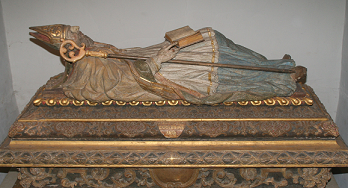
Willibrord's Sarcophagus
Willibrord’s Sarcophagus, Cornischong, CC-SA 3.0

7th November is the Feast Day of Willibrord, who was a saint and evangelist.

He was born around 658 AD in Northumberland and sent to the monastery in Ripon under Wilfrid at the age of seven, a not uncommon practice for those boys destined for the church.

When he was 20 he went to Ireland to study at Rath Melsigi, which was a renowned centre of learning, and in 690 AD Abbot Ecgberht approved him to lead a mission to convert the Frisians. Another priest, Wigbert, had previously gone to Frisia but had to return to Ireland after a couple of years having failed to convince the population of the benefits of Christianity. Willibrord therefore set out with Swidbert and ten other English monks on his mission.

The Anglo-Saxon drive to convert other people was based in part on the genuine desire to save souls from damnation, as they understood it. However, they were particularly concerned to convert the Frisians because they saw them as among their ancestral kin.

Willibrord was consecrated by the Pope as archbishop of the Frisians in 695 AD and was based at Utrecht. However it was a difficult time in that part of Europe as the Frisians were fighting the Franks under Charlemagne. Willibrord had to retreat to Echternacht (now in Luxembourg) on more than one occasion. He was given land there by Abbess Irmina who was the mother-in-law of King Pepin II (of Herstal), after he helped save her nunnery from plague by blessing the water and saying mass in the church. Between 704-706 AD he built a larger monastery there which included a scriptorium. This became the production site of the Echternacht Gospels, and was one of the most important scriptoria in Frankia.

The life of the missionary in Frisia was fraught with danger. For example, Bede relates the story of two missionaries, both called Hewald, were killed by the Frisians.

King Pepin died in 714 AD and in 716 AD Radbod, king of the Frisians and still a pagan, drove Willibrord and his companions out of Frisia.

Alban Butler tells us of an event during Radbod’s reign:

“In his return [Willbrord returning from Denmark where he had also been preaching] he was driven by stress of weather upon the famous pagan island, called Fositeland, now Amelandt, on the coast of Friesland, six leagues from Leuwarden, to the north, a place then esteemed by the Danes and Frisons as most sacred in honour of the idol Fosite. It was looked upon as an unpardonable sacrilege, for any one to kill any living creature in that island, to eat of any thing that grew in it, or to draw water out of a spring there without observing the strictest silence. St. Willibrord, to undeceive the inhabitants, killed some of the beasts for his companions to eat, and baptized three persons in the fountain, pronouncing the words aloud. The idolaters expected to see them run mad or drop down dead: and seeing no such judgment befal them, could not determine whether this was to be attributed to the patience of their god, or to his want of power. They informed Radbod, who, transported with rage, ordered lots to be cast three times a day, for three days together, and the fate of the delinquents to be determined by them. God so directed it that the lot never fell upon Willibrord; but one of his company was sacrificed to the superstition of the people, and died a martyr for Jesus Christ.”

Willibrord was only able to return following Radbod’s death in 719 AD, supported by Charles Martel, who was Pepin’s son and successor. This was the period when Boniface also worked alongside him for three years before moving on to preach in Germania.

Alcuin wrote about Willibrord and a number of his miracles. He also described him as follows:

“Now this holy man was distinguished by every kind of natural quality: he was of middle height, dignified mien, comely of face, cheerful in spirit, wise in counsel, pleasing in speech, grave in character and energetic in everything he undertook for God.”

Willibrord died on 7th November 739 AD, at the age of 81, before the mission could be said to have fully succeeded; that was left to Boniface who took a more aggressive approach to conversion with the support of Charles Martel. Alcuin describes Willibrord’s funeral, which had a hitch, resolved by another miracle:

“His venerable body was laid to rest in a marble sarcophagus, which at first was found to be six inches too short to hold the entire body of God’s servant. The brethren were greatly concerned at this, and, being at a loss to know what to do, they discussed the matter again and again, wondering where they could find a suitable resting­place for his sacred remains. Wonderful to relate, however, through the loving­kindness of God the sarcophagus was suddenly discovered to be as much longer than the holy man’s body as previously it had been shorter. Therein they laid the remains of the man of God, and to the accompaniment of hymns and psalms and every token of respect it was interred in the church of the monastery which he had built and dedicated in honour of the Blessed Trinity. A sweet and marvellous fragrance filled the air, so that all were conscious that the ministry of angels had been present at the last rites of the holy man.”

Further miracles of healing were then recorded at his tomb, along with a never-empty flagon of wine.

Discovery of the Trewhiddle Hoard, 8th November 1774
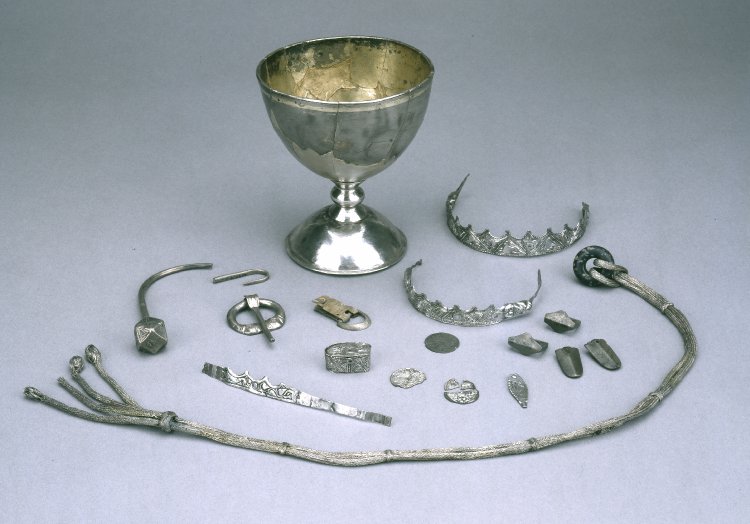
Trewhiddle Hoard items
Trewhiddle Hoard items, ©Trustees of the British Museum [CC BY-SA 4.0]

On 8th November 1774 some Cornish tin miners at Trewhiddle made an important discovery. They uncovered a large number of Anglo-Saxon coins, a silver chalice and other precious objects. The coins were of Mercian and Wessex origin and dated the find to around 868-878 AD. This date is significant in that it represents the period of the Viking incursions, around the time Alfred came to the throne following the death of his brother Athelred in 871 AD after the Battle of Merton. It is therefore supposed that the hoard was buried to protect it from the Vikings.

The items were described in some detail by Jonathan Rashleigh, in “The Numismatic Chronicle and Journal of the Numismatic Society” in 1868. He was the great-nephew of Philip Rashleigh, the local squire and Fellow of the Royal Society who first collected them from the miners and published an account in 1778. Of the coins, 114 were retrieved from the workmen but some were dispersed later. The other items included:

“The ornaments consisted of two gold objects (since lost), one of them having been a circular pendent ornament, enriched with filagree; a silver chalice-shaped cup, broken into several pieces, the hollow of the bowl having suffered much from oxidation; a silver cord (considered to have been a “disciplinarium”) of curious twisted workmanship, terminating in four nobbed lashes, like a scourge, at one end, whilst the other end is looped and rove through a dark mottled amulet of glass; a penannular brooch; the tip of a belt; buckles; richly chased bands, supposed to have been bracelets; a long curved pin, the head of which is curiously fashioned with fourteen facets chased in various ornamental patterns, and partly nielloed. Of the above ornaments, all of which are of a rare period, articles are conspicuous, viz,, the silver cup and the silver “disciplinarium”.”

The find gave rise to the identification of a “style” known as Trewhiddle. It is characterised by small fields, or cartouches, usually with beaded frames, containing lively animals, foliage and geometric designs. The background is often inlaid with niello. The designs are usually found on silver items which contrast sharply with the black niello inlay. It was a very popular style and can be found from Cornwall to Northumbria after the 820s. Other examples come from Pentney in Norfolk on disc brooches.

Pentney Hoard brooches
Pentney Hoard brooches, Trewhiddle style. ©Trustees of the British Museum [CC BY-SA 4.0]

It seems to have been derived from a Mercian animal style but was popular especially with Wessex royalty, of which the finger rings of King Athelwulf and his daughter Athelswith are well known examples. These rings were probably given to their retainers as badges of the household, rather than being worn by the named royals. They also show links to Carolingian designs dating to the time of Charlemagne depicting peacocks drinking from the Fountain of Life. Further examples of the style have been found on the Continent, such as a ring at Bologna, indicating the regularity of journeys to and from Rome and beyond, on pilgrimage or for trade.

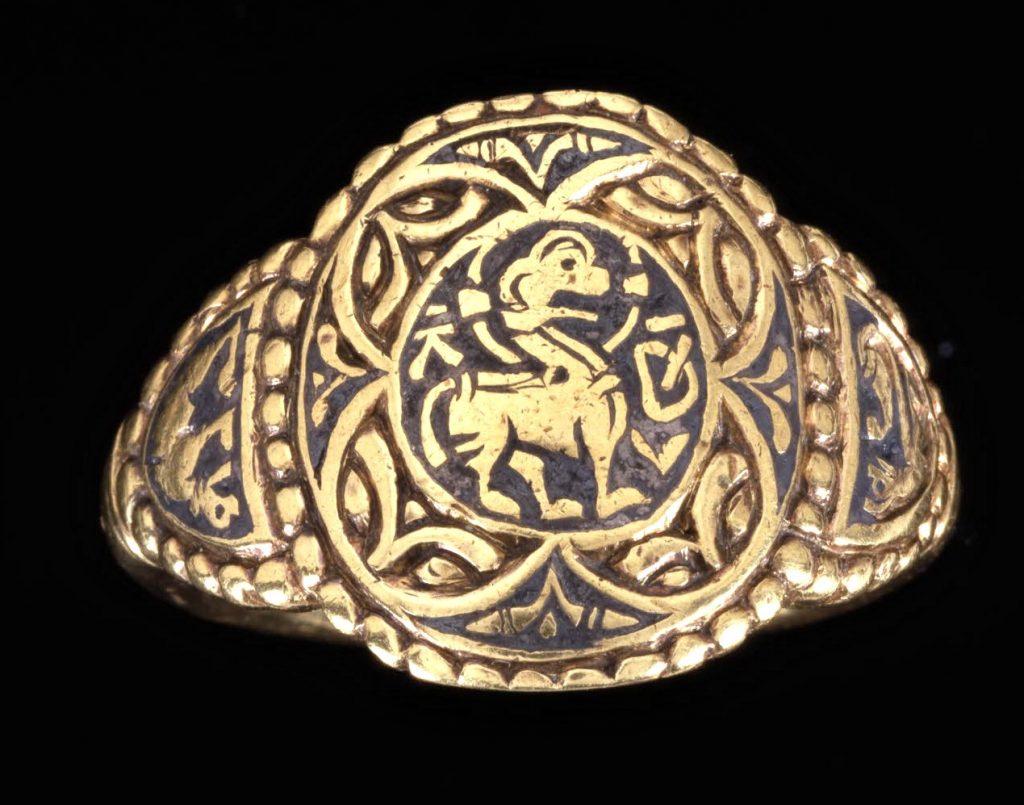
Athelwulf Ring
Athelwulf Ring, Anglo-Saxon, Trewhiddle style, ©Trustees of the British Museum [CC BY-SA 4.0]
Athelswith Ring
Athelswith Ring, Anglo-Saxon, Trewhiddle style, ©Trustees of the British Museum [CC BY-SA 4.0]

In his article Jonathan Rashleigh also included a list of the coins and his conclusion on the dating of the hoard.

“The following is a list of the kings, with the number their coins found at Trewhiddle: –

A.D. 757-796. Offa of Mercia (1)

796 – 818. Coenvulf, ditto (2)

820 – 824. Beornvulf, ditto (1)

839-852. Berhtulf, ditto (10)

852 – 874. Burgred, ditto (45)

874 Ciolvulf, ditto (1)

808 – 840. Eanred of Northumberland – silver penny (unique)  (1)

830 – 870. Ceolnoth, Archbishop (6)

800 – 837. Ecgbeorht, sole monarch (3)

887-857. Ethelvulf, ditto (10)

867 – 872. Ethelred, ditto (2)

872-901. Alfred, ditto (2)

814 – 840. Louis le Debonaire of France (1)

Other Saxon pennies never described, about 29

Total 114

Thus, the latest commencement of a reign, amongst these kings, is that of Ciolvulf, AD 874; so that the coins must have been secreted after that date. But as there are but two coins of Alfred, who commenced his reign in AD 872, and who reigned until a later period than any of the other kings whose coins were found at Trewhiddle, it is probable that the treasure was buried about AD 876-7, or early in King Alfred’s reign.”

He then compared them to the coins from other hoards, including Cuerdale and York, as evidence of the spread of a centralised currency issued by “sole monarchs”.

Feast Day of Justus, Archbishop of Canterbury, 10th November

Gravestones of Mellitus, Justus, and Laurence at Canterbury
Gravestones of Mellitus, Justus, and Laurence at Canterbury by Ealdgyth [CC BY-SA 3.0]

Justus, the fourth Archbishop of Canterbury, died on 10th November around 627 AD.

He had been sent to Britain by the Pope, Gregory the Great, in 601 AD to support Augustine’s earlier mission which had finally arrived in 597 AD. He became the first Bishop of Rochester in 604 AD, being consecrated by Augustine, and was present at the Council of Paris in 614 AD.

However, after the deaths of the Christian kings Athelberht of Kent and Saebert of Essex, both in 616 AD, there was a pagan resurgence led by their sons. Justus fled to Frankia with Bishop Mellitus until it was safe to return. The three sons of Saebert were duly killed in battle against the Gewisse (West Saxons). Athelberht’s son, Eadbald, was converted by Laurence, the Archbishop who remained in Canterbury. Laurence then recalled Justus and Mellitus from Frankia, a year after they had fled.

Justus was able to return to Rochester but Mellitus was less fortunate and was not welcomed back to his See at London. King Eadbald was not strong enough to enforce his return.

Justus became Archbishop of Canterbury in 624 AD and served until his death. He was the Archbishop who consecrated Paulinus in 625 AD before he went to Deira (Yorkshire) with the princess Athelburh who was to marry Edwin. Bede tells us:

“Hereupon the virgin [Athelburh] was promised, and sent to Edwin, and pursuant to what had been agreed on, Paulinus, a man beloved of God, was ordained bishop, to go with her, and by daily exhortations, and celebrating the heavenly mysteries, to confirm her and her company, lest they should be corrupted by the company of the pagans. Paulinus was ordained bishop by the Archbishop Justus, on the 21st day of July, in the year of our Lord 625, and so he came to King Edwin with the aforesaid virgin as a companion of their union in the flesh.”

When Justus died, Paulinus as Bishop of York was able to consecrate his successor Honorius, which he did at Lincoln, according to Bede, although technically this was  not proper ecclesiastical procedure.

“IN the meantime, Archbishop Justus was taken up to the heavenly kingdom, on the 10th of November, and Honorius, who was elected to the see in his stead, came to Paulinus to be ordained, and meeting him at Lincoln was there consecrated the fifth prelate of the Church of Canterbury from Augustine. To him also the aforesaid Pope Honorius sent the pall, and a letter, wherein he ordains the same that he had before established in his epistle to King Edwin, viz. that when either of the bishops of Canterbury or of York shall depart this life, the survivor of the same degree shall have power to ordain a priest in the room of him that is departed; that it might not be necessary always to travel to Rome, at so great a distance by sea and land, to ordain an archbishop.”

Edward’s Burh at Hertford, 11th November 912
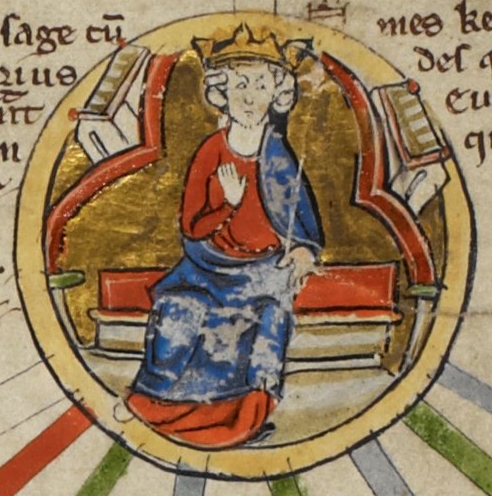
Edward the Elder in 13th century genealogy
Edward the Elder in 13th century genealogy, (c) British Library Royal MS 14 B V

On 11th November 912 AD Edward the Elder was at the burh (fortification) at Hertford on the southern bank of the River Lea, which he expanded and refortified. The burh had originally been built by his father Alfred in 895 AD, and is now believed to be under the later Norman castle.

This was the time during which Edward and his sister Athelflaed were expanding their father’s original series of burhs to reclaim territory taken by the Scandinavians. Between 910 and 918 AD the brother and sister instigated a campaign of building and aggression against the Scandinavian-led territories (later called the Danelaw).

At this stage Athelflaed had built or strengthened burhs at Bremesburh (probably Bromsberrow near Ledbury), Sceargeat (unknown) and Bridgnorth in the west. Hertford was the first of Edward’s refortifications in the campaign and within months he had added a second burh at Hertford on the north bank of the river. The Anglo-Saxon Chronicle year is dated from the September of 912 AD, so Martinmass in November fell in 912 AD (as we would date it) and the later events in 913 AD:

“AD 913. In this year, about Martinmas, king Edward commanded the northern fortress to be built at Hertford, between the Memera, the Benefica, and the Lea. And then after that, during the summer, between Rogation-days [3d May], and midsummer, king Edward went with some of his auxiliaries to Maldon in Essex, and there encamped, whilst the fortress at Witham was wrought and built; and a good part of the people who were before under the dominion of the Danish-men submitted to him: and in the meanwhile some part of his assistants constructed the fortress at Hertford, on the south side of the Lea. This year, by the help of God, Aethelfled, lady of the Mercians, went with all the Mercians to Tamworth, and there built the fortress early in the summer; and after this, before Lammas [1st.], that at Stafford.”

The rivers at Hertford flow to the north and the west of the town. The double fortification at Hertford would have protected London from any forces coming south from the central Danelaw area. At this stage the region of Essex appears to have submitted to Edward, making that border more secure as well.

Edward was able to move on to his next goal by April, but the logistics of the campaign require recognition. He and his sister were able to command and deploy resources to build the fortifications, protect them during the building phase, and garrison the resulting burh before moving on to the next target. This would have also required provisions for the men and animals involved without denuding the surrounding area of food or fodder, as well as providing space for accommodating the body of men and preventing crippling outbreaks of disease from medium to long-term encampments.

After Hertford Edward moved on to Witham; then in 914 AD to Buckingham; in 915 AD Bedford; in 916 AD to Maldon; in 917 AD to Towcester, Wigingamere (possibly Leighton Buzzard), Tempsford, Towcester, Huntindon and Colchester; and then in 918 AD, the year in which Athelflaed died, Stamford and Nottingham (north bank); in 919 AD at Thelwall and Manchester; in 920 AD Nottingham (south bank) and Bakewell; finally in 921 AD Cledemutha (probably Rhuddlan).

While 913 AD saw the submission of Essex in the Danelaw but there was a reaction from elsewhere as the leaders of the Danelaw realised the English were building up for an assault:

“After Easter [17th April], a pagan army from Northampton and Leogereceastre [Leicester], went plundering in the province of Oxford, and slew very many people in the king’s vill of Hokenertune, and in many other vills. Shortly after that one returned home, they equipped another composed of cavalry, and sent it towards Ligetun [Leighton ?] in the province of Hertford. But the natives assembled in force to resist them, and after slaying many of them and putting the rest to flight, captured some horses and the greater part of their arms, and re-captured the booty which they had taken. Leaving a portion of the army to build a city on the south side of the river Lige [Lea], king Eadward marched, after the rogations [23d May], with the greater part of it into East Saxony, and encamped at Mealdune: he remained there until a city was built at Witham and fortified ; and a great number of the people there, who were in subjection to the pagans, submitted themselves and all their property to him.”

Edward is less well-known than his father and often overshadowed by his son, Athelstan, whose success at Brunanburh in 937 AD is quoted as the time when England was united (although of course he was never actually crowned as King of England – that honour went first to Edgar). Nevertheless earlier chroniclers recognised his achievements in setting the stage for what followed.

William of Malmesbury says that:

“he [Edward] was much inferior to his father in literature, but greatly excelled in extent of power. For Alfred, indeed, united the two kingdoms of the Mercian and West Saxons, holding that of the Mercians only nominally, as he had assigned it to prince Ethelred: but at his death Edward first brought the Mercians altogether under his power, next, the West and East Angles, and Northumbrians, who had become one nation with the Danes; the Scots, who inhabit the northern part of the island; and all the Britons, whom we call Welsh, after perpetual battles, in which he was always successful. He devised a mode of frustrating the incursions of the Danes; for he repaired many ancient cities, or built new ones, in places calculated for his purpose, and filled them with a military force, to protect the inhabitants and repel the enemy. Nor was his design unsuccessful; for the inhabitants became so extremely valorous in these contests, that if they heard of an enemy approaching, they rushed out to give them battle, even without consulting the king or his generals, and constantly surpassed them, both in number and in warlike skill. Thus the enemy became an object of contempt to the soldiery and of derision to the king.”

Edward has no statues or popular stories, but he did the hard work needed to help his successors take control of what later became England. It is unlikely he had a vision of England as we would understand it, but nevertheless he contributed to its eventual emergence.

Death of King Cnut, 12th November 1035

King Cnut and Queen Emma presenting a cross to the altar of New Minster, Winchester
King Cnut and Queen Emma presenting a cross to the altar of New Minster, Winchester, Stowe 944, f. 6 (c) British Library

On 12th November 1035 King Cnut died at Shaftesbury and was buried at Winchester Old Minster. He was succeeded in England by his son Harold Harefoot, while his other son, Harthacnut, took and fought to hold the throne of Denmark. 

According to the Knytlinga Saga:

“Knut was exceptionally tall and strong, and the handsomest of men, all except for his nose, that was thin, high-set, and rather hooked. He had a fair complexion none-the-less, and a fine, thick head of hair. His eyes were better than those of other men, both the handsomer and the keener of their sight.”

Cnut was the son of Sweyn Forkbeard, the Dane who was briefly King of England (by right of conquest), having finally driven out Athelred Unrede in 1013 after extorting tribute from him for a number of years.  However, Sweyn did not live long to enjoy the fruits of his victory and died in February 1014.

On Sweyn’s death the Danelaw came out in support of Cnut but the other English nobles recalled Athelred from Normandy where he was in exile. Athelred returned to England, and, in a pre-cursor to the events of Runnymede in 1215 when King John Lackland signed the Magna Carta, Athelred swore to be a better king and rule more justly. Cnut at this time was a young warrior, relatively untried as a leader of men, and despite his support in parts of the country he was driven out by the English until he returned in full force in 1015. He was much more effective in this later campaign and took most of the country, with the only meaningful resistance being brought by Edmund Ironside, son of Athelred.

After Athelred’s death in 1016 Edmund fought back even more vigorously against Cnut so that by November the two were brought to an agreement at Deerhurst to split the country between them. However, Edmund died soon after, possibly as a result of wounds but it is not known, and Cnut became sole ruler of England with his coronation taking place on Christmas Day. In 1017 the Anglo-Saxon Chronicle tells us:

“AD 1017. In this year king Cnut obtained the whole realm of the English race, and divided it into four parts: Wessex to himself, and East Anglia to Thurkyll, and Mercia to Eadric, and Northumbria to Irke. And in this year was Eadric the ealdorman slain in London, very justly, and Northman, son of Leofwine the ealdorman, and Aethelweard, son of Aethelmaer the great, and Brihtric, son of Aelfeh, in Devonshire. And king Cnut banished Eadwigthe etheling, and afterwards commanded him to be slain, and Eadwi, king of the churls. And then, before the kalends of August, the king commanded the relict of king Aethelred, Richard’s daughter, to be fetched for his wife, ‘that was Elfgive in English, Ymma in French.”

His wife, Emma of Normandy, was daughter of Richard of Normandy, widow of King Athelred Unrede and mother of Edward and Alfred. She and Cnut had two children of their own, Gunnhilda and Harthacnut. Cnut also had a “Danish” wife, Alfgifu of Northampton, with whom he had a son known as Harold Harefoot.

Cnut ruled from 1016-1035. He established the earldoms of England and although he initially controlled Wessex directly he eventually created the Earldom of Wessex which was given to Godwin, establishing that family’s rise to power. Cnut’s brother Harold was King of Denmark, and when he died in 1018 Cnut took the throne of Denmark as well as England. In Norway, Olaf had replaced Sweyn Forkbeard as king but in 1029 his nobles supported the invasion of Cnut and so Cnut became King of Norway as well.

England took up Cnut’s main attention and he placed Alfgifu and their son Harold as regents in Norway with disastrous consequences. Their rule was so unpopular that they were driven out by Magnus, the son of Olaf, in 1035; Magnus was only an eleven year old boy but he was proclaimed king by the Norwegian nobles in preference to Alfgifu and Harold.

Cnut worked with the church, particularly Bishop Wulfstan, to rule England according to English laws and customs from the time of King Edgar. He promoted men he trusted from the English ranks as well as Danish. In 1027 he was able to leave the kingdom securely while he travelled to Rome to witness the coronation of Conrad, the Holy Roman Emperor. While in Rome he negotiated fiercely for better terms for English merchants, pilgrims and churchmen. He wrote in a letter to his nobles:

“I spoke with the Emperor himself and the Lord Pope and the princes there about the needs of all people of my entire realm, both English and Danes, that a juster law and securer peace might be granted to them on the road to Rome and that they should not be straitened by so many barriers along the road, and harassed by unjust tolls; and the Emperor agreed and likewise King Robert who governs most of these same toll gates. And all the magnates confirmed by edict that my people, both merchants, and the others who travel to make their devotions, might go to Rome and return without being afflicted by barriers and toll collectors, in firm peace and secure in a just law.”

Henry of Huntingdon, writing in the 12th century, records a summary of his reign including the curious story of the King Cnut and the Tide:

“A few words must be devoted to the power of this king. Before him there had never been in England a king of such great authority, He was lord of all Denmark, of all England, of all Norway, and also of Scotland. In addition to the many wars in which he was most particularly illustrious, he performed three fine and magnificent deeds. The first is that he gave his daughter in marriage to the Roman emperor, with indescribably riches. The second, that on his journey to Rome, he had the evil taxes that were levied on the road that goes through France, called tolls or passage tax, reduced by half at his own expense. The third, that when he was at the height of his ascendancy, he ordered his chair to be placed on the sea-shore as the tide was coming in. The he said to the rising tide, “You are subject to me, as the land on which I am sitting is mine, and no one has resisted my overlordship with impunity. I command you, therefore, not to rise onto my land, nor to presume to wet the clothing or limbs of your master.” But the sea came up as usual, and disrespectfully drenched the king’s feet and shins. So jumping back, the king cried, “Let all the world know that the power of kings is empty and worthless, and there is no king worthy of the name save Him by whose will heaven, earth and sea obey eternal laws.” Thereafter King Cnut never wore the golden crown, but placed it on the image of the crucified Lord, in eternal praise of God the great king. By whose mercy may the soul of King Cnut enjoy rest.”

Cnut was buried at the Old Minster in Winchester, which he and Queen Emma had richly endowed, and his bones were translated to a mortuary chest when the cathedral was rebuilt. In the English Civil War (17th century) his bones were scattered and trampled with others by soldiers, and only later collected and placed back in the mortuary chests, although in a muddled fashion with the other victims of the desecration.

Wasting of Worcester, 12th November 1041
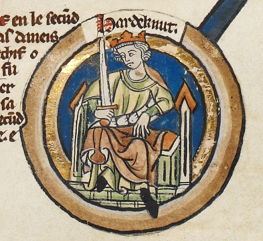
Harthacnut from a Royal Genealogy, 14th century
Harthacnut from a Royal Genealogy, 14th century © British Library  

On 12th November 1041 King Harthacnut laid waste to Worcester after the murder of his tax collectors on 4th May in that city. They had been killed when attempting to collect the hated heregeld or tax that Harthacnut imposed on coming to the throne.

John of Worcester records the year in detail:

“AD 1041: This year Hardicanute, king of England, sent his huscarls through all the provinces of his kingdom to collect the tribute which he had imposed. Two of them, Feader and Thurstan, were slain on the 4th of the ides [the 4th] of May, by the citizens of Worcester and the people of that neighbourhood, in an upper chamber of the abbey-tower, where they had concealed themselves during a tumult. This so incensed the king, that to avenge their deaths he sent Thorold, earl of Middlesex, Leofric, earl of Mercia, Godwin, earl of Wessex, Siward, earl of Northumbria, Roni, earl of Hereford, and all the other English earls, with almost all his huscarls, and a large body of troops, to Worcester, where Alfric was still bishop, with orders to put to death all the inhabitants they could find, to plunder and burn the city, and lay waste the whole province. They arrived there on the second of the ides [the 12th] of November, and beginning their work of  destruction through the city and province continued it for four days ; but very few of the citizens or provincials were taken or slain, because, having notice of their coming, the people fled in all directions. A great number of the citizens took refuge in a small island, called Beverege, situated in the middle of the river Severn, and having fortified it, defended themselves so stoutly against their enemies that they obtained terms of peace, and were allowed free liberty to return home. On the fifth day, the city having been burnt, every one marched off loaded with plunder, and the king’s wrath was satisfied. Soon afterwards, Edward, son of Ethelred the late king of England, came over from Normandy, where he had been an exile many years, and being honourably received by his brother, king Hardicanute, remained at his court.”

Leofric of Mercia, one of the earls sent to Worcester, would have had some concerns. He had supported Harthacnut’s brother Harold Harefoot previously, although he had remained in his seat following Harold’s death. In addition Worcester was the cathedral city of his people and so presumably close to his heart. It had been fortified in Alfred’s burh-building programme under Bishop Waerfrith and became a centre of church learning and influence. Oswald of Worcester had been a key figure in the Church reform movement in the later 10th century along with Athelwold and Dunstan. However, in 1041 the Bishop was Alfric Puttoc (Hawk), a supporter of King Harthacnut, and in fact one of the men who was instructed by him to find King Harold Harefoot’s body, disinter it and throw it in the sewer. In 1040 Alfric had also been the accuser of Earl Godwin and Bishop Lyfing, the then Bishop of Worcester, in the murder of Alfred Atheling; as a result Lyfing lost his Bishopric and Alfric took over. Lyfing however made his peace with Harthacnut and was reinstated in 1041 after the ravaging of the city.

Leofric was a man who gave a great deal of money to the church and Worcester was among the recipients.

Harthacnut died the following year at a wedding feast and Edward the Confessor took the throne.

St Brice’s Day Massacre, 13th November 1002

Christ Church Oxford
Christ Church Oxford, now in the site of the original nunnery, by Peter Trimming CC BY-SA 2.0

The St Brice’s Day Massacre took place on 13th November 1002.

Earlier in the year King Athelred had made a truce with the Danes by agreeing a payment of tribute of 24,000 lbs of silver. It was also the year in which he married Emma of Normandy and translated the bones of Oswald, Archbishop of York to a new shrine. He had to appoint a new archbishop later in the year. Then, according to the Anglo-Saxon Chronicle entry for 1002:

“Moreover, in this year king Athelred ordered all the Danes who were in England, both great and small, of either sex, to be slain, inasmuch as they had endeavoured to deprive him and his nobles of their lives and kingdom, and to get possession of the whole realm of England.”

Henry of Huntingdon, writing in the 12th century, expanded on the Chronicle’s account:

“In the year 1002, Emma, the jewel of the Normans, came to England and received the crown and title of queen. With her arrival, King Athelred’s pride increased and his faithlessness grew: in a treacherous plot, he ordered all the Danes who were living peacefully in England to be put to death on the same day, namely the Feast of St Brice. Concerning this crime, in my childhood [Henry was born c.1088] I heard very old men say that the king had sent secret letters to every city, according to which the English either maimed all the unsuspecting Danes on the same day and hour with their swords, or, suddenly, at the same moment, captured them and destroyed them by fire.”

It is possible the Danes were in fact the remnants of the troops who had been paid off by the silver, but it is not clear. Similarly a story grew up, reported by William of Malmesbury, that Sweyn Forkbeard’s sister died in the massacre; however William’s account is so muddled it needs to be treated very cautiously as he ascribes her death to 1013 with the massacre following the murder of Archbishop Alfheah. It is however possible she was killed in 1002 as Sweyn did also invade in 1003 which would fit the chronology, but it is by no means certain.

There has been some debate as to whether or how the order was carried out; it would seem unlikely to have been followed in the former Danelaw region of England where many inhabitants had Danish heritage and there was no meaningful distinction between “English” and “Dane”. However, it seems that St Frideswide’s Church in Oxford, on the borders of the Danelaw, was burned to the ground when people took refuge inside. According to a charter of St Frideswide dating from 1004 AD Athelred refers to the incident when he grants the monastery a new title-deed:

“In the year of the incarnation of our Lord 1004, the second indiction, in the 25th year of my reign, by the ordering of God’s providence, I, Aethelred, governing the monarchy of all Albion, have made secure with a liberty of privilege by royal authority a certain monastery situated in the town which is called Oxford, where the body of the blessed Frideswide rests.  And I have restored the territories which belong to that monastery of Christ with the renewal of a new title-deed; and I will relate in a few words to all who look upon this document for what reason it was done.

For it is fully agreed that to all those dwelling in this country it will be well known that, since a decree was sent out by me with the counsel of my leading men and magnates, to the effect that all the Danes who had sprung up in this island, sprouting like cockles amongst the wheat, were to be destroyed by a most just extermination, and this decree was to be put into effect even as far as death; so those Danes who dwelt in the aforementioned town, striving to escape death, entered the sanctuary of Christ, having broken by force the doors and bolts, and resolved to make a refuge and defence for themselves there in against the people of the town and the suburbs. But when all the people in pursuit strove, forced by necessity, to drive them out, and could not, they set fire to the planks and burned, as it seems, this church with its ornaments and its books. Afterwards, with God’s aid, it was renewed by me and my subjects, and, as I have said above, it was strengthened in Christ’s name with the honour of a fresh privilege, along with the territories belonging to it, and endowed with every liberty, regarding royal exactions as well as ecclesiastical dues.”

The term “cockles amongst the wheat” is taken from a parable in the Bible in which a field of good seed is infested with cockles, or weeds, planted by an enemy. They are left to grow until harvest when the mature plants are easier to separate from the wheat and can be burned. In medieval times this was interpreted as a warning against sin which needed to be expunged.

Archaeology confirms that a community of Danes was living in the town and it is possible they had been singled out in the wake of the king’s order. Whether they were mercenaries who had settled, or traders, or simply a more identifiably Danish community is unknown.

In the records it is clear the decision was not randomly taken by the king, but made with the agreement of his advising council. This would have included well-known figures such as Alfric of Canterbury, Wulfstan of York, Athelmaer and Queen Emma, who attested a number of charters and decisions at this time.

Two archaeological discoveries have been tentatively linked to the massacre. In 2008, at Oxford, a mass grave at St John’s College was found. The skeletons were all male, mostly aged 16-25 and dumped in a ditch outside the town boundaries. All showed signs of injury at the time of death, most commonly blade wounds to the back which would fit an explanation in which they were attempting escape. Several had been burned. There were virtually no personal items among them, indicating they had been stripped. Dating is inconclusive and may have been earlier than 1002, but it is possible they do in fact date to this event

In 2009 a mass burial in Dorset contained men aged in their teens to twenties of whom at least 31 had come from Scandinavia and lived there until shortly before their death. They display trauma around the head and neck and there are no defensive wounds so they were probably executed. The dates for these skeletons are more securely in the period 980-1020 although Dorset saw a number of attacks in this period and the bodies may have been from a different incident in which a raiding party was captured and killed. However, the lack of other wounds implies they had not fought in self-defence beforehand leading to the possibility they were in fact caught unprepared in 1002.

Whether the skeletons were men killed in 1002 or in other related incidents of the years of Viking invasions we are reminded that such executions did occur.

However, the policy proved disastrous. In 1003 Sweyn Forkbeard descended on England and devastated the eastern coast.

Death of Emperor Justinian, 14th November 565

Mosaic of Justinian at San Vitale
Mosaic of Justinian at San Vitale, Ravenna, By Petar Milošević – Own work, CC BY-SA 4.0

The Emperor Justinian I “the Great” died on 14th November 565 AD. He was Emperor of the Eastern Roman Empire and immensely influential throughout Europe.

Firstly he was determined to reunite the two halves of the Roman Empire and promulgated a number of military campaigns and wars to achieve this as well as to expand Roman influence. Under his rule, General Belisarius defeated the Vandals in North Africa, then with his colleague General Narses and others he took Rome and much of Italy back from the Ostrogoths. Roman control of the Western Mediterranean was restored and with it, the vast income and wealth from an expanded Roman hegemony.

Justinian also oversaw the extension of Roman influence to the east where previously it had not reached, and engaged the Sassanid Empire.

He also rewrote the legal code, known as the “Corpus juris civilis” (Body of Civil Law) or the “Code of Justinian”. These influenced the canon law of the church in Rome and arguably the whole western legal tradition up to the present day. Much of it was draconian by modern standards and aimed at protecting the Christian church and outlawing paganism. However, in other areas it also established, for example, the distinction between “law” and “custom”.

Justinian was also a builder (or at least, he paid for buildings to be constructed). These include treasures such as the rebuilt Hagia Sophia and the completion of San Vitale in Ravenna, as well as underground cisterns to protect the water supply to Constantinople, a dam at Dara to prevent floods, and the Sangarius Bridge to secure military supply trains.

His reign also saw the flourishing of poets and historians such as Procopius and the establishment of centres of learning. He developed trade and made government administration more efficient as well as combating corruption.

His reign was marked by natural disasters: the Beirut earthquake, extreme weather conditions and perhaps most notably, plague. The latter became known as the Justinian Plague and spread across Europe over the 6th century killing millions at a time when people had been weakened by famine from the extreme weather events of 535-536 AD which may have been caused by volcanic eruptions in the tropics. It is the first documented outbreak of Bubonic Plague, reported by Procopius in 541 AD. As it spread it impacted the outcomes of wars and potentially was affected the British kingdoms at the time of the Anglo-Saxon arrivals, although this is more speculation than historic fact based on a reference in British sources to the “Yellow Plague of Rhos” around 547 AD. The plague continued to have sporadic outbreaks through the next 200-300 years but nothing so overwhelming was seen again until the Black Death in the 14th century.

Much of what we know about Justinian, and also his wife the Empress Theodora, was written by Procopius. However, even here there is doubt and ambiguity, more than simply caused by the usual distance between us in time and cultural perspectives. His “Wars” describe the military campaigns led by Belisarius; then the “Buildings” is a praise document to the emperor about his public building works. However, at the same time as this he wrote the “Secret History”, which is a bitter and disillusioned story about the corruption and immorality of the emperor, the empress, Belisarius and his wife.

Battle of Winwaed, 15th November 655
Stained glass window in the cloister of Worcester Cathedral, the death of Penda of Mercia
Stained glass window in the cloister of Worcester Cathedral, the death of Penda of Mercia, by Violetriga [CC BY-SA 3.0]

On 15th November 655 AD King Oswiu of Northumbria faced the army of Penda which outnumbered him 3:1. Penda of Mercia had killed King Edwin of Northumbria at Hatfield Chase in 633 AD and Oswiu’s brother King Oswald at Maserfield in 642 AD. Penda had had unrivalled military success for years, but Oswiu faced Penda’s opposing forces resolutely. The battle is known as the Battle of Winwaed.

The situation was complicated by the shifting allegiances of other key figures. Bede explains it as follows:

“he [Oswiu] gave battle with a very small army against superior forces: indeed, it is reported that the pagans had three times the number of men; for they had thirty legions, led on by most noted commanders. King Oswy and his son Alfrid met them with a very small army, as has been said, but confiding in the conduct of Christ; his other son, Egfrid, was then kept as hostage at the court of Queen Cynwise, in the province of the Mercians. King Oswald’s son Ethelwald, who ought to have assisted them, was on the enemy’s side, and led them on to fight against his country and uncle; though, during the battle, he withdrew, and awaited the event in a place of safety. The engagement beginning, the pagans were defeated, the thirty  commanders, and those who had come to his assistance were put to flight, and almost all of them slain; among whom was Ethelhere, brother and successor to Anna, king of the East Angles, who had been the occasion of the war, and who was now killed, with all his soldiers. The battle was fought near the river Vinwed, which then, with the great rains, had not only filled its channel, but overflowed its banks, so that many more were drowned in the flight than destroyed by the sword.”

The battle site is a matter for passionate debate but it is generally agreed that it was somewhere in the vicinity of Leeds in West Yorkshire. There is contradictory evidence that Oswiu had agreed tribute to Penda in return for peace; in one chronicle Penda accepted and shared out the treasure, and in another he rejected the offer. There is also a reference to Ecgfrith, Oswiu’s son, being a hostage; however that may have been part of a deal agreed in which hostages were provided.

The combined Northumbrian kingdom had split back into its constituent two kingdoms following Oswald’s death. Bede reported Œthelwald’s decision to stay out of the battle; he was the son of Oswald (so Oswiu’s nephew) and King of Deira at this time, and Oswiu, Oswald’s brother, was King of Bernicia. It is not clear whether the two men agreed to the split or were in opposition to one another, although Œthelwald’s alliance with Penda appears to indicate conflict. After the battle Oswiu installed his own son Alhfrith as King of Deira, although they also clashed, especially at the Synod of Whitby.

Penda was let down by another ally in the battle, Cadafael ap Cynfeddw of Gwynedd who had succeeded Cadwallon in 634 AD. He was later known, according to Nennius, as Cadafael Cadomedd, or “Battle-Seizer Battle-Shirker” because of his perceived cowardice.

Athelhere, son of Eni, was also the nephew of Raedwald of East Anglia. His brother (or possibly cousin) Ecgric had been killed by Penda when he had been King in around 636 AD. His second brother Anna then became king and was killed, again fighting Penda. The presence of Athelhere in Penda’s army suggests that he was Penda’s client king. Henry of Huntingdon tells us that:

“In this engagement the pagans were defeated and all the 30 commanders [with Penda] were slain; for the God of Battles was with his faithful people and broke the might of King Penda, and unnerved the boasted strength of his arm, and caused his proud heart to fail, so that his assaults were not as they were wont to be, and the arms of his enemies prevailed against them. He was struck with amazement at finding that his foes were now become to him what he had formerly been to them, and that he was to them what they had been to him. He who had shed the blood of others now suffered what he had inflicted on them, while the earth was watered with his blood, and the ground was sprinkled with his brains.”

Penda is known as the last pagan king of the Anglo-Saxons, and his death is often seen as the end of the pagan age in the Anglo-Saxon Kingdoms. However, the purpose of the battle was not religious, it was political. It was about power and control of kingdoms and people as can be seen by the mixture of loyalties within and between the armies.

Queen Emma loses her jewels, 16th November 1042

Emma of Normandy with her two young sons fleeing before the invasion of Sweyn Forkbeard
Emma of Normandy with her two young sons fleeing before the invasion of Sweyn Forkbeard (1013) © Cambridge University Library Ee.3.59 fol. 4r c. 1250

On 16th November 1042 Queen Emma’s son Edward (the Confessor) and his earls descended upon her at Winchester and took all of her gold, jewellery and precious things allegedly because of the way she had treated Edward as a boy. The Anglo-Saxon Chronicle tells us about the new king’s decision:

“AD 1043. This year was Edward consecrated king at Winchester on the first day of Easter [3d April]. And this year, fourteen days before Andrews-mass [16th Nov.], the king was advised to ride from Gloucester, and Leofric the earl, and Godwine the earl, and Sigwarth [Siward] the earl, with their followers, to Winchester, unawares upon the lady [Emma]; and they bereaved her of all the treasures which she possessed, they were not to be told, because before that she had been very hard with the king her son; inasmuch as she had done less for him than he would, before he was king, and also since: and they suffered her after that to remain therein.”

He then deposed Stigand, who had only that year been made Bishop of East Anglia, because of his closeness to Emma and seized all his lands as well. After which he married Earl Godwin’s daughter, Edith.

Meanwhile William of Malmesbury recognised some good in the queen mother:

“his mother had for a long time mocked at the needy state of her son, nor ever assisted him; transferring her hereditary hatred of the father to the child; for she had both loved Canute more when living, and more commended him when dead: besides, accumulating money by every method, she had hoarded it, regardless of the poor, to whom she would give nothing, for fear of diminishing her heap. Wherefore that which had been so unjustly gathered together, was not improperly taken away, that it might be of service to the poor, and replenish the king’s exchequer. Though much credit is to be attached to those who relate these circumstances, yet I find her to have been a religiously-disposed woman, and to have expended her property on ornaments for the church of Winchester, and probably upon others.”

This was also the year in which her son by Cnut, Harthacanut, had died and she had lost not only her wealth but also her power at court. Until this point she had probably been the richest and most powerful woman in England.

Emma died on 6th March 1052.

Death of Queen Margaret of Scotland, 16th November 1042

Margaret and Malcolm Canmore
Margaret and Malcolm Canmore, wife depicted on a frieze by the Victorian painter William Hole at Scottish National Gallery, Wikimedia Commons CC SA 3.0

Margaret of Scotland died on 16th November 1093.

Margaret was born around 1045 in Hungary and was the sister of Edgar the Atheling, the heir apparent to the English throne in 1066, and of Cristina. They had been in England a little over 10 years having returned in 1057 when their father Edward the Exile was invited by Edward the Confessor to return and secure the English succession. Unfortunately her father died of sickness almost immediately upon reaching England but the family remained at the English court and the children grew up with some expectation that Edgar might inherit the throne instead. This view was changed dramatically in 1066 when Edward the Confessor died and Harold Godwinson was chosen as king, Edgar being too young and inexperienced to take the throne at a time when England was under threat from invasion. However, following Harold’s death Edgar was proclaimed king by a number of the nobles although he was never crowned.

Following the coronation of the Norman Duke William, Edgar was taken to Normandy as a hostage and did not return until 1068. At this point the family fled to the Continent but were caught in storms and driven aground in Scotland, traditionally near North Queensferry. Simeon of Durham claims they spent the winter in Scotland but then places them back in York in 1070 after the Harrying of the North, when they once again fled. Meanwhile King Malcolm of Scotland was ravaging Northumbria.

Simeon of Durham tells us how they met:

“When he [Malcolm] was riding along the banks of the river, beholding from an eminence the cruel exploits of his men against the unhappy English, and feasting his mind and eyes with such a spectacle, it was told him that Edgar Atheling and his sisters, who were beautiful girls of the royal blood, and many other very rich persons, fugitives from their homes, lay with their ships in that harbour. When they came to him with terms of amity, he addressed them graciously, and he pledged himself to grant them and all their friends a residence in his kingdom as long as they chose.”

When they returned to Scotland Malcolm and Margaret were married, and she immediately had a positive influence on the rather rough and rowdy king:

“By her care and labour the king himself, laying aside the barbarity of his manners, became more gentle and civilized. Of her he begat six sons, Eadward, Eadmund, king Eadgar, king Alexander, Ethelred, and king David, and two daughters, Matilda queen of the English, and Mary, whom Eustace count of Bologne took in marriage.”

Margaret was very popular in Scotland, renowned for good works and charity, and pious, introducing religious reform to the church to bring it in line with continental practice. As well as establishing a monastery at Dunfermline, restoring Iona Abbey and interceding for English victims of Norman injustice, she set up ferries at Queensferry (hence the name) and North Berwick to ensure pilgrims could cross the Firth of Forth safely on their way to and from St Andrew’s in Fife.

Malcolm undertook several campaigns in support of Edgar’s claim to the throne of England but these were not successful. By 1093 he was attempting to negotiate with William Rufus for peace but not succeeding with that either. On 13th November the English and Scots met at the Battle of Alnwick and Malcolm and their eldest son Edward were killed fighting an army led by Robert de Mowbray.

On hearing the news, Margaret died of a broken heart.

“On hearing of his death, Margaret, queen of Scots, was afflicted with so great distress, that she at once fell into a severe illness; and without delay, summoning her priests, she went into the church, and having confessed her sins to them, she caused herself to be anointed with oil and strengthened by the heavenly viaticum, beseeching God with constant and most earnest prayers, that He would no longer allow her to continue in this miserable life. Nor were her prayers long unheard; for three days after the king’s death, she was freed from the fetters of the flesh, and passed, as we trust, to the joys of eternal salvation. For while she lived she had devoutly cultivated piety, justice, peace and charity. She was frequent in prayers, and kept under her body by watching and fasting; she endowed churches and monasteries; she loved and honoured the servants and handmaids of the Lord; she divided her bread to the hungry; clothed the naked; gave lodging, garments and food to all wanderers who came to her; and she loved God with her whole heart.”

Margaret and Malcolm had eight children, among them Edith (Matilda) who later married Henry I of England, William of Normandy’s son, providing a start towards the unification of the Norman and Anglo-Saxon houses. Three or four of Margaret’s surviving sons became kings of Scotland in turn: Edmund (evidence for his kingship is disputed), Edgar, Alexander and David. Her youngest son, David, honoured her memory by building St. Margaret’s Chapel at Edinburgh Castle on the spot where his mother died.

She was canonised in 1250 and on 19th June 1250, both her body and that of Malcolm were exhumed and removed to a magnificent shrine. Mary, Queen of Scots had St. Margaret’s head removed as a reliquary to Edinburgh Castle in the 16th century and in 1597 it was taken by a “gentleman” to Antwerp, then France when it was lost during the French Revolution.

Death of Abbess Hild, 17th November 680

Ellerburn Church, Dalby, North Yorkshire
Ellerburn Church, Dalby, North Yorkshire © PWicks

Abbess Hild died at Whitby on 17th November 680 AD at the age of 66.

Bede tells us that she had spent the first 33 of her years living “most nobly in the secular life” and then spent her remaining 33 years dedicated to God. Bede says:

“she was nobly born, being the daughter of Hereric, nephew to King Edwin, with which king she also embraced the faith and mysteries of Christ, at the preaching of Paulinus, the first bishop of the Northumbrians.”

She was born therefore around 616 AD to Hereric and Bregusuit, and was baptised perhaps at Easter 627 AD with King Edwin and a number of his relatives in York. Hereric was poisoned at the court of King Cerdic (or Ceretic) of Elmet. It is possible he had gone to Cerdic following the annexation of Deira by Athelfrith around 605 AD which saw the death of Aelle, Edwin’s father, and Edwin’s exile; Edwin later deposed Cerdic about 619 AD, possibly in retribution. Hereric’s relationship to Edwin is not known but he may have been a cousin, nephew or even unrecorded brother.

At the age of 33, Hild decided to enter the religious life and went first to East Anglia. Her sister Heresuid was the mother of the king there and had retired to a nunnery in France, and Hild intended to join her. However, after a year in East Anglia she was called by Bishop Aidan to Northumbria where she lived on the north side of the River Wear with a small number of companions.

After a year there she was then sent to a new monastery at Hartlepool (Hereteu), which had been established around 640 AD by Heiu, the first Northumbrian woman to become a nun. Hild took over the rule of the monastery and established a regular system as she had been taught by Aidan and others. King Oswiu entrusted his daughter Alfflaed to Hild’s care during this time. She was recognised for her wisdom and frequently visited by leading churchmen.

In 657 AD she established a foundation at Whitby (Streaneshalch) which she set up on the same principles as Hartlepool.

Bede continues:

“so that, after the example of the primitive church, no person was there rich, and none poor, all being in common to all, and none having any property. Her prudence was so great, that not only indifferent persons, but even kings and princes, as occasion offered, asked and received her advice; she obliged those who were under her direction to attend so much to reading of the Holy Scriptures, and to exercise themselves so much in works of justice, that many might be there found fit for ecclesiastical duties, and to serve at the altar.”

Five bishops were trained under her direction, including Wilfrid.

The Synod of Whitby, held in 664 AD, was convened to discuss a range of important church issues, including the decision to follow either the rule of Rome or the rule of the Irish church, and thus establish the correct way to calculate the date of Easter. Hilda presided over the conference, and was in favour of the Irish rule as was King Oswiu who convened the Synod. However, the final decision went to Rome following passionate argument by Wilfrid, her former protégé.

Another of Hild’s protégés was the poet Caedmon His story describes How he miraculously began to compose poetry on Biblical themes following a vision one night. He repeated his initial composition to Hild and she asked him to make another poem to test that his gift came from a holy source, and upon his successful composition, as Bede describes:

“the abbess, embracing the grace of God in the ‘man, instructed him to quit the secular habit, and take upon him the monastic life; which being accordingly done, she associated him to the rest of the brethren in her monastery, and ordered that he should be taught the whole series of sacred history. Thus Caedmon ‘ keeping in mind all he heard, and as it were chewing the cud, converted the same into most harmonious verse; and sweetly repeating the same, made his masters in their turn his hearers.”

After Hild’s death Eanflaed, King Edwin’s daughter and Oswiu’s widow, became Abbess of Whitby jointly with her own daughter Alfflaed.
Ammonites in Ellerburn Church
Ammonites in Ellerburn Church, © PWicks

A local legend says that when sea birds fly over Whitby Abbey they dip their wings in honour of Saint Hilda. Her symbol, the ammonite, can be seen in a number of locations around the area, such as Ellerburn Church in Dalby, North Yorkshire.

Death of Queen Elfrida, 17th November

Edward the Martyr is offered a cup of mead by Alfthryth at Corfe Castle
Edward the Martyr is offered a cup of mead by Alfthryth at Corfe Castle, by James William Edmund Doyle [Public domain]

17th November around the year 1000 AD saw the death of Elfrida (Alfthryth), the wife of King Edgar and mother of kings Edmund and Athelred.

She was born around the 940s to Ordgar, a wealthy nobleman in Wessex. Her brother Ordulf founded Tavistock Abbey. According to the later chronicler Gaimar, Elfrida was able to get her own way much of the time and was indulged by her father and she probably had a reasonable education and would have been prepared for a suitable marriage to one of the noble families of the period.

Her first husband was Athelwald, son of Athelstan Half-King of East Anglia. However, she was famous for her beauty and King Edgar was famous for having an eye for the ladies. The result was that Athelwald died and Elfrida ended up marrying Edgar. William of Malmesbury likes to tell a legend of considerable intrigue, although limited reliability:

“There was, in his time, one Athelwold, a nobleman of celebrity and one of his confidants. The king had commissioned him to visit Elfthrida, daughter of Ordgar, duke of Devonshire, (whose charms had so fascinated the eyes of some persons that they commended her to the king), and to offer her marriage, if her beauty were really equal to report. Hastening on his embassy, and finding everything consonant to general estimation, he concealed his mission from her parents and procured the damsel for himself. Returning to the king, he told a tale which made for his own purpose; that she was a girl nothing out of the common track of beauty, and by no means worthy such transcendent dignity. When Edgar’s heart was disengaged from this affair, and employed on other amours, some tattlers acquainted him, how completely Athelwold had duped him by his artifices. Paying him in his own coin, that is, returning him deceit for deceit, he showed the earl a fair countenance, and, as in a sportive manner, appointed a day when he would visit his far-famed lady. Terrified, almost to death, with this dreadful pleasantry, he hastened before to his wife, entreating that she would administer to his safety by attiring herself as unbecomingly as possible: then first disclosing the intention of such a proceeding.”

Rather than listen to her husband, Elfrida then so inflamed the king’s passion that he took Athelwald hunting and in the forest ran him through with a spear so he could marry the widow!

According to the Anglo-Saxon Chronicle, they married in 964 AD:

“Eadgar, the pacific king of the English, married Alftryth, daughter of Ordgar, ealdorman of Devonshire, after the death of her husband Aethelwold, the glorious ealdonnan of the East Angles; and had by her two sons, Eadmund and Aethelred. He had also previously by Ethelfleda the Fair, surnamed Ened, a son called Eadward, afterwards king and martyr; and by St. Wulfrith a daughter named Eadgith, one of God’s most pious virgins.”

When Edgar had his second coronation in 973 AD Elfrida was crowned alongside him as Queen of England; so not only was Edgar the first king crowned King of England, but she was its first Queen. She had probably also been crowned earlier when they were married as she was particularly keen to emphasise that her sons were the legitimate children of Edgar and made sure they appeared higher in the witness list on charters than his first son Edward.

Elfrida and Edgar were keen church reformers and Elfrida founded Wherwell Abbey where she later retired there until her death.

Her negative reputation comes from the murder of her step-son King Edward (the Martyr) at Corfe Castle when he visited her there in March 978 AD.  Her involvement is unclear and much evidence from chronicles can be assigned to misogynist monks, although that does not mean it is untrue.

Following Edward’s death she acted as regent while her son Athelred was in his minority until he came of age in 984 AD. After this she ceased to attend council meetings and went into obscurity until around 993 AD. Although little is known about what happened the parallels with the experiences of Emma, mother of Edward the Confessor, are too close to ignore; Edward had deprived his mother of her wealth because of the way she had treated him as a child (see 16th November). However, Elfrida then appeared again witnessing charters, although lower in the hierarchy, and appears to have spent time caring for Athelred’s children, as she was remembered specifically and fondly in the will of Athelstan Atheling who died in 1014. Her son the king was also reconciled to her judging by the grants of land made to her following her reappearance at court. Her reputation however remained forever blackened for some and the monks at Ely recorded in their chronicle that she was observed in practising witchcraft by their Abbot Byrhtnoth and she had him murdered to prevent him from betraying her secret.

She is recorded as dying at Wherwell on 17th November but not in which year. However, on the basis of other records it would have been between 999-1001 AD.

She lived a long life but died before her son’s reign fell completely apart. Her involvement in court affairs set an example for influential queens in future generations.

Death of Abbot Odo, 18th November 942

Benedictional of St Athelwold
Christ entering Jerusalem, Benedictional of St Athelwold, British Library MS 49598

18th November is the Feast Day of St Odo, Abbot of Cluny.

Odo was the son of Abbo, a Frankish knight and was at dedicated the church by his parent as a small child. However, his father removed him from the abbey when he was 16, having changed his mind, and Odo was introduced to the noble pastimes of hunting and hawking. The physical sporting life of a young nobleman did not suit him and he suffered from violent headaches and general weakness until he was 18. Convinced that the headaches were a punishment for his lapse in his church career, he was returned to study at the Abbey of St Martin at Tours.

He settled into a quieter, more studious life, including studying the classics such as Virgil, but following a dream which included a vase of serpents he gave up the secular literature and went to study philosophy in Paris under Remigius of Auxerre, who had opened the first public school there in 900 AD. One winter’s day in Paris he gave his warm fur coat to a beggar who was freezing on the street. Upon returning to his room he went to bed to get warm under the covers and discovered a gold coin there which was more than enough to buy himself a new coat to replace the one he had given away.

Remigius died in 908 AD and Odo probably returned to Tours at this time. Later he went to Bearme and was admitted by the Abbot Berno to become a monk.  Berno became head of the Abbey of Cluny in 910 AD and on his death in 927 AD was succeeded by Odo. There he ensured the Benedictine Rule was followed strictly, and according to some reports, more than a little harshly. In fact when the monks at Fleury heard he was coming to enforce the rule stating they should not eat meat, they took up arms to prevent him coming in.

Odo died on 18th November 942 AD.

Odo’s devotion to the Rule earned the Abbey protection and gifts from Popes and kings, so that it was secure and wealthy. The strictness of its adherence to the Rule made it the leader of monasticism in western Europe. The “Cluniac Reforms” spear-headed by Odo had a profound effect across Europe and in England, via Fleury. In the late 10th century under King Edgar, and led by Dunstan, Athelwold and Oswald, widespread reform was carried out mainly in the south and midlands of England, as the north was still not strongly controlled by the king despite the unification of the kingdoms of the English by 973 AD. The monastic reforms led to the expulsion of secular clergy from monasteries to be replaced by monks. This in turn resulted in high levels of scholarship and artistry, such as that of Athelwold’s Benedictional.

Death of Abbess Abbe, 19th November 694

Minster Abbey, on the Isle of Thanet
Minster Abbey, on the Isle of Thanet, Kent by Nick Smith [CC BY-SA 2.0]

On 19th November 694 AD Abbe (or Domne Eafe) of Minster-in-Thanet died. She founded the Abbey after she was granted the land within the bounds run by her tame doe.

Eormenred of Kent had a number of children including Athelred and Athelbert, Ermengitha and Ermenburga as well as Abbe. She was married to King Merewalh of the Magonsaete (in Mercia) and three of their daughters also became saints: Mildred, Milburga and Milgytha. During her reign it is supposed Abbe owned land which took her name as Abingdon.

However, not all of her family were saintly. Her cousin Egbert came to the throne of Kent in 664 AD after his father’s death on 14th July. He acted swiftly to secure his succession by murdering his cousins Athelred and Athelbert, Abbe’s brothers. The murder was badly received and the young men became the centre of a local cult. Egbert saw the error of his bloodthirsty ways and therefore approached Abbe to offer her the “weregild” or blood compensation for their deaths.

Abbe demanded land for a religious foundation. According to legend she asked for as much land as her tame doe could encircle in one day and so the doe was let out to run on the Isle of Thanet. She circled 48 ploughs of land and this was duly given to Abbe who built a monastery there which became known as Minster-in-Thanet. It became one of the richest and most important nunneries of England. It received land grants and toll remissions on ships trading between London and Frankia. It later fell victim to Danish raids and the nuns fled to Lyminge, although a small community may have continued at Thanet for some time.

Meanwhile Egbert died young, probably aged about 30. His reign saw the installation of the Archbishop Theodore of Tarsus, and he also founded a church at Reculver in Kent and granted a charter to found Chertsey Abbey in Surrey.

Death of King Edmund, 20th November 869

The Wilton Diptych
The Wilton Diptych, created for Richard II, shows Edmund the Martyr on the left as one of Richard’s patron saints, © The National Gallery

King Edmund the Martyr died on 20 November 869 AD at the hands of the Great Heathen Army following his refusal to renounce his faith. It is not known if this story is anything other than legend and he may have died in battle – records of his reign were lost during this period. 

We know little about Edmund, bar a few coins and the legend of his martyrdom. Ironically coins were struck in the Danelaw in the late 9th – early 10th century in Edmund’s name following the conversion to Christianity of the Danish settlers.

It seems he was crowned on Christmas Day in 854 AD, probably succeeding Beorhtric, although his relation to his predecessor is not known. In 865-6 AD the Micel Here, or Great Army, of Scandinavian warriors set up winter quarters in the Fens of East Anglia, determined to settle rather than raid. Edmund appears to have left them alone, and even possibly supplied food and horses, whether under duress is unclear. As they were intending to target York, no doubt he would have been pleased to see them move on as quickly and peacefully as possible, and he received no support from Mercia or Wessex.

According to the Anglo-Saxon Chronicle:

“AD.’870. This year the army rode across Mercia into East-Anglia, and took up their winter quarters at Thetford; and the same winter king Eadmund fought against them, and the Danes got the victory, and slew the king, and subdued all the land, and destroyed all the minsters which they came to. The names of their chiefs who slew the king were Ingwar and Ubba.”

Correcting the date for 869 AD, we learn that Ubba and Ivarr the Boneless (Ingwar in the text above) came down to Thetford, clearly confident to stay inland. Having taken York they had failed at Nottingham and moved back to East Anglia instead.

It is possible that at this stage Edmund was told to submit part of his kingdom (rather than give up his religion). In any case he met the Great Army at Hoxne to fight. In the Chronicle’s version of events Edmund is killed in or after battle and is not recorded as explicitly martyred. However, if he was captured he is very likely to have been executed.

He seems to have been beheaded and his remains were later recovered by his men. Although the Vikings now held East Anglia, there is some coin evidence of a puppet king, Oswald, in the 870s.

Edmund’s remains were translated to the monastery at Bury St Edmunds in the 10th century and this remained the centre of his cult. By the 14th century he was the patron saint of England, only to be replaced later by St George.

The first written record of Edmund’s life was by Abbo of Fleury in the late 10th century, over 100 years after the events it recorded. This was then adapted by Alfric who produced a sermon rather than a lengthy hagiography (saint’s life).The story of Edmund’s martyrdom appears in these texts.

In the 13th century Roger of Wendover spins a lengthy yarn in which Ragnar Lothbrock was washed ashore in East Anglia and taken to Edmund’s court where he became a favourite of the king. This roused the jealousy of another of Edmund’s men, his huntsman, who killed Lothbrock. Lothbrock’s sons, Ingvar and Ubba therefore were after revenge for their father and this was why they invaded. Edmund was required to submit to the brothers and reportedly said to his bishop Humbert:

“O Humbert, servant of the living God, and the half of my life, the fierce barbarians are at hand, who have in part devastated my beloved country and destroyed the inhabitants, and are endeavouring to blot out that which remains from the memory of our successors. But oh that I might fall so that my people might thereby escape death; for I will not, through love of a temporal kingdom or the gain of the present life, subject myself to a heathen tyrant, when by dying for my people and country I can become a standardbearer of the eternal kingdom.”

In this way we are made to understand how a truly Christian king is supposed to behave.

After the battle Edmund led his surviving men to the royal vill at Haeilesdune. However he was taken in the church and beaten and then shot with so many arrows until “it was as completely covered with darts and arrows as is the hedgehog’s skin with spines.” He was then beheaded and his body taken to the woods and left in the briars, while his head was thrown away nearby. The invaders then spent the winter pillaging and looting, and finally left in the spring.

Once they had left the people then began to search for the king’s body and head so it could be decently buried.

“When they had all met together and were diligently searching the woods for the martyr’s head, there appeared a wonderful and unheard-of prodigy; for while searching among the woods and brambles, and calling out to each other in their native tongue, “Where are you? Where are you?” the martyr’s head made answer in the same tongue. “Here, here, here,” and did not cease repeating the same till it brought them all to the spot; where they found a huge and horrible looking wolf embracing the head with its paws, and keeping watch over the blessed martyr. Boldly seizing the head and offering praises unto God, they conveyed it to the body, followed by the wolf as far as the place of sepulchre; then uniting the head to the body, they deposited both in a suitable tomb, after which the wolf returned to his wonted solitude.”

Ordination of Willibrord, 22nd November 696

Radbod
Portrait of Radbod, Rijksdienst voor het Cultureel Erfgoed, CC 4.0

On 22nd November 696 AD Willibrord was ordained Archbishop of the Frisians at the request of Pepin King of the Franks. This incurred the opposition of the Frisian King, Radbod, who did not wish the missionaries to come into his kingdom. He was the last independent King of Frisia before its incorporation into the growing empire of Pepin and, later, Charles Martel.

Radbod had succeeded to the rule of Frisia from Aldgisl near the end of the 7th century. Aldgisl is a shadowy figure but known for sheltering that rather difficult priest, Wilfrid of Ripon, who had been deposed as Archbishop of York and then exiled. Wilfrid went to Rome to complain in 678 AD and landed on the coast of Frisia on the way where he spent the winter and allegedly converted Aldgisl and a number of his people (there is no strong evidence for this in fact).

When Radbod became ruler after Aldgisl he was determined to remove any Christian influence from his kingdom. Opposition to Christianity was probably tied up with opposition to the Frankish kingdom of the Merovingians, who ruled Frankia until 751 AD.

At this time the Franks were ruled by Pepin of Herstal. Pepin had defeated Radbod at the Battle of Dorestad in 689 AD and driven Radbod out of Nearer Frisia. The following year Willibrord arrived at Pepin’s court with his followers and so was provided with access to Frisia, as Bede describes:

“They arrived there, twelve in number, and turning aside to Pepin, duke of the Franks, were graciously received by him; and as he had lately subdued the Hither Frisland, and expelled King Rathbed, he sent them thither to preach, supporting them at the same time with his authority, that none might molest them in their preaching, and bestowing many favors on those who consented to embrace the faith.”

Radbod went into exile but apparently in 711 AD his daughter Thiadsvind married Grimoald, Pepin’s son; their marriage was officiated by Willibrord.

Pepin died in 714 AD and Radbod forced the monks to leave Frisia. However, there are various conflicting stories about the priest Wilfram who converted Radbod’s son and also nearly converted Radbod himself following a number of miracles. Famously as Radbod was on his way to be baptised he asked Wulfram where his dead ancestors were. Wulfram replied that they were in Hell, with all other unbelievers. Radbod changed his mind about converting and replied that he would rather “live there with my honourable ancestors than go to heaven with a parcel of beggars.”

In 716 AD Radbod assembled a force and marched to Cologne against Charles Martel, Pepin’s illegitimate son and successor. On this occasion Charles Martel had the victory and forced Radbod to submit.

Radbod died in 719 AD.

Kathleen Herbert, born 23rd November 1924

Beowulf sailing to Daneland
Beowulf sailing to Daneland, from Marshall, Henrietta Elizabeth (1908), J. R. Skelton [Public domain]

Kathleen Herbert was born on 23rd November 1924 and through her scholarship she made a significant contribution to our understanding of Anglo-Saxon mythology and folklore.

So what tales might have entertained the Anglo-Saxon audience? We do know of quite a few poems which were lovingly preserved by later monks, regardless of their pre-Christian roots. They include religious stories, riddles and heroic tales such as Beowulf, albeit with Christian elements added or interspersed. But the earlier settlers to the island of Britain brought stories with them, and we can find their echoes still.

The migrants in the 5th-6th centuries, as we know from Bede, and also from archaeology and DNA, were primarily Germanic. Most of the later stories which have survived fall into four broad cycles: Germanic heroes; Anglo-Saxon origin stories; non-Germanic characters; Baltic and North Sea characters. So let’s take a look at each of these in turn.

While standard versions of stories do not exist, the Germanic myths can be recognised by common elements. These would include the story of Mathhild and Geat, Sigemund, Weland the Smith and Beaduhild, and Wudga/Widia and Hama, and Theodric. Meanwhile the origin myths based on the founding figures of royal bloodlines include Finn and Hengest (Kent); Freawine (Wessex) and Offa of Angeln (Mercia). The Germanic incomers retained memories of their Continental roots with stories about Atla (Attila), Guthhere of Burgundy, Heoden and Hagena from the Vistula estuary, and Waldere of Acquitaine. From the Baltic and North Sea areas there was Beowulf, of course, Hrothgar (Danes), Hygelac (Geats), Ingeld (Heathobards), Ongentheow (Swedes) and Eormanric (Goths) among others. Many of these characters are referenced in Widsith and / or Deor, two Old English poems. Kathleen Herbert derived versions of some of the stories mentioned in the poem Deor in her book “English Heroic Legends”, reconstructing them painstakingly from the fragments found across a range of sources and adding her own personal flair for storytelling to bring them to life.

When Bede described the origins of the Anglo-Saxon peoples, he was describing their perception of themselves as originating from specific areas of Northern Europe, and need not be taken entirely literally. However, they would have had sufficient reality behind them to be acceptable to their audience. The stories that continued to be told were those of interest to the people paying the storytellers, namely the kings. The stories were also copied into such sources as the Anglo-Saxon Chronicle to present the legends of the formation of the kingdoms.

Strangely there do not seem to have survived specific stories about the migrations as such, but the interpretation of certain Biblical themes in the later period with the emphasis on the wanderings of the Jewish people as a migration with family and belongings and as a chosen people who then were able to establish rightfully a new homeland may be argued to be a reflection of the prevailing view the Anglo-Saxons had of their history. Here’s the poem Genesis (ll.1730-1738) as an example:

Gewat him tha mid cnosle      ofer Caldea folc
feran mid feorme      faeder Abrahames;
snotor mid gesibbum      secean wolde
Cananea land.      Hine cneowmaegas,
metode gecorene      mid sithedon

of thaere etheltyrf,      Abraham and Loth.
Him tha cynegode      on Carran
Athelinga bearn      eard genamon,
weras mid wifum.  

“He took himself with his family through the people of Chaldea

Journeying with his possessions the father of Abraham;

The wise man with his kin would seek

The land of Canaan. His kinsmen,

chosen by God, travelled with him

from their ancient turf, Abraham and Lot.

Those nobles for themselves in the land of Harran

Sons of men, a homeland took,

Men with their wives.”

(trans. Henson)

Feast Day of Eanflaed, 24th Novermber
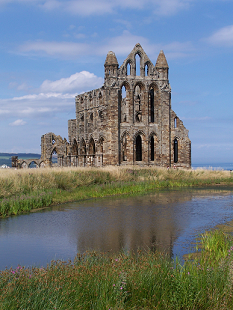
Whitby Abbey
Whitby Abbey (11th century), Photo © PWicks

24th November is the Feast Day of Eanflaed, daughter of King Edwin of Northumbria, and later Abbess of Whitby.

Eanflaed was the daughter born to Edwin the day of his attempted assassination by Eumer, a man sent by Cwichelm of Wessex. Bede tells this story in his “Ecclesiastical History of the English People”, and places it at Easter 626 AD. Edwin was saved from the attack but he lost two of his men, Lilla and Forthhere. In gratitude for his safe deliverance Edwin promised his newly born baby daughter should be dedicated to the Church. She was duly baptised by Paulinus the following year along with her father, Hild, and ten others of her family at York.

Following Edwin’s death at the Battle of Hatfield Chase in 632 AD, she and her brothers were taken south to Kent with her mother, to her uncle Eadbald’s court where she grew up.

She was later married to Oswiu, King of Bernicia; he was the brother of Oswald who eventually took the throne of Northumbria after Edwin’s death. The marriage was probably designed to increase support for Oswiu against the rising power of Penda in Mercia, and to provide any children with a strong claim to the combined thrones of Bernicia and Deira. However, in 651 AD Oswiu was implicated in the death of Oswine, King of Deira and kinsman of Eanflaed, which resulted in her receiving the wergild for his death in the form of the foundation of an abbey at Gilling in Yorkshire.

She and Oswiu had at least four children together: Ecgwin (sub-King of Deira 664-670 AD, then King of Northumbria 670-685 AD); Alfwin (sub-King of Deira 670-679 AD); Osthryth (married Athelred of Mercia and was murdered by the nobles in 697 AD); and Alfflaed (fostered by Hild and became Abbess of Whitby). 

Oswiu died in 670 AD, and at some point Eanflaed retired to a religious life at Whitby Abbey under Hild, where her daughter Alfflaed was living. Edwin’s relics were translated to Whitby during this time and became the centre of a royal cult.

Eanflaed was a friend of Wilfrid, the rather controversial Bishop. When he was a young man she had helped him enter the monastery at Lindisfarne and later supported him in his trip to Rome by commending him to her cousin Eorcenberht who was then King of Kent.

When Hild died in 680 AD Eanflaed and Alfflaed jointly ruled Whitby until Eanflaed’s own death no later than 704 AD.

Tolkien’s “Beowulf: The Monsters and the Critics”, 25th November 1936
Beowulf Manuscript
Opening page of Beowulf, British Library Cotton MS Vitellius A XV ff. 132r-201v

Only around 30,000 lines of Old English poetry survive and Beowulf comprises around 10% of these, at about 3,000 lines.

On 25th November 1936, three years before the excavation of the ship burial at Sutton Hoo, Professor JRR Tolkien delivered his seminal lecture to the British Academy – “Beowulf: the monsters and the critics” – in which he aimed to change the prevailing view of the poem and of the Anglo-Saxons.

First of all, Tolkien said, we should understand what the poem is not:

“Nearly all the censure, and most of the praise, that has been bestowed on The Beowulf has been due  either  to  the  belief  that  it  was  something  that  it  was not—for  example,  primitive,  pagan, Teutonic, an allegory (political or mythical), or most often, an epic; or to disappointment at the discovery  that  it  was  itself  and  not  something  that  the  scholar  would  have  liked  better—for example, a heathen heroic lay, a history of Sweden, a manual of Germanic antiquities, or a Nordic Summa Theologica.”

Beowulf, he suggested, had been seen primarily as history rather than literature, and it seemed the poem was viewed with embarrassment by the literary establishment. Tolkien argued strongly that the poem was in fact a complex and important piece of art, worthy of recognition for its poetic quality, and that the illusion of historical content was a product of art and not actual documentary evidence for a particular period. This did not stop it being valuable as a resource for Germanic custom, belief and linguistics, but it should always be viewed through the lens of poetry.

“So far from being a poem so poor that only its accidental historical interest can still recommend it, Beowulf is in fact so interesting as poetry, in places poetry so powerful, that this quite overshadows the historical content, and is largely independent even of the most important facts… that research has discovered. It is indeed a curious fact that it is one of the peculiar poetic virtues of Beowulf that has contributed to its own critical misfortunes. The illusion of historical truth and perspective that has made Beowulf seem such an attractive quarry, is largely a product of art. The author has used an instinctive historical sense – a part indeed of the ancient English temper (and not unconnected with its reputed melancholy), of which Beowulf is a supreme expression; but he has used it with a poetical and not an historical object.”

Tolkien also argued against the prevailing view of the time that a focus on folk tales and fantastic content (monsters, magic etc) was trivial, childish and not worthy of serious attention. In fact he expanded on this theme in his lecture “On Fairy Stories” in 1939. He argued in favour of a mythological mode of imagination which cannot be mechanically analysed, “For myth is alive at once and in all its parts, and dies before it can be dissected.” Meanwhile the monsters allowed the poet to examine themes of evil, humanity and mortality.

“it is in fact written in a language that after many centuries has still essential kinship with our own, it was made in this land, and moves in our northern world beneath our northern sky”

The discovery of the treaures under Mound 1 at Sutton Hoo three years later further strengthened the argument that the Anglo-Saxon age had not been as dark and impoverished as many had believed. The finds were consistent with the imagery in Beowulf to a very great extent.

A full copy of the talk with appendices and notes can be found here:

https://jenniferjsnow.files.wordpress.com/2011/01/11790039-jrr-tolkien-beowulf-the-monsters-and-the-critics.pdf

Siege of Paris, 26th November 885

Count Odo defends Paris against the Norsemen
Count Odo defends Paris against the Norsemen, Jean-Victor Schnetz, Galerie des Batailles, Palace of Versailles

The Vikings arrived in Paris on 24th or 25th November 885 AD, asking for tribute from the Franks. When this was denied, they began a siege on 26th November.

England in 885 AD was beginning to reap the benefits of Alfred’s strategy against the Vikings. In response to tougher times seeking wealth in Britain the Vikings pragmatically turned to easier pickings in Frankia, where the Carolingian Empire was fragmenting and defences were uncoordinated. Charles the Fat had been paying the Norse to go away, just as the English had before and would again. In 884 AD he paid 12,000 pounds of gold and silver, although the Vikings took both the money and the opportunity to pillage as well.

In November 885 AD a band of Vikings led by Sigfrid demanded further payment from Charles, who refused. The Vikings sailed up the Seine to Paris and on 26th November they attacked the northeast tower. The siege of Paris had begun.

The defence of Paris was led by Count Odo and he held out for over a year. His actions were recorded later by Abbo of Fleury (who also spent a couple of years studying in Ramsey Abbey in England and wrote a well-known “Passion S. Eadmundi” about Edmund the Martyr King). Here is what he says:

“885. The Northmen came to Paris with 700 sailing ships, not counting those of smaller size which are commonly called barques. At one stretch the Seine was lined with the vessels for more than two leagues, so that one might ask in astonishment in what cavern the river had been swallowed up, since it was not to be seen. The second day after the fleet of the Northmen arrived under the walls of the city, Siegfried, who was then king only in name but who was in command of the expedition, came to the dwelling of the illustrious bishop. He bowed his head and said: “Gauzelin, have compassion on yourself and on your flock. We beseech you to listen to us, in order that you may escape death. Allow us only the freedom of the city. We will do no harm and we will see to it that whatever belongs either to you or to Odo shall be strictly respected.” Count Odo, who later became king, was then the defender of the city. The bishop replied to Siegfried, “Paris has been entrusted to us by the Emperor Charles, who, after God, king and lord of the powerful, rules over almost all the world. He has put it in our care, not at all that the kingdom may be ruined by our misconduct, but that he may keep it and be assured of its peace. If, like us, you had been given the duty of defending these walls, and if you should have done that which you ask us to do, what treatment do you think you would deserve?” Siegfried replied. “I should deserve that my head be cut off and thrown to the dogs. Nevertheless, if you do not listen to my demand, on the morrow our war machines will destroy you with poisoned arrows. You will be the prey of famine and of pestilence and these evils will renew themselves perpetually every year.” So saying, he departed and gathered together his comrades.

In the morning the Northmen, boarding their ships, approached the tower and attacked it [the tower blocked access to the city by the so-called “Great Bridge,” which connected the right bank of the Seine with the island on which the city was built. The tower stood on the present site of the Châtelet]. They shook it with their engines and stormed it with arrows. The city resounded with clamor, the people were aroused, the bridges trembled. All came together to defend the tower. There Odo, his brother Robert, and the Count Ragenar distinguished themselves for bravery; likewise the courageous Abbot Ebolus, the nephew of the bishop. A keen arrow wounded the prelate, while at his side the young warrior Frederick was struck by a sword. Frederick died, but the old man, thanks to God, survived. There perished many Franks; after receiving wounds they were lavish of life. At last the enemy withdrew, carrying off their dead. The evening came. The tower had been sorely tried, but its foundations were still solid, as were also the narrow bays which surmounted them. The people spent the night repairing it with boards. By the next day, on the old citadel had been erected a new tower of wood, a half higher than the former one. At sunrise the Danes caught their first glimpse of it. Once more the latter engaged with the Christians in violent combat. On every side arrows sped and blood flowed. With the arrows mingled the stones hurled by slings and war-machines; the air was filled with them. The tower which had been built during the night groaned under the strokes of the darts, the city shook with the struggle, the people ran hither and thither, the bells jangled. The warriors rushed together to defend the tottering tower and to repel the fierce assault. Among these warriors two, a count and an abbot [Ebolus], surpassed all the rest in courage. The former was the redoubtable Odo who never experienced defeat and who continually revived the spirits of the worn-out defenders. He ran along the ramparts and hurled back the enemy. On those who were secreting themselves so as to undermine the tower he poured oil, wax, and pitch, which, being mixed and heated, burned the Danes and tore off their scalps. Some of them died; others threw themselves into the river to escape the awful substance. . . .

Meanwhile Paris was suffering not only from the sword outside but also from a pestilence within which brought death to many noble men. Within the walls there was not ground in which to bury the dead. . . . Odo, the future king, was sent to Charles, emperor of the Franks, to implore help for the stricken city. One day Odo suddenly appeared in splendor in the midst of three bands of warriors. The sun made his armor glisten and greeted him before it illuminated the country around. The Parisians saw their beloved chief at a distance, but the enemy, hoping to prevent his gaining entrance to the tower, crossed the Seine and took up their position on the bank. Nevertheless Odo, his horse at a gallop, got past the Northmen and reached the tower, whose gates Ebolus opened to him. The enemy pursued fiercely the comrades of the count who were trying to keep up with him and get refuge in the tower. [The Danes were defeated in the attack.]”

Odo petitioned Charles for help as things worsened. Naturally the Parisians expected Emperor Charles to support them in their heroic endeavours so they were not delighted with his response after all their suffering.

“Now came the Emperor Charles, surrounded by soldiers of all nations, even as the sky is adorned with resplendent stars. A great throng, speaking many languages, accompanied him. He established his camp at the foot of the heights of Montmartre, near the tower. He allowed the Northmen to have the country of Sens to plunder; and in the spring he gave them 700 pounds of silver on condition that by the month of March they leave France for their own kingdom. Then Charles returned, destined to an early death.”

The Vikings were free to leave, Burgundy was sacrificed to them and Charles was deposed the following year on 11th November 887AD.

Death of Clovis, 27th November 511

Gaul in 511 AD
Gaul in 511 AD, Vidal-Lablache, Atlas général d’histoire et de géographie (1894) [Public Domain]

Clovis I, the first King of the Franks, died 27th November 511 AD.  He was the first pagan European king to convert to Christianity and his story has parallels with that of Edwin of Northumbria in the 7th century.

Clovis united the Frankish tribes under one king, ensured the throne would be passed down to his heirs, and is credited with being the founder of the Merovingian dynasty. In practice he established founded the kingdom of the Franks which continued to expland after his death.

Clovis’ father was Childeric, who had ruled a Frankish tribe, but when Clovis succeeded him in 481 AD aged about 15 or 16 he began to expand his territory, taking over other tribes as he went. The remains of the Western Roman Empire were under attack by Emperor Justinian, whom we recently discussed on 14th November, and Clovis was responsible for contributing to its final fall as he united northern Gaul. Then in 507 AD he defeated Alaric II and the Visigoths at the Battle of Vouillé which resulted in Alaric’s death.

So it was unsurprising that through Clovis’ power and influence, his conversion to Christianity would impact the religious life of a swathe of northern Europe. His conversion combined with his military success became a blueprint for future rulers who linked success in battle with the gods being followed.

Gregory of Tours wrote a history of the Franks about a century after Clovis, contrasting his behaviour as a pagan with his later conversion. Gregory recorded an incident at Soissons before his conversion:

“At this time [A.D. 486] the army of Clovis pillaged many churches, for he was still sunk in the errors of idolatry. The soldiers had borne away from a church, with all the other ornaments of the holy ministry, a vase of marvelous size and beauty. The bishop of this church sent messengers to the king, begging that if the church might not recover any other of the holy vessels, at least this one might be restored. The king, bearing these things, replied to the messenger: “Follow thou us to Soissons, for there all things that have been acquired are to be divided. If the lot shall give me this vase, I will do what the bishop desires.””

When Clovis gathered his men to divide the treasure he asked that he be allowed to keep the vase in addition to his share. The men agreed with one exception, who smashed the vase. Clovis returned the pieces to the bishop, but a year later he called his men together to display their arms for him to review.

“But when he had reviewed them all he came to the breaker of the vase, and said to him, “No one bears his arms so clumsily as thou; for neither thy spear, nor thy sword, nor thy ax is ready for use.” And seizing his ax, he cast it on the ground. And when the soldier had bent a little to pick it up the king raised his hands and crushed his head with his own ax. “Thus,” he said, “didst thou to the vase at Soissons.””

Clovis married a Christian princess, Clothild of Burgundy, but she was not able to persuade him to convert. Sadly their son Ingomer died in infancy after baptism and Clovis associated the events as being evidence of the weakness of the Christian god.  Their second son, Clodomir, also fell ill after his baptism but his mother prayed for his recovery and he did indeed get well again.

Needless to say, it was a war that changed his mind, as he was fighting the Alemanni in 496 AD:

“It happened that the two armies were in battle and there was great slaughter. Clovis’ army was near to utter destruction. He saw the danger; his heart was stirred; he was moved to tears, and he raised his eyes to heaven, saying “Jesus Christ, whom Clotilde declares to be the son of the living God, who it is said givest aid to the oppressed and victory to those who put their hope in thee, I beseech the glory of thy aid. If thou shalt grant me victory over these enemies and I test that power which people consecrated to thy name say they have proved concerning thee, I will believe in thee and be baptized in thy name. For I have called upon my gods, but, as I have proved, they are far removed from my aid. So I believe that they have no power, for they do not succour those who serve them. Now I call upon thee, and I long to believe in thee -all the more that may escape my enemies.”

When he had said these things, the Alemanni turned their backs and began to flee. When they saw that their king was killed, they submitted to the sway of Clovis, saying: “We wish that no more people should perish. Now we are thine.” When the king had forbidden further war, and praised his soldiers, he told the queen how he had won the victory by calling on the name of Christ.”

However, like Edwin in Northumbria he was not ready to convert until he was sure his people would support the change in religion. The conversion of a king necessitated the conversion of all his people, or perhaps their rebellion if they were not willing to make the change.

Clovis later called the First Council of Orleans, a synod of Gallic bishops, which approved a number of laws and made them equally applicable to all people, putting the conquered tribes on a parity with the Franks.

Clovis is said to have died on 27th November 511 AD but it is not certain. However, following his death the kingdom was shared out between his four sons. Although he had founded a dynasty he had also established a rivalry between regions which was not united, except briefly under Charlemagne in the 8th century, and went on to form the early kingdoms of France, the German states, Lotharingia and Burgundy.

Death of King Edmund Ironside, 30th November 1016

Battle of Assandun. Edmund Ironside
Battle of Assandun. Edmund Ironside, 14th century Matthew Paris, Public Domain

Edmund Ironside died on 30 November 1016 at Oxford having negotiated with Cnut to rule half the country following Cnut’s victory at Assandun in October. His death left Cnut as the single ruler of all England.

Edmund was the second son of Athelred “Unrede” (Ill-Advised) born around 988 AD. Athelred had married his first wife, Alfgifu in 985 AD and they had at least 6 sons and 2 or 3 daughters, and the two eldest boys at least were raised by their grandmother. Edmund became his father’s heir following the death of his elder brother Athelstan in 1014. In Athelstan’s will he left his prized sword, originally belonging to Offa of Mercia, along with estates and other war gear to Edmund. This may be taken to indicate that he and Edmund were of similar opinions about a range of issues, because the family itself was divided over how to handle the difficulties of the kingdom at the time.

By this time the king’s current wife, Emma of Normandy, may have been attempting to ensure the supremacy of the claim of her eldest son Edward (the later “Life of Edward” claims as much); there were certainly tensions within the family. Nevertheless Edmund became the chief witness of his father’s charters.

In 1015, with the help of the devious Eadric Streona, Athelred engineered the deaths of two leading northern thanes, Sigeferth and Morcar. Sigeferth’s widow was forced into retirement at the monastery at Malmesbury. Edmund rescued the widow and married her, as William of Malmesbury explains:

“The wife of Sigeferth, a woman remarkable for her rank and beauty, was carried prisoner to Malmesbury; on which account, Edmund, the king’s son, dissembling his intention, took a journey into those parts. Seeing her, he became enamoured; and becoming enamoured, he made her his wife; cautiously keeping their union secret from his father, who was as much an object of contempt to his family as to strangers.”

Sigeferth and Morcar had been in receipt of a string of honours and ranks from 1009 onwards, and yet were among the first to submit to Sweyn Forkbeard in 1013, so they were not the most reliable of the king’s men. As it happens they had also been close associates of Athelstan so Edmund’s actions may have been in support of his brother’s allies.

Edmund took his new wife and marched north, claiming the lands of the murdered brothers and obtaining the submission of the people there. Some have suggested (eg Stafford) that Edmund and Athelstan may have attempted to seize the throne on 1014 after Sweyn’s death before Athelred was reinstated. Athelred was ageing and becoming increasingly reliant on the unpopular Eadric Streona. In fact Athelred is the longest reigning Anglo-Saxon monarch and by now it must have seemed his time was well and truly over. Roach, for instance, suggests that Athelred may even have prevented his sons from marrying to avoid rival households – Athelstan was unmarried despite being in his twenties and Edmund’s first action upon his rebelling was to marry.

It may not have been that Edmund wanted to become king, only to get land in the north. However, this was the moment at which Cnut appeared, and Edmund’s activity may have persuaded him against heading north himself. Athelred meanwhile was ill and unable to respond effectively to the latest threat. Edmund raised a force but being in revolt against his father meant that the other nobles were uncertain how to respond – although Eadric went over to Cnut.

Before Christmas 1015 Edmund raised an army but the men refused to march without the king. He tried again after Christmas and this time his father joined him initially but then left again on the strength of rumours that Edmund would betray him. Clearly even a Danish invasion was not enough to bring them together.

Edmund therefore went north in search of support and joined with Uhtred of York, his brother-in-law. Together they ravaged Staffordshire and Shropshire, Eadric’s lands. Cnut and Eadric then pillaged in Buckinghamshire, Bedfordshire, Huntingdonshire, Northamptonshire and Lincolnshire which were loyal to Edmund and Uhtred. Uhtred abandoned Edmund, who went to London to his father.

Athelred died on 23rd April 1016 and Edmund was declared king. Over that summer he fought five battles against Cnut with no overall victor (see 12th November for example). The country was therefore divided between the two men but Edmund died soon after, possibly of wounds from his last battle. Although later writers have given lurid accounts that he was murdered or poisoned, no contemporary account indicates foul play.

Edmund was the last fully English king from the House of Wessex. He left two sons, Edward and Edmund, who were sent by Cnut to King Olaf in Sweden, who in turn sent them on to Kiev and then Hungary. Edmund died without children but Edward Atheling did marry and had three children, Edgar Atheling, Margaret and Christina.

Edward the Confessor recalled Edward “the Exile” and his family to England in 1056 to be made his heir, although the Exile died shortly after his arrival. His son Edgar was briefly elected by the Witan to be king (although never crowned) after the Battle of Hastings in 1066. Of his daughters, Margaret married King Malcolm of Scotland and Christina entered the nunnery at Romsey Abbey. The male line of Wessex ended with the death of Edgar Atheling in or after 1125.

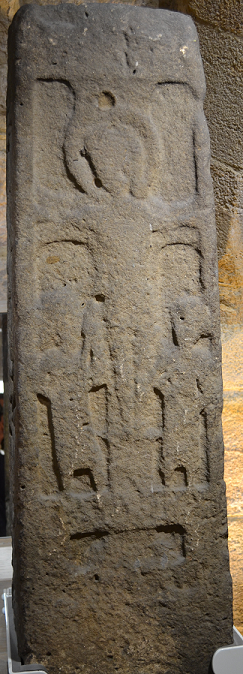
On This Day in October

Death of King Eadwig, 1st October 959

Miniature of Eadwig in the early fourteenth-century Genealogical Roll of the Kings of England in the British Library

On 1st October we remember the death in 959 AD of a ‘wanton youth’ who ‘misused his personal beauty in lascivious behaviour’ (according to William of Malmesbury). The youth in question was King Eadwig, who came to the throne of Wessex at the age of 15, ruled for 4 years, then died mysteriously and early to be succeeded by Edgar, his younger brother.

Eadwig “All-Fair” was born in 940/941 AD to King Edmund and Alfgifu of Salisbury. According to the Chronicle of Athelweard (a 10th century nobleman):

 “His [Eadred’s] successor to the throne was Edwy, who, on account of his great personal beauty, was called Pankalus by the people. He held the sovereignty four years, and was much beloved.”

He succeeded his uncle Eadred in 955 AD, having been too young to take the throne in 946 AD when his father was killed in an altercation at Pucklechurch. He immediately had a confrontation with Dunstan, the Bishop who had been so important in the reigns of his predecessors.

Eadwig’s reign was brief and crisis-ridden, although there was no challenge to the unity of the kingdom from York, despite the fact that Eadred had only recovered it by driving out the Viking ruler Erik Bloodaxe the previous year. Eadwig is possibly best remembered as “the one who had the Coronation Scandal”, where he is reported to have absented himself from the feast in order to indulge in some fun and games with a young lady and her mother. The trio were found in bed by Bishop Dunstan, who forced him to return to the feast; Eadwig exiled Dunstan soon after. However, by exiling Dunstan he earned the enmity of a number of ecclesiastics who were powerful within the kingdom.

Eadwig also confiscated his grandmother Eadgifu’s estates, possibly due to her long and unstinting support of Dunstan. Soon after that he lost the services of another of Dunstan’s supporters, the ealdorman Athelstan Half-King of East Anglia who retired to a monastery in 956 AD; his family had been extremely powerful, but Eadwig now appointed a new ealdorman to some of his estates in Mercia.

Around 60 charters survive from 956 AD as Eadwig attempted to build a loyal base of followers. The charters saw a number of promotions of his royal relations. This favouritism may well have had the opposite effect from that he wanted by alarming the other noble families, including Dunstan’s.

His wife Alfgifu was probably the sister of the chronicler Athelweard and a descendant of Athelred I of Mercia, like Eadwig himself. Eadwig’s marriage would have been a threat to Edgar, Eadwig’s younger brother, as the prospect of a son to contest the throne became more likely. In 957 AD, when Edgar was 14 and considered of age, the kingdom split into two, apparently fairly peacefully. North of the Thames, Mercia and Northumbria gave their loyalty to Edgar and his court, while in the south (Wessex) rule remained in Eadwig’s court. Eadwig appeared as “rex anglorum” (King of the English) in charters after this date, so probably was regarded as the overall king, while Edgar was referred to as King of the Mercians. Coins were still issued in Eadwig’s name both north and south of the Thames as well. However, Edgar did recall Dunstan from the exile imposed by Eadwig.

The split may have been indicative of a revolt by the northern kingdoms, but it is also possible it was agreed in advance. The Worcester manuscript of the Anglo-Saxon Chronicle in particular records:

“AD 955. This year king Eadred passed away, and he rests in the Old-Minster. And Eadwy succeeded to the kingdom of the West Saxons, and Eadgar, his brother, succeeded to the kingdom of the Mercians: and they were the sons of king Eadmund and of S. Aelfgyfe.”

In 958 AD the Archbishop of Canterbury annulled the marriage between Eadwig and Alfgifu on the grounds of consanguinity (being too closely related). Given that this would not have been new information, it would be more likely that this was for political reasons. There were no children.

Sources for Eadwig’s reign are primarily the “Life of Dunstan”, which is hostile to him, or later from Edgar’s time, and Edgar was his rival. Eadwig’s early death does not allow us to know for sure whether he could have been a strong king or not.

On Eadwig’s death at the age of 18 or 19 on 1st October 959 AD Edgar succeeded to Wessex and was able to re-unite the two kingdoms once more.

Ordination of Bishop Tilberht, 2nd October 779

Spital Cross
Spital Cross, 8th century, Hexham Abbey, Photo (c) PWicks, 2017

Tilberht (Tilbert) was ordained as Bishop of Hexham on 2nd October 779 AD according to the Anglo-Saxon Chronicle:

“AD 779 Alhmund, bishop of Hexham, died on the 7th of the ides of September [7th Sept.], and on the 6th of the nones of October [2nd Oct.], Tilbert was ordained in his stead.”

Little is known about Tilberht. According to Baring-Gould:

“S.Alkmund was consecrated Bishop of Hexham in 767, and died on the 7th September, 780. He was succeeded in the see by Tilbert or Gilbert, who died in 789. Nothing is known of their acts. The translation of their relics took place in the 12th century, and an account of the miracles then wrought by their intercession was written by a canon of Hexham. This account still exists. The bishops are mentioned by Simeon of Durham and Roger Hoveden.”

Simeon of Durham adds that the consecration took place “in the place which is called Uulfeswelle, that is, the Wolfs Well.” This has been identified as Haltwhistle near Hadrian’s Wall. He also records that in 786 AD:

“Aldulf was consecrated bishop, by archbishop Eanbald and bishops Tilberht and Hygbald, in the monastery which is called Et Corabrige and, enriched with many gifts and donations, was honourably sent back to his own church.”

Putting Tiberht’s episcopate in context, the instability in Northumbria and ominous events in the south can be noted. Firstly, in 787 AD, three ships of Northmen landed in Wessex and the king’s reeve was killed when he tried to take them to the royal estate; these were the first recorded ships of Norse invaders and pre-dated the notorious attack on Lindisfarne in 793 AD. In 788 AD the Northumbrian King Alfwald was assassinated by Sicga and Osred then ruled Northumbria until 790 AD.

Tilberht died in 789 AD and was succeeded by Bishop Athelberht.

Tostig Godwinson driven out of York, 3rd October 1065

Sundial at St Gregory Minster, Kirkdale, Yorkshire
Sundial at St Gregory Minster, Kirkdale, Yorkshire. Photo © PWicks, 2017

On 3rd October 1065 the thanes of Yorkshire occupied York and outlawed Tostig Godwinson, their Earl, for unlawful actions. In his place they called upon Morcar, the brother of Edwin, Earl of Mercia. Tostig was subsequently banished by King Edward (the Confessor) and eventually he allied himself with Harald Hardrada and reappeared at the invasion of Fulford and Stamford Bridge the following year, where he was killed.

The Anglo-Saxon Chronicle tells us that:

“all the thanes in Yorkshire and in Northumberland gathered themselves together, and outlawed their earl, Tostig, and slew his household men, all that they might come at, as well English as Danish: and they took all his weapons at York, and gold, and silver, and all his treasures which they might anywhere there hear of, and sent after Morkar, the son of Aelfgar the earl, and chose him to be their earl.”

Alfgar of Mercia was the son of Leofric and Godgifu (Godiva) and he was unjustly outlawed in 1055 by King Edward, but later reinstated. He had four children, one of whom pre-deceased him. The others were his sons Edwin and Morcar, and his daughter Ealdgyth who was first married to Llewellyn ap Gruffydd and then later to Harold Godwinson. Harold had been at the root of Alfgar’s troubles in 1055 over the Earldom of East Anglia. Alfgar’s family and the Godwins were the most powerful in England.

Earl Godwin had a large family, and Tostig was the third son, younger than Sweyn and Harold. Their sister Eadgyth married Edward the Confessor.

Harold and Tostig were not necessarily close. Sweyn had received an earldom in 1043 and Harold received his earldom in 1045, but Tostig was still a thane when the family was briefly exiled in 1051. The family went to Flanders where Tostig married Judith, the daughter of the Baldwin IV, the Count of Flanders. Judith was also the aunt of Matilda of Flanders who married William of Normandy, making William Tostig’s nephew through marriage.

In 1052 the family was able to return to England and pick up their old honours. In 1055 the Earl of Northumbria, Siward, died in York. His surviving son was too young to take over the earldom and Tostig was appointed in his place, as well as receiving the earldoms of Northamptonshire and Huntingdonshire. He was never popular with the Yorkshire nobles, although King Edward was fond of him. He introduced new laws and high levels of taxation, and was seen as tyrannical and unjust. It is alleged that he was involved in the murders of a number of noblemen. Around 1063 or 1064, Gamal, son of Orm, and Ulf, son of Dolfin, were assassinated when they visited Tostig under safe conduct. (The sundial at St Gregory Minster in Kirkdale mentions Tostig, and was set up by Orm, the son of Gamal.)

The ‘Vita Edwardi’, records that Tostig had ‘repressed the Northumbrians with the heavy yoke of his rule’. As he became more unpopular he struggled to raise his levies to defend against Scottish incursions and had to resort to hiring expensive and even more unpopular mercenaries.

However, in 1061 he and Judith made a pilgrimage to Rome with Ealdred, the recently appointed Archbishop of York, and are generally recorded as being very devout. It was not enough to bring him favour at home.

Finally Tostig was ousted on 3rd October 1065.

Harold tried to broker an agreement between the parties, but Morcar was granted the earldom in Tostig’s place and Tostig and Judith went to Judith’s family home Flanders once more. In the following spring of 1066 he visited his nephew William in Normandy to try to persuade him to invade England immediately and left him when William insisted on preparing more thoroughly. Tostig then raised a fleet with the help of Baldwin V (Judith’s brother and now the Count of Flanders) and ravaged the south coast of England. Harold (who was by now the King) drove him off and Tostig made his way north, attempting to bring his younger brother Gyrth onto his side but failing. Edwin and Morcar were similarly robust in their response and also drove Tostig off. Finally Tostig arrived in Scotland where he spent the summer at King Malcolm’s court.

In the autumn he persuaded King Harald Hardrada of Norway to invade England and their forces arrived at Fulford outside York to meet the men of Edwin and Morcar in battle on 20th September 1066.

Meanwhile Henry of Huntingdon tells an unlikely story of how in 1065 Tostig and his brother Harold had a fight in the royal hall at Windsor in front of the king. It was allegedly caused by Tostig who was jealous of Harold’s high standing with King Edward and was unable to restrain himself when Harold was serving wine to the king. The chronicler than claims that Tostig went to Harold’s estate in Hereford and dismembered all the servants, putting body parts into all the vessels of drink. As a result Edward outlawed him and he went into exile.

Death of Osgyth, 7th October

St Osith

Illuminated capital depicting Saint Osith (c. 653). Public domain

On 7th October c. 700 AD there was a Danish raid in Essex which resulted in the death of Osgyth, the Abbess of a convent which later became St Osgyth’s [Osith’s] at Chich in Essex.

Osgyth  was the daughter of Frithuwald of Surrey and Wilburh, his wife. Her uncle, Wilburh’s brother, was Wulfhere of Mercia, son of Penda and his successor as ruler of Mercia. Frithuwald was not only Wulfhere’s brother-in-law but also his sub-king, ruling Surrey as part of the Mercian hegemony.

Osgyth was probably born at Quarrendon in Buckinghamshire where her father had a palace. She was raised by her aunt Edith at Aylesbury, along with aunt Eadburh of Bicester, another two of Penda’s children and both Christian saints.

During her childhood a miracle story tells about her restoration to life following an accident. One day her aunt Edith sent her with a book to St Modwenna. On the way Osgyth had to cross a stream during inclement weather and was blown from the bridge into the water where she drowned. Edith thought she was safely with Modwenna, but Modwenna was unaware she was coming, so the poor girl was not missed for a couple of days. On the third day the alarm was raised and her body was found in the water with the book. Fervent prayers were offered by both the saintly women and Osgyth was miraculously restored to them unharmed (along with the book).

When she grew up Osgyth was married to King Sighere of Essex by her uncle Wulfhere in order to establish his control of Essex. Sighere was joint king with his cousin Saebbi from 663-688 AD when he died and Saebbi became sole ruler. However, Sighere had reverted to paganism and although he agreed to convert upon the marriage the couple separated almost immediately in 673 AD.

There is a miracle story about their separation which enabled Osgyth to enter a religious life as she preferred.

According to Agnes Dunbar’s “Dictionary of Saintly Women”:

“Osith’s inclinations turned towards a religious life, she would rather have been an abbess than a queen, and had secretly made a vow of celibacy. Her fate was decided for her, and she was given to Sighere, but still prayed that she might have no husband but the Lord. On her marriage, she went with her husband, probably to London, which was then the capital of Essex. On one pretence or other, she declined for several days to receive the king in her bower—a separate house for herself and her attendant ladies, within the enclosure of the royal residence. At last her contrivances were exhausted, and so was the king’s patience. Her seclusion came to a sudden end and her husband stood before her. Still she prayed that she might keep her vow. Sighere began to protest that without her, life held no happiness, no interest for him. But even while he spoke, there was a sound of eager voices and hurrying feet. Some of his lords cried, “The stag, the stag! ” and close to the gate was the largest stag that ever was seen. Up sprang Sighere, and with all his court, started in pursuit. Osith regarded this interruption as an answer to her prayers, and took his departure as a release from her engagement. She sent in all haste for Bishops Acca and Bedwin. When the king returned, after a chase of four or five days, he found her a veiled nun. He generously gave her an estate at Chich in Essex, and built her a church and a monastery, where she soon gathered many holy nuns about her, and attained to wonderful sanctity.”

Around the year 700 AD Danish raiders arrived in Essex and came to Chich. When Osgyth refused to renounce her religion, the leader of the raiding band decapitated her, and a spring rose up where her head fell. Later the water from this spring was the miraculous cure of a number of ailments. Osgyth meanwhile was undeterred by her decapitation and, rising to her feet, carried her head bloodily to the church.

Initially her body was buried at Aylesbury by her family. However, following visions of the saintly Osgyth in which she requested that her remains should rest in her own religious house, she was translated some years later to a shrine at Chich which became a centre of pilgrimage.

Feast Day of Iwig, 8th October

St Mary (Old Church), Wilton

St Mary (Old Church), Wilton, CC-SA 2.0

8th October is the Feast Day of St Iwig (Ywi) who is said to have died in Brittany on 6th October c.690 AD. He was, however, of Northumbrian origin and a student of St Cuthbert, who ordained him as a deacon. In the Irish tradition Iwig was inspired to go on “peregrination”, which means leaving one’s homeland and wandering for the love of God. The “Voyage of St Brendan” is a famous example of this.

Iwig set sail on the first boat he found and landed at Brittany where he became a hermit, and he remained there until his death. He was known for his miracles of healing.

The real story begins much later, in the 10th century, when some monks from Brittany brought his relics back to England. They reached Wilton near Salisbury and asked for hospitality. During their visit they left Iwig’s relics safely on St Eadgyth’s altar in the abbey church. When the time came for them to move on, they found they couldn’t move the relics again. The abbess, Wulfthryth, paid them 2000 gold solidi (coins) and the monks “wearied and despairing” returned to Brittany, “surrendering to those who held it the blessing of the incomparable treasure.”

One explanation for this is that Eadgyth had decided the monks were too impure to carry Iwig’s remains. Another might be that the abbey purchased or even appropriated the relics for their own establishment, and a miracle was attached to disguise a rather sordid or even illicit transaction. Certainly the Breton monks did not seem pleased with the outcome, and Wulfthryth is known for having used the abbey’s wealth to increase its possession of relics. She was the mother of the Eadgyth who predeceased her; it was alleged Wulfthryth had been abducted by King Edgar and had Eadgyth as a result. The abbey’s wealth was in large part due to the generous donations of Edgar during his daughter’s lifetime.

Iwig’s feast was commemorated in a number of 11th century church calendars.

Death of Bishop Paulinus, 10th October 644


Depicting Saints Aidan of Lindisfarne, Paulinus (first Bishop of York) and Cuthbert (holding St Oswald’s head) at All Saints Pavement in York. Photo by Jules & Jenny from Lincoln, UK [CC BY 2.0]

Paulinus, Bishop of York, died 10th October 644 AD. He came to the north with Athelburh, the Kentish princess, who was to marry King Edwin of Northumbria on the provision that Edwin did not hinder her religion and considered converting to Christianity himself.

Paulinus had originally been sent by the Pope to bolster Augustine’s mission to Britain. When Edwin agreed to the terms imposed for the marriage to Athelburh, Paulinus was ordained as a bishop on 21st July 625 AD and accompanied her to the north. Upon arrival he supported the Christian household which had travelled from Kent but also preached to convert the Northumbrians.

When Cwichelm of Wessex sent an assassin against Edwin the following year, Edwin promised his new-born daughter to the Church in thanks for his survival. Bede describes the momentous events:

“On that same holy night of Easter Sunday, the queen had brought forth to the king a daughter, called Eanfled. The king, in the presence of Bishop Paulinus, gave thanks to his gods for the birth of his daughter; and the bishop, on the other hand, returned thanks to Christ, and endeavoured to persuade the king, that by his prayers to Him he had obtained that the queen should bring forth the child in safety, and without much pain. The king, delighted with his words, promised, that in case God would grant him life and victory over the king by whom the assassin had been sent, he would cast off his idols, and serve Christ; and as a pledge that he would perform his promise, he delivered up that same daughter to Paulinus, to be consecrated to Christ.”

After Edwin’s successful campaign of retribution against Wessex he continued to be instructed by Paulinus in the Christian faith but still hesitated to commit his kingdom to the Church. Paulinus increased the pressure by revealing that Edwin’s vision of a mysterious man who spoke to him when he was in exile was in fact Paulinus himself. Edwin had promised he would follow the guidance of this stranger if he was able to help him become king and defeat his enemies. Paulinus now called in the promise on the basis that God had done all this for Edwin, and proved his authenticity by giving the sign the stranger had made in the vision.

Edwin then called his witan to debate the new faith, and it was agreed that they should accept it wholesale. The following Easter Edwin and his court, including his little daughter, his niece Hild (later Abbess) and his son Osfrid from his first marriage, were baptised. Paulinus also directed the king to lay the foundation of a great stone church in place of the wooden one built for the ceremony, and so York Minster was founded.

Bede claims the new religion was received with great enthusiasm, although this may not be entirely accurate:

“So great was then the fervour of the faith, as is reported, and the desire of the washing of salvation among the nation of the Northumbrians, that Paulinus at a certain time coming with the king and queen the royal country-seat, which is called Adgefrin [Yeavering], stayed there with them thirty-six days, fully occupied in catechising and baptizing; during which days, from morning till night, he did nothing else but instruct the people resorting from all villages and places, in Christ’s saving word; and when instructed, he washed them with the water of absolution in the river Glen, which is close by.”

Paulinus also preached and baptised in Swaledale when the king was at his palace there, and in Lindsey, converting the governor of Lincoln and consecrating its bishop.  Somewhat unusually we have a portrait of Paulinus’ appearance, from Bede description:

“he was tall of stature, a little stooping, his hair black, his visage meagre, his nose slender and aquiline, his aspect both venerable and majestic.”

When Edwin was killed in battle in 632 AD, Paulinus took the queen and her children back to Kent by sea, along with a quantity of church treasure. He was then made Bishop of Rochester where he served until his death on 10th October 644 AD.

He was buried at Rochester St Andrew and his successor was Ithamar, the first English-born bishop since Augustine’s arrival. Alban Butler tells us that:

“When Gundulf the Norman was bishop of Rochester, Archbishop Lanfranc rebuilt the cathedral church of St. Andrew, and causing the bones of St. Paulinus to be taken up, placed them in a rich shrine”.

Feast Day of Agilbert, 11th October

Crypt at Jouarre, tomb of Agilbert
Crypt at Jouarre, tomb of Agilbert. Photo by  GFreihalter [CC BY-SA 3.0]

11th October is the Feast Day of Agilbert, a Frank who became the first Bishop of the West Saxons.

Agilbert was born to an aristocratic Frankish family in the district of Soissons. Both his sister and his cousin were important figures in the church and Agilbert himself studied in Ireland before travelling to preach in Wessex, where King Cenwealh invited him to become Bishop of the West Saxons around 650 AD.

He established a See at Dorcherster-on-Thames but his reputation soon lost its glamour as Cenwealh became frustrated that Agilbert did not speak his language. As a result he split the See and appointed the Englishman Wine to be Bishop of a new See based at Winchester. Agilbert failed to exhibit Christian patience and humility, and left Wessex.

Bede summarises the events for us:

“But when Coinwalch was restored to his kingdom, there came into that province out of Ireland, a certain bishop called Agilbert, by nation a Frenchman, but who had then lived a long time in Ireland, for the purpose of reading the Scriptures. This bishop came of his own accord to serve this king, and preach to him the word of life. The king, observing his erudition and industry, desired him to accept an episcopal see, and stay there as his bishop. Agilbert complied with the prince’s request, and presided over those people many years. At length the king, who understood none but the language of the Saxons, grown weary of that bishop’s barbarous tongue, brought into the province another bishop of his own nation, whose name was Wini, who had been ordained in France; and dividing his province into two dioceses, appointed this last his episcopal see in the city of Winchester, by the Saxons called Wintancestir. Agilbert, being highly offended, that the king should do this without his advice, returned into France, and being made bishop of the city of Paris, died there, aged and full of days. Not many years after his departure out of Britain, Wini was also expelled from his bishopric, and took refuge with Wulfhere, king of the Mercians, of whom he purchased for money the see of the city of London, and remained bishop thereof till his death. Thus the province of the West Saxons continued no small time without a bishop.”

In 664 AD Agilbert was in Northumbria where he supported the case for the Roman church at the Synod of Whitby. However, as his spoken English was still poor he appointed Wilfrid to speak for him.

He finally gave up attempts to settle in England and in 668 AD he became Bishop of Paris, where he ordained Wilfrid as a Bishop. He also hosted Theodore of Tarsus over the winter of 668-9 as he travelled north to Britain to become the new Archbishop of Canterbury. One wonders what tips he gave to Theodore about what he could expect to find.

Cenwealh offered to reinstate him in 670 AD but Agilbert refused and sent his nephew Leuthere instead, Cenwealh accepted the substitution and Archbishop Theodore duly consecrated him as Bishop and the kingdom recovered.

Agilbert died around 690 AD and was buried at Jouarre alongside his family.

Battle of Hatfield Chase, 12th October 632

Edwin of Northumbria, at Sledmere St Mary, North Yorkshire
Edwin of Northumbria, at Sledmere St Mary, North Yorkshire by DaveWebster14 [CC BY 2.0]

King Edwin of Northumbria was killed on 12th October 632 AD at the Battle of Hatfield Chase.

Edwin is one of the Bretwaldas, the overlords or “High Kings” of the Anglo-Saxon Kingdoms, the 5th according to Bede, and the first in a line of Northumbrian Bretwaldas which went on to include Oswald and Oswy.

Edwin had come to power after defeating Athelfrith the Twister at the Battle of the River Idle in 616 AD and expanded his kingdom and authority across most of the other Anglo-Saxon kingdoms and even into the Isle of Man, which was Welsh territory. This brought him into conflict with Cadwallon of Gwynedd who allied himself with King Penda of Mercia to fight back.

On 12th October 632 AD Edwin fought them at the Battle of Hatfield Chase and was killed, along with his eldest son Osfrith. His second son, Eanfrith, was captured and later killed by Penda. His wife, young children and his grandson Yffi fled back to Kent. The children were now exiles, as their father had been. Eanflaed grew up in Kent with her mother and uncle, but Wuscfrea and Yffi were sent abroad for their safety to the court of King Dagobert, who was related to them through Athelburh’s mother Bertha. Unfortunately both died in infancy and the male line of Edwin was ended.

Twelve months of chaos followed Edwin’s death in Northumbria as the victors ravaged the land. Order was finally restored by the coming of the next great Northumbrian King, Oswald.

Feast Day of Bishop Wilfrid, 12th October

Anglo-Saxon Crypt at Hexham
Anglo-Saxon Crypt at Hexham © PWicks, 2017

Wilfrid of Ripon’s Feast Day is celebrated on 12th October.

He was born into a noble Northumbrian family around 634 AD and was ambitious and energetic. He left home as a young man to seek royal preferment at court and made himself a friend of Eanflaed, the wife of Oswiu, King of Northumbria. Eanflaed sent him to Lindisfarne to study for a life in the Church and when Wilfrid expressed a desire to study in more depth in Rome, she sent him to Kent, where her uncle was King Eorcenberht. Wilfrid studied there for about a year before finally moving on to Rome in the company of Benedict Biscop of Monkwearmouth- Jarrow. He quarrelled with the group however, and left them at Lyons. He stayed a while with Bishop Dalfinus before eventually making his own way to the Eternal City.

In Rome he met and made friends with Boniface and studied under him. After a stay of some months he received the blessings of the Pope and then, with some relics he had acquired, he returned to Lyons. Bishop Dalfinus there tonsured him. Wilfrid stayed in Lyons with Dalfinus for three years.

Wilfrid finally returned to England where Ahlfrith, the son of Oswiu, established him as Abbot in the newly founded monastery at Ripon. Around 663 AD he was made a priest by Agilbert, former Bishop of the West Saxons; you may recall he was the Bishop sent away by the king because he was unable to speak English. When the Synod of Whitby was held in 664 AD Wilfrid acted as Agilbert’s spokesman, as Agilbert was still unable to speak English well. He argued passionately for the Roman form of rule and eventually persuaded Oswiu to accept it in place of the Irish tradition. He did not make himself popular with a number of the Irish traditionalists such as Colman as a result.

Wilfrid was then appointed to the Bishopric of York which was vacant. However, Wilfrid felt that he should be consecrated by someone in favour with Rome and so he went to Frankia to receive his elevation. He was delayed there for a while and in his absence Chad was made Bishop of York instead.

On his way back to England Wilfrid’s ship was attacked by pagan pirates, but thanks to his prayers they were driven off multiple times, even though they greatly outnumbered the men on Wilfrid’s boat.

Initially Wilfrid returned to Ripon but also acted as Bishop for Kent and Mercia when required at the request of those kings. He spent some time in Canterbury and it was there he recruited as singing-master the man who came later to write his hagiography, Eddius Stephanus (Aedde Stephanus).

In 669 AD Theodore became Archbishop of Canterbury and he restored Wilfrid to the bishopric in York, with Chad going back to Lastingham and then to the bishopric of Mercia. Wilfrid found the church founded by Edwin was in a poor condition, with water coming in through the broken roof and birds nesting inside.

“so, forthwith, in accordance with the will of God, he made a plan to restore it. First of all he renewed the ruined roof ridges, skilfully covering them with pure lead; by putting glass in the windows he prevented the birds or the rain from getting in, although it did not keep out the rays of light. He also washed the walls, and, in the words of the prophet, made them “whiter than snow.” Furthermore, not only did he adorn the inside of the house of God and the altar with various kinds of vessels and furniture, but outside he richly endowed the church with many estates which he had acquired for God, thus removing its poverty by endowing it with lands.”

He also lavished attention on Ripon, decorating it with gold, silver and purple in a splendid fashion. At the dedication of the church Wilfrid made sure that everyone was very clear about what lands had been granted to it for its wealth.

“Then St Wilfrid the bishop stood in front of the altar, and, turning to the people, in the presence of the kings, read out clearly a list of the lands which the kings, for the good of their souls, had previously, and on that very day as well, presythented to him, with the agreement and over the signatures of the bishops and all the chief men, and also a list of the consecrated places in various parts which the British clergy had deserted when fleeing from the hostile sword wielded by the warriors of our own nation.”

Feasting went on for three days and three nights to celebrate the grand occasion. Many other treasures were also provided and it was a glittering and lavish occasion.

Although Wilfrid had great pretensions regarding his power and influence he also made enemies widely. The Northumbrian King Ecgfrith disliked him because Wilfrid had supported Ecgfrith’s wife Athelthryth to take the veil. Meanwhile Abbess Hild of Whitby, who supported the Irish tradition and had opposed Wilfrid at the Synod on 664 AD, may have used her influence with Archbishop Theodore to reduce Wilfrid’s reach. Theodore certainly decided to split the vast Northumbrian See and in 678 AD Wilfrid was driven out. New bishops were installed in Ripon and Hexham and York.

Wilfrid was not a man to take matters lying down and he set off to Rome to complain to the Pope.  As a result he was restored to York, but alongside other bishops chosen by Wilfrid and consecrated by Theodore in the new bishoprics. King Ecgfrith however did not comply and Wilfrid was driven out again, ending up in the pagan kingdom of Sussex. King Athelwalh granted him land at Selsey where he founded a monastery and converted the last pagan Anglo-Saxon kingdom. Cadwalla of Wessex invaded Sussex and killed Athelwalh and made Wilfrid his Bishop, giving him land in the Isle of Wight.

Hild died in 680 AD and King Ecgfrith of Northumbria died in 685 AD at Nechtansmere and with this enemy removed Wilfrid was restored to York and the monasteries at Ripon and Hexham. However he continued to try to regain his full estate, as he saw it, until he was driven out again in 692 AD to Mercia where he remained for about eleven years. He focused on missionary activity in Frisia in this period and one of his students, Willibrord, was an active missionary there, as we have discussed in another post.

In 703 AD the Archbishop of Canterbury Berhtwald (Theodore had died in 690 AD) agreed at a council in Northumbria that Wilfrid should be suspended from office and deprived of his lands except Ripon. Wilfrid tried to reverse the decision by going back to Rome to complain but this time was not met sympathetically and in fact was excommunicated. However, Berhtwald was instructed to call a synod jointly with Wilfrid and the bishops of York and Hexham.

On his way back to England to attend the synod Wilfrid suffered a seizure and never fully regained his strength. Be became reconciled with Berhtwald by 705 AD and in 706 AD he regained control of Hexham when the bishop, John of Beverly, was translated to York.

Wilfrid lived another four years but suffered further seizures. He disposed of his property in a very aristocratic fashion far from in keeping with the Benedictine Rule he had been one of the first to impose on monasteries.

He died in 710 AD at Oundle, and was buried at Ripon, immediately being treated as a saint.

Wilfrid is an example of the very different view of sanctity which existed in the early Anglo-Saxon church. He was ambitious and very aware of his rights and wealth. However, he also inspired great loyalty and genuinely wanted to promote the Christian faith. He proved unable to compromise or work constructively with those in authority who did not follow his guidance or advice.

Translation of Edward the Confessor, 13th October 1163

Edward the confessor touching for the evil
Edward the confessor touching for the evil. from Cambridge University Library, Photo number: M0011314 from Wellcome Images, [CC BY 4.0]

On 13th October 1163, in the presence of Henry II, Edward the Confessor’s body was transferred by Thomas Beckett, Archbishop of Canterbury, to a Shrine specially prepared for it.

Until then Edward had rested in a reliquary of gold and silver made for Edward’s remains by William of Normandy. In 1102 the tomb was opened for some unrecorded reason, and “a wonderful fragrance filled the church”. The king was wrapped in a pall with a sceptre by his side and a crown on his head. On his finger was a ring and sandals were on his feet. The pall which covered his head was cut beneath the chin and the long beard was seen. Miracles were said to have taken place at the tomb and it became a place of sanctuary in the early 12th century. When the body was translated, Edward’s ring was taken off his finger and deposited with the Abbey relics, although all the relics disappeared during the dissolution of the monastery in 1540.

One of the things not often remembered about Edward is that he was the first King of England to touch for the “king’s evil” (scrofula, a form of tuberculosis) and many sufferers from the disease were cured by him. After touching the diseased patient, Edward ordered that they be maintained at royal expense until they were cured.

It was believed that the touch of the king could cure the disease through their holy office as God’s Anointed and thus affirming their Divine Right to rule. Edward (r. 1042-1066), along with Philip I of France (r. 1058-1108), was the first king around whom the custom grew. Later English and French kings were believed to have inherited the touch as an indication that their rule was God-given. During the 13th century the upkeep of the patients was replaced by the donation of a coin to each one.

In ceremonies called “Touching for the King’s Evil” the ruler would touch the heads of those suffering from the disease, and the afflicted were then given a coin, called a touchpiece, which they wore as an amulet.

Charles II restored the practice following his return to the throne after it had been stopped in England during the Commonwealth and people had to travel abroad to be healed. He had continued the practice during his exile in the Netherlands in the 1650s, where he was in such demand that a number of potential patients were trampled to death in the rush to be healed.

The practice ceased once more under William III who thought it a silly superstition. However, it was re-introduced for one last time by Queen Anne (r. 1702-1714). One of her supplicants was a two year old boy called Samuel Johnson, who later became known for his English Dictionary.

Scrofula is now known medically as tuberculous cervical lymphadenitis. It appears as lesions around the neck and throat, today easily cured but in medieval times destined to fester and weep as indications of sin, primarily gluttony. Many medieval physicians therefore recommended restrictive diet and avoidance of “all things that fill the head with fumes,” such as garlic and onions, strong wine, shouting, worry, and anger. Treatment consisted of a plaster of lily root, unripe figs, bean flour, and nettle seed. Attempts might be made to rupture the lesions with the help of blister beetles. Surgery consisted of incision of the lump, scraping away and clamping the flesh overlying it. On occasion, the lesions healed by themselves resulting in stories of miraculous cures.

Battle of Hastings, 14th October 1066

Bayeux Tapestry showing death of Harold, Photo by Myrabella [Public domain]
English Companions wreath laying at Battle, photo © PWicks

King Harold Godwinson met William of Normandy at Senlac Hill on 14th October 1066. He had marched his depleted army south from Stamford Bridge after his defeat of Harald Hardrada of Norway, and he spent a week in London before moving to camp near William’s forces on 13th October.

With fewer numbers than the Normans, the English shield wall held for much of the day but broke at last when the king was killed, his house-carls fighting to their last breath. The battle went to the invaders from Normandy. 

Many pages have been written about the battle, whether Harold was overly rash or excitingly bold; whether Edwin and Morcar were treacherous or too weak to fight after the battles of Fulford and Stamford Bridge; whether William was lucky or inspired. There are plenty of sources too for the military details. Final figures are unknown but thousands died.

The Anglo-Saxons did not magically vanish that day; they are still here now. But a way of life and culture was irrevocably changed.

The Anglo-Norman writer William of Malmesbury summarises the English warriors thus:

“they were few in number and brave in the extreme; and sacrificing every regard to their bodies, poured forth their spirit for their country.” You can read more about the events of 1066 elsewhere on the website, under “Events in Anglo-Saxon Times”.

You can read more about the events of 1066 elsewhere on the website, under Events in Anglo-Saxon Times | Events of 1066”.

Identification of King Harold’s body, 15th October 1066

The spot marking the place where Harold is supposed to have died, Battle Abbey, Sussex
The spot marking the place where Harold is supposed to have died, Battle Abbey, Sussex; photo by Néstor Daza, Public Domain

Rumour was flying about the fate of the King after his defeat and death at the Battle of Hastings (14th October 1066). Scandinavian sagas written down much later tell a story that Harold was rescued from the battlefield where he had been left for dead. Recognising the judgement of God Harold then chose to live the life of a hermit.

However, the chronicler William of Poitiers tells us that Duke William had him buried on the seashore, in an attempt to prevent a focus for resistance building up around a tomb.

“The two brothers of the King were found near him and Harold himself, stripped of all badges of honour, could not be identified by his face but only by certain marks on his body. His corpse was brought into the Duke’s camp, and William gave it for burial to William, surnamed Malet, and not to Harold’s mother, who offered for the body of her beloved son its weight in gold. For the Duke thought it unseemly to receive money for such merchandise, and equally he considered it wrong that Harold should be buried as his mother wished, since so many men lay unburied because of his avarice. They said in jest that he who had guarded the coast with such insensate zeal should be buried by the seashore.”

Two final resting places have been proposed, perhaps if his body was moved at a later date: Bosham and Waltham Abbey both have a claim to his remains, but neither can be substantiated.

His body was identified by his “Danish” wife Edith Swan-Neck, who recognised him only by a mark which she alone knew, as his face and body had been badly mutilated and could not be otherwise identified.

His wife Edith of Mercia, sister of Edwin and Morcar and widow of Gruffydd ap Llewellyn, was pregnant when Harold died and gave birth to a son, or possibly twin sons soon after. She initially fled to her brothers and stayed in Chester but probably went abroad into exile later with her sons and possibly joined other members of Harold’s family after Edwin and Morcar rebelled and were killed.

Harold and Edith Swan-Neck had had five or six children, and their sons Godwin and Edmund, and possibly Magnus, fled to Ireland. They launched an invasion via Devon in 1069 but were defeated.

Harold’s mother Gytha held Exeter against William in 1068 but was defeated and escaped via Flatholm Island in the Bristol Channel to Flanders. Her grand-daughter Gytha later joined her there. She later married Vladimir Monomachus of Kiev. Harold’s other daughter Gunnhilde went to the nunnery at Wilton.

The King of Denmark, Swein Estrithsson was Harold’s cousin and launched an invasion in 1068 but with little impact.

After Hastings Edgar the Atheling was proclaimed King of England by the Witan in London. Sadly he was never crowned and was forced to submit to William of Normandy. Initially William took him back to Normandy with him, but then returned to England. Eventually Edgar found himself with his family at the court of Malcolm of Scotland, where his sister Margaret married the king. Edgar was the last male descendant of the line of Cerdic of Wessex.

Death of Athelweard, 16th October 922

Will of Alfred the Great,
Will of Alfred the Great, AD 873–888, granting land to Athelweard (11th-century copy, British Library Stowe MS 944, ff. 29v–33r), (c) British Library

According to John of Worcester, the chronicler, Athelweard, the brother of King Edward the Elder, died on 16th October 922 AD:

“AD 922 Ethelward, the etheling, king Edward’s brother, died on the seventeenth of the calends of November [16th October], and was carried to Winchester and buried there.”

This is alarmingly short on details. Furthermore it looks like John was probably wrong by a couple of years and it is more likely Athelweard died around 920 AD. For example, William of Malmesbury, generally thought to be more accurate with his dates for this period, tells us that in 924 AD:

“Edward, going the way of all flesh, rested in the same monastery [Winchester] with his father, which he had augmented with considerable revenues, and in which he had buried his brother Ethelward four years before.”

Athelweard is not well-known and information is scant despite his noble birth.  He was the youngest of five children of Alfred according to Asser, probably born around 880 AD. Asser also describes his education, with that of other royal and noble children, in his work on the life of King Alfred:

“The sons and daughters whom he [Alfred] had by his wife above-mentioned were – Athelflaed, the eldest, after whom came Edward, then Athelgivu, then AIfthryth, and finally Athelward — besides those who died in childhood.

Athelflaed, when she arrived at a marriageable age, was united to Athelred, Ealdorman of Mercia. Athelgivu, having dedicated her maidenhood to God, entered His service, and submitted to the rules of the monastic life, to which she was consecrate, Athelward, the youngest, by the divine counsel and by the admirable foresight of the king, was intrusted to the schools of literary training, where, with the children of almost all the nobility of the country, and many also who were not noble, he was under the diligent care of the teachers. Books in both languages, namely, Latin and Saxon, were diligently read in the school. They also learned to write; so that before they were of an age to practise human arts, namely, hunting and other pursuits which befit noblemen, they became studious and clever in the liberal arts.”

While Edward and AIfthryth were raised at court Athelweard was described as “distinguished in learning”, and it would appear from the records that he was never seen as being in line for the throne after his brother. However, his education seems to have been much more focused on preparing for a career in the church; Alfred himself had indicated Latin should only be taught to those boys who were expected to have such a career, and Asser makes a point of describing his education in the separate school.

Nevertheless Athelweard inherited a wide range of lands in Alfred’s will:

“And to my younger Son the land at Eaderingtune and that at Dene, and at Meone, and at Ambresbyry, and at Deone, and at Sturemynster, and at Gifle, and at Cruaern, and at Whitchurch, and at Axan mouth, and at Brancescumbe, and at Columtune, and at Twyfyrd, and at Mylenburn, and at Exanmynster, and at Sutheswyrth, and at Liwtune, and the lands that thereto belong ; which are all that I in Weal district have, except Triconshire.”

He also inherited 500 pounds of Alfred’s wealth, the same as Edward, representing a quarter of the total amount.

Athelweard witnessed two of Alfred’s charters late in his reign, but is otherwise not notable in the records. He also attested 18 of Edward’s charters between 900-909 and a further 3 allegedly in 923 AD. He is the most prominent of signatories to Edward’s charters which seems to be at odds with the plan for his career in the church; instead he seems to have been present at court for much of the time although he is not mentioned in relation to any of Edward’s military operations.

He appears to have had two sons, Athelwine and Alfwine, both of whom are recorded as dying at the Battle of Brunanburh in 937 AD fighting alongside their cousin King Athelstan. According to William of Malmesbury, they were honourably buried at Malmesbury on the orders of their cousin the King.

Athelweard himself was buried at Winchester in Edward’s New Minster alongside their mother Ealhswith (d. 902 AD) and later his nephew Alfweard and Edward himself, both of whom died in 924 AD.

Translation of Etheldreda, 17th October 695

Saint Athelthryth of Ely from the Benedictional of St. Athelwold,
Saint Athelthryth of Ely from the Benedictional of St. Athelwold, illuminated manuscript in the British Library, (c) British Library

Athelthryth (also known as Etheldreda or Audrey) was the third daughter of King Anna. She married twice, remained a virgin and founded a church at Ely, later to become Ely Cathedral.

Athelthryth died on 23rd June 679 AD. Her translation and elevation to the sainthood took place on 17th October 695 AD, 16 years after her death, when Athelthryth’s body was raised from her coffin and found to be perfect.

The Liber Eliensis (Book of Ely) describes these events in detail. It was quite an occasion. The stone for the tomb which was found among the Roman ruins of Granchester had apparently appeared miraculously and was not recognised as having been there previously by the local people. The monks concluded it had been placed there by God for use in Athelthryth’s new sarcophagus.

The day of the translation was attended by huge crowds and among those present as witnesses were Athelthryth’s friend, Bishop Wilfrid, and the doctor Cynefrith, who had attended her when she was dying and tried to relieve the large swelling on her jaw by cutting it open.

When her grave was opened, Athelthryth’s body was discovered to be uncorrupted and her coffin and clothes proved to possess miraculous powers.  Cynefrith’s first-hand account of the events is as follows:

“So a tent awning having been fixed up and arranged in a seemly manner over the place, with the whole congregation, brothers on one side, sisters on the other, were standing around her grave singing psalms, a trench was dug, a heap of earth being removed, and her coffin was raised from the dust. And the holy Abbess Seaxburh, after the casket lid had been opened, went in with a few people, as if to raise the bones and shake them apart, and after there had been a short pause, we suddenly heard her call out from inside in a loud voice “Glory be to the most high name of the Lord!” And so that these things might be made public in the confirmatory presence of the witnesses, a little while later, they called me inside too, and I saw, raised from the tomb and placed on a couch, the body of the holy virgin, looking like someone asleep. And when her body had been brought out from the open tomb into the light, it was found as undecayed as if she had died or been buried that same day.

And when the covering of her face was removed, they showed me also that the wound of the incision which I had made, had been healed, in such a way that instead of the open, gaping wound with which she was buried, there appeared at that time the slightest traces of a scar.”

The Abbess Seaxburh supervised the preparation of her sister’s body, which was washed and wrapped in new robes before being reburied. She apparently oversaw the translation of her sister’s remains without the supervision of her bishop, using her knowledge of procedures gained from her family’s links with the Faremoutiers Abbey as a basis for the ceremony. After Seaxburh, Athelthryth’s niece and her great-niece, both of whom were royal princesses, succeeded her as abbess of Ely.

Miracles were reported relating to the coffin and, the shroud clothes from Athelthryth’s burial, and a spring of water appeared at the place where she had been buried. The water from it had healing properties.

Bede was very impressed by Athelthryth’s works and wrote a poem to her which included teh following lines:

 “Many a triumph is won on Earth by hearts that are sober

Love of sober restraint triumphs mightily on Earth.

Our times too a noble virgin has graced with a blessing.

Now Etheldreda shines, noble our virgin as well.”

You can also listen to a reading from the Book of Ely (Liber Eliensis) commemorating the translation of Athelthryth, along with Seaxburh, Wihtburh and Eormenhild, on 17th October 1106. Their remains were moved to a higher part of Ely Cathedral and placed in a special quadruple shrine. Thanks to William Benjamin for this reading.

Battle of Assandun, 18th October 1016

St Andrew's parish church, Ashingdon, Essex
St Andrew’s parish church, Ashingdon, Essex, Lonpicman [CC BY-SA 3.0 ]

On 18th October 1016 was the Battle of Assandun (Ashingdon) when Cnut, son of Swein Forkbeard, King of England in 1014, defeated Edmund Ironside, the son of Athelread Unrede. The two men had fought a punishing series of battles across England since Athelred’s death in April 1016, and In spite of his victory at Assundun, Cnut agreed to divide England between the two of them.

The idea of England as a single country was understood, but not a fixed idea yet. It was still reasonable to split the land in this way, and may even have continued if Edmund had not died fairly soon after. Edmund’s death a few weeks later was the point at which England as a whole became part of Cnut’s “Empire of the North”.

William of Malmesbury describes the events of early 1016:

“Canute, having settled his affairs in Denmark, and entered into alliance with the neighbouring kings, came to England, determined to subdue it or perish in the attempt. Proceeding from Sandwich into Kent, and thence into West Saxony, he laid everything .waste with fire and slaughter, while the king was lying sick at Corsham. Edmund indeed attempted to oppose him, but being thwarted by Edric [Streona], he placed his forces in a secure situation.”

Edmund in fact had raised revolt against his father and married Ealdgyth, whom his father had ordered should be taken to Malmesbury Abbey following the murder of her husband by Eadric Streona. Edmund tried to persuade his army to fight the invading Danish but they dispersed because Athelred did not come to lead them.

Finally on 23rd April 1016 Athelred died, while he and Edmund were in London preparing to defend it from Cnut. Edmund was chosen as King and so began his brief and embattled reign, during which he displayed a more martial spirit than his father. While London held itself against Cnut, who besieged it to no avail, Edmund broke out and headed for Wessex where he raised a further army. Cnut then moved to Wessex to face the threat from Edmund. They fought first at Penselwood (Dorset) where Edmund had a victory, then at Sherston after midsummer, which was inconclusive although some English defected to the Danish side, including Eadric Streona.

Cnut returned to London to try to take the city again. Edmund raised more troops and was then able to relieve London. Some of Cnut’s forces were driven to their ships, and Edmund fought them again at Brentford. He then drove the Danes into Kent and fought at Otford, and Eadric appeared to feel the tide had turned in the English favour and returned to Edmund, although not for long.

The Battle of Assandun was the final and decisive battle of the year. The location is not entirely certain but generally thought to be in Essex near Rochford. Both sides had lost a great many men in the preceding months and the date is late in the campaigning season; but the battle went to Cnut, along with the kingdom. The Anglo-Saxon Chronicle describes it tersely:

“then assembled he [Edmund], for the fifth time, all the English nation, and followed after them [the Danes], and overtook them in Essex, at the down which is called Assandun: and there they strenuously joined battle. Then did Eadric the ealdorman, as he had oft before done, begin the flight first with the Magesaetas, and so betrayed his royal lord and the whole people of the English race. There Cnut had the victory; and all the English nation fought against him. There was slain bishop Eadnoth, and abbat Wulsige, and Aelfric the ealdorman, and Godwine the ealdorman of Lindsey, and Ulfcytel of East-Anglia, and Aethelweard, son of Aethelwine the ealdorman; and all the nobility of the English race was there destroyed.”

The Liber Eliensis (Book of Ely) also records that “there was a massacre in that place of almost the whole array of the nobility of the English, who never received a more wounding blow in war than there.”

Eadric’s treachery was countered by Edmund’s stirring rally of his men, according to the Encomium Emmae Reginae, written for Queen Emma, widow of King Athelred, who married Cnut after his victory.

“Then Eadmund, observing what had occurred, and hard pressed on every side, said: “Oh Englishmen, today you will fight or surrender yourselves all together. Therefore, fight for your liberty and your country, men of understanding; truly, those who are in flight, inasmuch as they are afraid, if they were not withdrawing, would be a hindrance to the army.” And as he said these things, he advanced into the midst of the enemy, cutting down the Danes on all sides, and by this example rendering his noble followers more inclined to fight.”

Edmund did not want to admit defeat even after this catastrophe, but his support drained away. Skaldic verse refers to one further battle near the Forest of Dean before the peace talks at Deerhurst, where England was divided between the two sides, until Edmund’s death in November. And so England had a second Danish king.

In 1020 Cnut consecrated a church at Assandun on 18th October, the anniversary of the battle, to commemorate the warriors who died.

Death of Frideswide, 19th October 735

St Frideswide's Priory, now Christ Church Cathedral
St Frideswide’s Priory, now Christ Church Cathedral , Wiki alf [CC BY-SA 3.0 ]

St Frithuswith (Frideswide), the patron saint of Oxford and Oxford University, died on 19th October 735 AD and was buried in her monastery in Oxford. She cured the blind, healed the sick and was Abbess of the monastery she founded, which was a house for both men and women.

Frithuswith was a noble daughter of the Mercian King Didan and his wife Sefirda, both Christians. She had decided to enter a religious life and with her parents’ blessings she founded a monastery at Oxford. Although her father was a king, he was subject to other more powerful kings, and one of these called Alfgar wanted to marry Frithuswith. When she refused he decided he would abduct her from her monastery. Frithuswith however escaped with two nuns and a young man, and they rowed down the River Isis to Abingdon where she hid. Alfgar was not easily deterred, however, and followed her with great determination. Frithuswith prayed energetically for help from God, who responded by striking Alfgar blind.

He recognised that he was not going to be able to persuade her, and so gave up his intention. Frithuswith then prayed for his sight to be restored, which was granted, and returned to her monastery in peace where she remained for the rest of her days.

This miracle resulted in a belief that the Kings of England could neither live in nor pass near Oxford without being struck blind, until Henry III ignored the story. His reign certainly had some significant challenges although it is not likely the two are connected and he did not go blind.

Miracles abounded around Frithuswith, naturally. For example, Baring Gould tells the story of how she healed a leper:

“It happened on her return to Oxford after her flight to Abingdon, that an unfortunate young man, struck with leprosy, met her on the road, and prayed her, ” I conjure you, Virgin Frideswide, by the Almighty God, to kiss me, in the name of Jesus Christ His only Son.” The maiden, overcoming the horror felt by all towards this loathsome disease, approached him, and after having made the sign of the cross, she touched his lips with a sisterly kiss. Soon after the scales of his leprosy fell off, and his body became fresh and wholesome like that of a little child.”

Baring Gould also relates how her tomb was disturbed in the time of Elizabeth Tudor:

“Her body still rests there, and her shrine is shown; but it must be added that a commissioner of Queen Elizabeth, in brutal disrespect for the sacred relics, placed beside them, and mixed with them the bones of a disveiled nun married to a renegade priest, Peter Martyr. The commissioner having mingled the bones so that it was impossible to distinguish the one from the other, placed them in a stone coffin, on which he engraved the words, now happily effaced, Hie requiescit religio cum superstitione.” Frithuswith’s cult remained popular locally until the later Middle Ages although only two medieval churches and a chapel are known to have been dedicated to her. Her monastery was closed in 1524/5 by Cardinal Wolsey

Feast Day of Bishop Acca, 20th October

Acca’s Cross at Hexham Abbey
Acca’s Cross at Hexham Abbey, Photo © PWicks, 2017

20th October is the feast day of Acca, Bishop of Hexham, who was deposed in 732 AD.

Acca was the chaplain of Wilfrid, Bishop of Hexham, and succeeded him as Abbot in 710 AD. Bede tells us:

“Acca, his priest, succeeded Wilfrid in the bishopric of the church of Hagulstad [Hexham]; being himself a most active man, and great in the sight of God and man, he much adorned and added to the structure of his church, which is dedicated to the Apostle St. Andrew. For he made it his business, and does so still, to procure relics of the blessed apostles and martyrs of Christ from all parts, to place them on altars, dividing the same by arches in the walls of the church. Besides which, he diligently gathered the histories of their sufferings, together with other ecclesiastical writings, and erected there a most numerous and noble library. He likewise industriously provided holy vessels, lights, and such like things as appertain to the adorning of the house of God. He in like manner invited to him a celebrated singer, called Maban, who had been taught to sing by the successors of the disciples of the blessed Gregory in Kent, for him to instruct himself and his clergy, and kept him twelve years, to teach such ecclesiastical songs as were not known, and to restore those to their former state which were corrupted either by want of use, or through neglect. For Bishop Acca himself was a most expert singer, as well as most learned in Holy Writ, most pure in the confession of the catholic faith, and most observant in the rules of ecclesiastical institution; nor did he ever cease to be so till he received the rewards of his pious devotion,  having been bred up and instructed among the clergy of the most holy and beloved of God, Bosa, bishop of York. Afterwards, coming to Bishop Wilfrid in hopes of improving himself, he spent the rest of his life under him till that bishop’s death, and going with him to Rome, learned there many profitable things concerning the government of the holy church, which he could not have learned in his own country.”

He had studied under Bosa as well as Wilfrid. He was a close friend of Bede, supplying him with further material for Bede’s “Ecclesiastical History of the English People”, and encouraging him to write a number of treatises, many of which Bede then dedicated to him. Acca also commissioned, and provided Stephen of Ripon with material to use in, a hagiography of Wilfrid, the “Vita S. Wilfridi”, which Stephen dedicated to Acca in thanks.

Despite this obvious interest in learning and writing we have nothing surviving of Acca’s own writing except part of a letter to Bede which Bede copied in one of his other works, the “Commentarius in Lucam”.

Acca left the bishopric under somewhat controversial circumstances, none of which are clear but are likely to have been political. This was around this time that King Ceolwulf of Northumbria was deposed (although he was restored to power a couple of years later) and it was to this “most glorious king” that Bede had dedicated his “History” in 731 AD. Key figures would no doubt have been at risk. His movements after his deposition are not known, although various stories exist.

Simeon of Durham tells us that:

“AD 732: In this year also, king Ceoluulf, being taken prisoner, received the tonsure, and was sent back into his kingdom. He was imbued with an extraordinary love of the Scriptures, as truthful Beda testifies in the beginning of his preface. In the same year, bishop Acca was driven from his see; and Cyneberht, bishop of the church of Lindisfarne, died.”

However, following Acca’s death about 10 years later he was buried at Hexham Abbey and venerated as a saint. The remains of Acca’s Cross, an intricately sculpted stone cross, can be seen in the Abbey today. It is thought the Cross originally marked his grave.

The chronicler Simeon of Durham has a very lengthy entry about Acca to commemorate his death, beginning:

“AD 742: In the same year, bishop Acca, of revered memory, was raised to the land of the living.’ This blessed man was most vigorous in action, and had in honour before God and man. He was deeply skilled also in the rules of ecclesiastical discipline; and, to the end of his life, aimed at the highest rewards of pious devotion : for as much as from his childhood he was brought up and educated among the clergy of the most holy and beloved of God, Bosa, bishop of York, . Going from thence, with a view to further progress, to bishop Wilfred, he spent his whole time in attendance on him until his death. With him journeying to Rome, he there learnt many useful institutes of holy church, which he could not acquire in his own country, and delivered them to those under him. This holy man was taken from this world on the thirteenth of the kalends of November [20th Octob.]; his spirit was carried by angels to the reward of supreme happiness ; his body was buried on the outside of the wall, at the east end of the church of Hexham, over which he had ruled in episcopal dignity for twenty-four years. Two stone crosses, adorned with exquisite carving, were placed, the one at his head, the other at his feet. On one, that at his head, was an inscription stating that he was there buried.”

Simeon then proceeds to describe how Acca’s remains were later translated following a vision, and many of the miracles associated with him. These included preventing some of his remains from being separated and removed from the church, and curing blindness and a tumour. He was also credited with preventing Malcolm of Scotland from devastating the Abbey by raising the waters of the River Tyne (without any rain!) so that the invading army could not cross, and then enveloping them in fog so that they most of them ran away.

“Acca’s Cross” can be seen at Hexham Abbey, although it may not be the one Simeon refers to, and could instead be a preaching cross. However, it is well worth a visit to Hexham Abbey to see this and a number of other Anglo-Saxon stones, the extraordinary crypt and Etheldreda’s Chapel.

Death of Charles Martel, 22nd October 741

Charles Martel, Grandes Chroniques de France.
Charles Martel, Grandes Chroniques de France. BL Royal MS Royal 16 G VI f. 118v. Public domain.

Charles Martel (“the Hammer”) died on 22nd October 741 AD.

He’s not an Anglo-Saxon but he is a key figure in European history, being the founder of the eponymous Carolingian dynasty (from the Latin version of his name: Carolus).

He was the son of Pepin of Herstal, also called Pepin II, and Alpaida. Pepin had multiple significant women in his life – it’s hard to say whether we would call them wife or mistress – but another of them called Plectrude had persuaded Pepin to designate their grandson as his heir but this was not met with the support of the nobles as the boy was only eight years old, and civil war ensued in 715-719 AD. The victor was Charles Martel who defeated all opponents to take control. At this time the Merovingian dynasty was still providing Kings of the Franks, but the real power now lay in the hands of the “Mayors of the Palace” represented by Pepin’s family.

War continued as Charles established control of the various hegemonies in the Frankish kingdom.  This included attacking the Saxons who had invaded earlier, and whom he defeated in the Teutoberg Forest in 731 AD, establishing a clear border.

On 10th October 732 AD Charles fought the Battle of Tours against Abdul Rahman Al Ghafiqi, Governor-General of al-Andalus (the Moorish kingdom of Andalucia in Spain). The Andalusians were no more than a raiding army planning to pillage St Martin of Tours, and similar armies had been attacking Frankish territory for a while. At Tours however Charles was victorious and the battle may be referenced in Bede, although this may alternatively refer to other raids:

“In the year of our Lord’s incarnation 729, two comets appeared about the sun, to the great terror of the beholders. One of them went before the rising sun in the morning, the other followed him when he set at night, as it were presaging much destruction to the east and west; one was the forerunner of the day, and the other of the night, to signify that mortals were threatened with calamities at both times. They carried their flaming tail towards the north, as it were ready to set the world on fire. They appeared in January, and continued nearly a fortnight. At which time a dreadful plague of Saracens ravaged France with miserable slaughter; but they not long after in that country received the punishment due to their wickedness.”

In 737 AD the Merovingian King, Theuderic IV, died and Charles did not appoint a successor, nor was one proposed by the nobles. For four years there was an interregnum, until Charles’ death in 741 AD in Picardy, and he was buried in Paris. He had already divided his lands between his two sons, Carloman and Pepin (the father of Charlemagne).  Among his other children he also had an illegitimate son called Remigius who became Archbishop of Rouen.

He was an extraordinarily successful commander; he never lost a war, and he established control over rivals, neighbouring leaders and the Merovingian kings. If he is now less well-known it is probably because of his fantastically successful grandson, Charlemagne, who took the lands his grandfather had united and doubled them, establishing a renaissance as he went.

From an Anglo-Saxon perspective, Charles Martel was the ruler who protected Boniface from 723 AD onwards in his mission to the Saxons, probably because his own agenda chimed with Boniface’s desire to replace the pagan religion with Christianity while Charles wanted to break the power of the Saxon warlords and incorporate their lands into his own empire. It was Charles who established the four dioceses in Bavaria to support Boniface.

Equally the constant fighting in Frankia throughout this period would have affected Anglo-Saxon travellers heading and to and from Rome.

Bede completed his history in 731 AD, and died in 735 AD.  This was the time of the growth of Mercian power under Athelbald, whom Bede described as ruling all the lands south of the Humber. In 726 Ine of Wessex abdicated and went to Rome, and Athelheard became the king after defeating a rival claimant, Oswald; he was the first not recorded as descended from Cynric. However, he seems to have been subject to Athelbald of Mercia. Meanwhile there was increasing chaos in Northumbria (we discussed Ceolwulf recently, who was deposed and sent to a monastery but later restored). We can only imagine that Charles Martel’s military might on the Continent was regarded with somewhat envious eyes from Britain.

Fire at Ashburnham House, 23rd October 1731

Ashburnham House in 1880, Photo by Henry Dixon
Ashburnham House in 1880, Photo by Henry Dixon [Public domain]

By 1731 the collection of Anglo-Saxon manuscripts amassed by Sir Robert Cotton in the 1580s, and augmented by his son (Thomas) and grandson (John), was regarded as a valuable source of precedents for political purposes. It was the richest private collection of manuscripts ever amassed. In 1702 it was transferred to the care of the nation on Sir John Cotton’s death at his request.  This was confirmed by an Act of Parliament that states that the library was to ‘be kept and preserved … for Publick Use and Advantage’, and that it should ‘not be sold, or otherwise disposed of’.  This was the first national collection of documents in Britain.

It was moved to Ashburnham House in the grounds of Westminster Abbey to make it more readily available to Members of Parliament, and also because its previous location was seen as at a high risk from fire. Ironically, on the night of 23rd October 1731 a fire broke out in Ashburnham House itself and many manuscripts were lost, including original copies of key texts known only today through their later transcriptions, such as The Battle of Maldon and Asser’s Life of King Alfred. Other manuscripts were badly damaged including our only copy of Beowulf; the damage from the fire is clearly visible today when viewing it in the British Library where it is on display.

There was a report to Parliament of the distressing events of that night which can be read in full (it’s long and completely heart-breaking) below:

“A Narrative of the Fire which happened at Ashburnham-House, Oct. 23, 1731, and of the Methods used for preserving and recovering the Manuscripts of the Royal and Cottonian Libraries.

On Saturday Morning October 23, 1731, about two o’ Clock, a great Smoak was perceived by Dr. Bentley, and the rest of the Family at Ashburnham-House, which soon after broke out into a Flame: It began from a wooden Mantle-Tree’s taking Fire, which lay across a Stove-Chimney, that was under the Room, where the MSS. of the Royal and Cottonian Libraries were lodged, and was communicated to that Room by the Wainscot, and by Pieces of Timber, that stood perpendicularly upon each end of the Mantle-Tree. They were in hopes at first to have put a Stop to the Fire by throwing Water upon the Pieces of Timber and Wainscot, where it first broke out, and therefore did not begin to remove the Books so soon as they otherwise would have done. But the Fire prevailing, notwithstanding the Means used to extinguish it, Mr. Casley the Deputy-Librarian took Care in the first Place to remove the famous Alexandrian MS. and the Books under the Head of Augustus in the Cottonian Library, as being esteemed the most valuable amongst the Collection. Several entire Presses with the Books in them were also removed; but the Fire increasing still, and the Engines sent for not coming so soon as could be wished, and several of the Backs of the Presses being already on Fire, they were obliged to be broke open, and the Books, as many as could be, were thrown out of the Windows. Some were carried into the Apartment of the Captain of Westminster School; others into the little Cloisters; whence, after the Fire was extinguished, they were convey’d into the great Boarding House opposite to Ashburnham-House, and upon Monday following, October 25, Leave being ob tained, they were removed into the new Building designed for the Dormitory of the West-minster Scholars.

The Right Honorable the Speaker of the House of Commons came down to Ashburnham-House, as soon as he heard of the Fire, to see that due Precaution was taken, that what had escaped the Flames should not be destroyed or purloined; and on Monday following the Right Honourable the Lord Chancellor, the Lord Raymond, Lord Chief Justice of the King’s-Bench, and Mr. Speaker, being Trustees for the Cottonian Library, were all three at the Dormitory; and as great Numbers of the Manuscripts that remained had suffered exceedingly from the Engine-Water, as well as from the Fire, and were in danger of being quite destroyed, if some cure was not speedily provided; the Right Honorable the Speaker of the House of Commons appointed several Persons, some of whom are concerned in Offices, where Records as well of Paper as Parchment are lodged, to meet him October 28, at the said Dormitory, to consider what was proper to be done for preserving and recovering, as much as possible, the Manuscripts, which had so suffered; and they attended accordingly, and having viewed the Manuscripts, they went together, and drew up the following Paper, viz.

We, whose names are hereunto subscribed, having met at the Desire of the Right Honorable Arthur Onslow Esq; Speaker of the Honourable House of Commons, to consider of proper Methods for preserving the Manuscripts of the Royal and Cottonian Libraries, that have suffered by the late Fire at Ashburnham-House, have agreed upon the following Proposals, viz. I. That the Paper Books, that are stained, be immediately unbound, and put into the softest and clearest cold Water, that can be procured, till the Stains disappear, and then shifted into Water, in which Allum has been dissolved, in order to strengthen and fortify them; afterwards to be hung upon Lines till dry, and then bound again.

II. With regard to the Vellum Manuscripts, it is thought proper, that great Care be taken to separate those, that are damaged, from those that are not damaged; and that a farther Separation be also made of those that are damaged by Water, from those, that are damaged by Fire only; and that Care in the first Place be taken of those, that have suffered by Water, preferring, if possible, the most valuable, and most intire.

III. That the wet Vellum Manuscripts be very carefully turned over Leaf by Leaf; that they be laid as strait and smooth with the Hand as may be, gently pressing each Leaf with a clean Flannel; and where the Wet has penetrated to the Backs of those, that are bound, that they be taken out of the Binding, and turned over in like manner; afterwards to be hung upon Lines, three or four Leaves together, frequently separating each Leaf, as well as those that are bound, as unbound, that they may not stick together.

IV. That the Vellum Manuscripts, which are closed together by the Fire, be separated with an Ivory Folder; that they be turned over Leaf by Leaf, and the glewy Substance which has been fried out upon the Edges, be taken off by the Fingers carefully, in order to prevent its infecting and corroding the rest, as we apprehend it will otherwise do; and that such as are so hardened, and shriveled up, as not to be legible in their present Condition, be softned by cold Water, in case no other Method more proper shall be found.

V. That the Fragments be also carefully cleaned and preserved.

Lastly, That a sufficient Number of proper Hands be imployed to proceed in the Work with all possible Diligence and Dispatch.

October 28, 1731.

S. BURROUGHS.
N. HARDINGE.
ROB. SANDERSON, Usher of the Rolls.
JOHN LAWTON, Keeper of the Records inthe Exchequer.
GEO. HOLMES, Deputy-Keeper of the Records in the Tower.
JAMES STEWART, Clerk to the said Mr. Lawton.
W. WHISTON, Clerk to Mr. Lawton.
P. FORBES.
BENJ. AYCRIGG.
RICHARD BENTLEY, Library-Keeper to his Majesty.
DAVID CASLEY, Deputy-Librarian.

This Paper, which was delivered the Day following to Mr. Speaker, was shown to the Lord Chancellor, and Lord Chief Justice of the King’s-Bench; and all three approving of the Method therein proposed, the three Clerks of the Record Office belonging to his Majesty’s Court of Receipt of the Exchequer were directed by Mr. Speaker to assist Mr. Bentley and Mr. Casley in the Work, according to the Method proposed. A Book-binder also was imployed to wash and re-bind the Paper Books; and others were imployed in turning over the Manuscripts for the first Week; the Number of Books damaged requiring many Hands at the first, that each Book might as soon, as was possible, be turned over, at least once, to prevent their mildewing and corrupting.

November I. The said Persons entered upon their Work. They made a Separation of the Paper Manuscripts from those of Vellum and Parchment, beginning with the wet Paper Manuscripts, that were intire, in the first Place; which were immediately taken out of the Binding, and put into Tubs of cold Water, then shifted into Allum Water, and afterwards hung upon Lines, and, when dry, were taken down, and with great Care and Pains collated; and the Leaves, that had been misplaced and transposed by the Operation, were restored to their proper Places again, and were then delivered to the Book-binder to be bound again. The Vellum Manuscripts were in like manner separated, the wet from those that had suffered by Fire only; and the wet were turned over Leaf by Leaf, and placed open upon the Floor for a few Days, and then taken up, and turned over again, and placed, as before; and this Method was in like manner repeated, till they were dry, and they were then put up into their respective Presses. Some that had suffered much by the Water, when they had been turned over once, or twice, and were found more likely to mildew and corrupt, than to be dried by such Process, were turned over and dried Leaf by Leaf before a Fire; and a very few were obliged to be taken quite out of the Binding, and hung upon Lines, two or three Leaves together, to be dried, the Water having so thoroughly insinuated it self into every Part of them, that they would have rotted sooner than become dry by any other Method.

Those that had suffered by Fire only were next taken in hand, and turned over Leaf by Leaf, as the wet Manuscript had before been; and the glutinous Matter, that had been forced out upon the Edges of the Vellum and Parchment by the Heat of the Fire, was carefully taken off by the Fingers, a few only excepted, and those of little or no Value; the glewy Matter having so cemented and incorporated their Leaves together, that they can hardly be separated without being torn and pulled in Pieces. The Paper Fragments were also separated from those of Vellum or Parchment. The former of these were washed, and hung upon Lines to be dried, as the Paper Books had been before; and the latter were turned over, and laid, as thin as might be, to expose them to the Air to be dryed, and, when dry, were several Times looked over; and the Pieces, that were Parts of the same Book, were laid together, as much as could be found; and the remaining single Leaves, or Pieces of Leaves, when it could not be found to what Book or Books they belonged, were put into Drawers to be kept safe.

All the Time this Affair has been in hand, the Right Honorable the Speaker of the House of Commons has been pleased, not only to order one or other of the Persons employed to attend him several Times a Week, to acquaint him with the daily Progress made in it, and to receive his Directions upon any Emergency, but has also visited the Dormitory in Person frequently, that he might see, that nothing was neglected or omitted, that could any way conduce to the Recovery and Preservation of what the Fire has left. And whereas there are two Originals of the MAGNA CHARTA granted by King John in the Cottonian Library, from one of which the Seal has long since been lost, or plucked off; and that, which has the Seal still remaining affixed to it, was greatly shrivel’d up, the Letters being contracted, Part of the Wax of the Seal melted, and one or two Words quite destroyed, and was so much damaged by the Fire, that there is Reason to fear, that some Parts of it will not much longer continue legible; Mr. Speaker was pleased to direct, that a Copy should be exactly taken from it upon Parchment, in a fair and durable Hand, and that the Words or Parts of Words which were eaten out by the Fire, should be supplied in red Letters from the other Original, and then procured it to be compared with both Originals by several Keepers of Records, and others versed in such Writings, to see that the Copy agreed exactly with the said Originals, i.e. Each Part of the Copy with its respective Original, and to testify such Agreement and Correspondence of the Originals and Transcript upon the Back of the Transcript; which was done accordingly December 18: and an Inscription was then also wrote upon the Back of the said Transcript, mentioning the Fire, and the State the two Originals of the Magna Charta were in at the Time of making the said Transcript; which is to remain in the Library ad perpetuam Rei Memoriam.

There having no way hitherto been found out to extend Vellum or Parchment, that has been shrivel’d up and contracted by Fire, to its former Dimensions, Part of several of the Vellum Manuscripts must remain not legible, unless this Desideratum can be supplied by any Person, which is therefore much to be wished; but it is hoped, that the Care, that has already been taken about them, will prevent their receiving farther Damage from what has happened to them.

A few of the Paper Fragments still remain to be examined; and such, as belong to the same Book, placed together; the main Part of them having been gone thro’ in this Manner already, and thereby several large Portions of Books, and some entire Books have been made up out of them; and when this is done, it seems expedient, that each Book, or Portion of Book, so collected together, should be carefully collated, and the Leaves placed, as near as possible, in the same Order, that they were in before the Fire; and then such, as are thought worth being bound again, may be so served, and the Remainder put either into Covers or Drawers, according to the respective Subjects they treat of, that so the least Fragment may not be lost.

W. WHISTON.
January 20, 1731/2

The Number of Manuscript Volumes, which the Cottonian Library consisted of before the late Fire, was 958: of which are lost, burnt, or intirely spoiled, 114, and damaged, so as to be defective, 98. So that the said Library at present consists of 746 intire Volumes, and 98 defective ones; of which a third Part has been preserved by the aforesaid Method; one hundred and upwards of them being Volumes of letters and State Papers, that have been quite taken to Pieces, washed and bound again.”

Gruffydd ap Llewellyn attacks Hereford, 24th October 1055

Hereford Cathedral
Hereford Cathedral, Mark Warren 1973 [CC BY-SA 4.0]

The 1050s were an especially unsettled period on the Welsh Marches and on 24th October 1055 Gruffydd ap Llewellyn attacked Hereford killing three canons of the church called Eilmar, Ordgar and Godo, along with Eilmar’s four sons, also canons, as they defended the doors of the cathedral.

Leading up to this attack, King Edward has appointed Tostig Godwinson to the Earldom of Northumbria in opposition to Alfgar. Edward then outlawed Alfgar unjustly, and he had fled to Ireland, where he recruited Viking support. He then went to Wales seeking support from Llewellyn. Meanwhile Llewellyn had succeeded in conquering Deheubarth earlier in the year, probably with help from Alfgar and his men, and had now united almost all of Wales. Alfgar also married Llewellyn’s daughter, either in 1055 or possibly later.

An army was therefore gathered and began laying waste to Herefordshire. John of Worcester describes the battle:

“Earl Ralph, the cowardly son of king Edward’s sister [Godgifu], having assembled an army, fell in with the enemy two miles from the city of Hereford, on the ninth of the calends of November [24th October]. He ordered the English, contrary to their custom, to fight on horseback; but just as the engagement was about to commence, the earl, with his French and Normans, were the first to flee. The English seeing this, followed their leader’s example, and nearly the whole of the enemy’s army going in pursuit, four or five hundred of the fugitives were killed, and many were wounded. Having gained the victory, king Griffyth and earl Algar entered Hereford, and having slain seven of the canons who defended the doors of the principal church, and burnt the monastery built by bishop Athelstan, that true servant of Christ, with all its ornaments, and the relics of St. Ethelbert, king and martyr, and other saints, and having slain some of the citizens, and made many other captives, they returned laden with spoil.”

Ralph was the son of Godgifu, Edward’s sister, and Drogo of Mantes, Count of the Vexin. He came to England with Edward in 1041 and seems to have been provided with an earldom based in the lands of his wife Gytha. He supported Edward against Godwin of Wessex in 1051 but failed to prevent the return of the Godwin family in 1052 when he was in command of the fleet supposed to resist them. He probably took over the Earldom of Hereford from Sweyn Godwinson following the latter’s death on pilgrimage to Rome in 1052. His poor performance at Hereford in 1055 earned him the nickname of “the Timid”.  He died on 21 December 1057 and was buried at Peterborough Abbey.

Earl Leofric of Mercia, who was on the borders with Hereford, did not intervene; Alfgar was his son. It was Harold Godwinson who brought levies from Wessex to chase Llewellyn away.

As a result of Ralph’s defeat a treaty was negotiated and Alfgar restored; he succeeded to the Earldom of Mercia when his father died in 1057.

Bishop Athelstan survived but died the following year, and Edward replaced him with Harold Godwinson’s chaplain, Leofgar. Leofgar was a warrior before he was a man of God, and shockingly wouldn’t even shave off his moustache until he was made a bishop. Llewellyn killed him the following year at the Battle of Glasbury.

Death of King Magnus of Norway, 25th October 1047

Coin of Magnus the Good minted in Denmark.
Coin of Magnus the Good minted in Denmark. Ole Andreas Øverland (1855-1911) [Public domain]

25th October 1047 saw the death of Magnus “the Good”, King of Norway.

Magnus was the son of King Olaf Haroldsson (St. Olaf as he was later known) who was ousted by Cnut the Great, King of England and Denmark, in 1029 and driven into exile in Sweden. Olaf died in 1030 at the Battle of Stiklestad trying to regain his throne.

Magnus was born around 1024 and went into exile with his father and family while still very young. Olaf left him to be fostered by Yaroslav the Wise, Grand Prince of Rus, and his wife Ingegerd. In 1031 the news of his father’s death reached the court through the person of Harald Sigurdsson, later known as Hardrada. Harald was half-brother to Olaf and therefore Magnus’ uncle.

Magnus continued to live at Yaroslav’s court, being educated in Greek, Russian and, of course, warfare. In 1035 Cnut died and the Norwegian nobles rebelled against the continuing rule of his son Swein and Swein’s mother Alfgifu. Magnus was brought back from Rus to Norway. Magnus’ mother was also the sister of the King of Sweden, who gave them support and raised an army. Magnus was proclaimed King, still only eleven years old, and the army drove out Swein and Alfgifu. They fled to Denmark where Swein died the following year.

Svein’s half-brother, Harthacnut, was on the throne of Denmark and seeking to take Norway as well. However, a peace treaty was negotiated instead, in which the two agreed that whichever of them died first would be succeeded by the other. When Harthacnut died in England in 1042 Magnus became the King of Denmark. He was opposed by Swein Estrithson, whom Harthacnut had left in charge in Denmark when he went to England. Swein Estrithson had support and so an ongoing conflict between the two countries began.

Magnus had not forgotten about England, which he also felt should be his following Harthacnut’s death. Edward the Confessor had returned from Normandy to take the throne, and Magnus warned him that he intended to attack and regain his rightful inheritance. It appears that Emma, Edward’s mother but also widow of Cnut, in fact had favoured Magnus.

The Anglo-Saxon Chronicle tells us that:

“AD 1045. In this year Eadward, king of the English, collected a very powerful fleet, at the port of Sandwich, to oppose Magnus, king of the Norwegians, who was meditating an invasion of England ; but whose coming was stayed by Sweyn [Estridson], king of the Danes, making war against him.”

In addition Swein Estrithson was a cousin of Harold Godwinson and his siblings, as Godwin of Wessex had married Swein Estrithson’s aunt Gytha. So when Swein asked Edward the Confessor for support against Magnus, Godwin spoke out strongly in his favour. However, Edward preferred not to involve himself, instead leaving the two to fight hoping this would distract Magnus from attacking England.

In 1046 the Chronicle reports that Magnus routed Swein, then:

“AD 1047: Sweyn, king of the Danes, sent his ambassadors to Eadward, king of the English, requesting him to send his fleet against Magnus, king of the Norwegians. Then Earl Godwin advised the king that he should send at least fifty ships, manned with soldiers; but this meeting with the disapproval of earl Leofric and all the people, he declined to send any. Afterwards Magnus, king of the Norwegians, having got together a large and strong fleet, fought a battle with Sweyn, and after many thousands had fallen on both sides, expelled him from Denmark, and subsequently reigned there, and made the Danes pay heavy tribute to him: shortly afterwards he [Magnus] died.”

However, Magnus’ death did not end the threat to England. Harald Hardrada now took the throne for himself, having earlier negotiated to share it with Magnus on his return from Byzantium. He had initially allied himself with Swein in Denmark and forced Magnus to concede a half-share in the throne of Norway in 1046.

“AD. 1048. Sweyn recovered Denmark, and Harold, who was son of Siward, king of the Norwegians, and brother by the mother’s side to St. Olaf, and uncle by the father’s side to king Magnus, went over again to Norway; and shortly afterwards sent ambassadors to king Eadward, making offers of peace and friendship, which were accepted. Sweyn, king of the Danes, also sent ambassadors to him, requesting him to despatch a fleet to his assistance. But although Earl Godwin wished to send at least fifty ships, earl Leofric and all the people unanimously opposed him.”

Harald’s agreement with Magnus was the rather tenuous basis for his claim that he should inherit the English throne, as he had inherited all of Magnus’s lands and rights after his death. And so the stage was set for the first invasion on 1066.

Death of King Alfred, 26th October 899

An Old English Translation of Gregory the Great’s Cura Pastoralis
An Old English Translation of Gregory the Great’s Cura Pastoralis, Bodleian Library MS Hatton 20

“For every man must, according to the measure of his understanding and leisure, speak what he speaketh and do what he doeth.”

Alfred the Great, the only English monarch to be awarded this title, died on 26th October 899 AD. In later times he was called “England’s Darling” and “the most perfect character in history.” He certainly set in place the foundations for the formation of the nation of England, an endeavour completed eventually by his descendants. His achievements cannot possibly be summarised in a Facebook post, but a flavour of them follows here.

Initially Alfred was not expected to be king. He was the youngest of five boys, sons of Athelwulf of Wessex. He even visited Rome twice as as young child with his father, while his brothers stayed at home and were more involved in court. His biography tells us that he was fond of learning, although he learned to read later in life.

However, through various events and disasters he eventually came to the throne after the death of his brother Athelred in 871 AD following nine major battles with the Great Heathen Army. We will discuss them on their appropriate dates, so not go into detail for now. Athelred left a young son who was passed over at a time when military strength and experience were the key requirement in the king.

Alfred had to pay the heathen to leave and successes in further engagements were limited. While celebrating Twelfth Night at Chippenham in January 878 AD Alfred narrowly avoided being captured and killed by a Viking raid, possibly in collusion with some of his nobles. Wessex was the last Anglo-Saxon Kingdom still unconquered and chance of winning against the Vikings must have seemed vanishingly remote.

Alfred fled to the marshes of Atheleny with his family, including the young Athelflaed and Edward. There are many apocryphal stories of this period, including a vision of St Cuthbert. The burnt cakes appear in much later sources. However, it would seem he conducted guerrilla warfare, keeping his nobles aware that he had not left the country and was still intending to fight. But things looked bleak without a doubt.

“878 AD: This year, during midwinter, after twelfth night [6th Jan.] the army stole away to Chippenham, and overran the land of the West- Saxons, and sat down there; and many of the people they drove beyond sea, and of the remainder the greater part they subdued and forced to obey them, except king Aelfred: and he, with a small band, with difficulty retreated to the woods and to the fastnesses of the moors. And the same winter, the brother of Inwaer and of Healfdene came with twenty-three ships to Devon shire in Wessex ; and he was there slain, and with him eight hundred and forty men of his army: and there was taken the war-flag, which they called the Raven. After this, at Easter [23d March], king Aelfred, with a small band constructed a fortress at Athelney; and from this fortress, with that part of the men of Somerset which was nearest to it, from time to time they fought against the army.”

But Alfred wouldn’t give up. He rallied his people and called them to meet him at Ecgbert’s Stone and so they came.

“Then in the seventh week after Easter he rode to Ecgbryhts-stane, on the east side of Selwood ; and there came to meet him all the men of Somerset, and the men of Wiltshire, and that portion of the men of Hampshire which was on this side of the sea; and they were joyful [at his presence]. On the following day he went from that station to Iglea, and on the day after this to Ethandun, and there fought against the whole army, put them to flight, and pursued them as far as their fortress: and there he sat down fourteen days.”

Alfred won the decisive Battle of Ethandun (or Edington) and starved the Vikings into submission. He negotiated peace with their leader, Guthrum, who agreed to be baptised and leave Wessex permanently. Alfred gave him East Anglia under the Treaty of Wedmore and at baptism Guthrum took the Anglo-Saxon name of Athelstan, under which he minted coins. He died in 890 AD and was buried at Hadleigh in Suffolk.

Meanwhile Alfred was determined to ensure his kingdom was better defended against future attack. He initiated a fort building programme of “burhs”, which was further extended by Athelflaed and Edward in their time. He reorganised the levies so that only half was on duty at a time, thus providing continuous cover. He used Frisian expertise to build ships to improve coastal defence. In 886 AD he took control of London, previously controlled by the Vikings, and entrusted it to Athelflaed’s husband Athelred, Ealdorman of Mercia. His preparations paid off when the next wave of Viking invasions occurred in the 890s but with much more limited effect.

Yet he was more than a successful military strategist and commander. He also initiated a programme of religious regeneration and education, and made sure we know about it by employing a biographer to record his deeds. He brought together scholars at his court, such as Grimbald of Saint-Bertin and John the Old Saxon, as well as the Welsh Bishop Asser.

He issued a new law code, founded monasteries and nunneries, and, crucially, made translations of key texts from Latin into Old English – those “most needful for men to know”. Four texts are believed to have been translated by the king himself, although this is a matter of debate. They are nevertheless linked stylistically and are: Gregory’s Pastoral Care, Boethius’ Consolation of Philosophy, Augustine’s Soliloquies, and the first 50 Psalms. He also commissioned translations of Orosius’ Histories against the pagans and Bede’s Ecclesiastical History. It is also thought that he commissioned the Anglo-Saxon Chronicle itself.

It was clear he expected his bishops and leading men to engage with his programme. Ealdormen and other officials were required to study and read, or lose their office. With threats he also issued gifts in true Germanic kingly fashion, among which examples we see the Alfred Jewel (the most ornate of the ones found), the Minster Lovell Jewel, the Yorkshire Astel, the Warminster Jewel, the Bowleaze jewel and the Bideford Bobble. The Borg Astel, found in Borg in Norway, has also been linked with these as Alfred was known to have been visited by Ottar, a powerful Norwegian trader (or perhaps it was looted in a raid).

He also reformed the coinage and was not above annexing church property to make sure he could afford to run his affairs. He was upbraided by the Pope for doing it.

His concern about the rights and responsibilities of kingship may have been fashioned in part by the betrayal at Chippenham. Certainly some key men disappear from the charters after that date. And his poor health is often referred to; he probably suffered from Crohn’s Disease, although it clearly did not prevent him from fulfilling his role or acting on his vision.

In his will, and in fact before he died, he worked hard to ensure his son Edward’s succession in place of his nephew.

Here is part of his Preface to the Pastoral Care (in Old English it’s called the “Hierdeboc” meaning  “Shepherd-Book”).

“Consider what punishments befell us in this world when we neither loved wisdom at all ourselves, nor transmitted it to other men; we had the name alone that we were Christians, and very few had the practices.

Then when I remembered all this, then I also remembered how I saw, before it had all been ravaged and burnt, how the churches throughout all England stood filled with treasures and books, and there were also a great many of God’s servants. And they had very little benefit from those books, for they could not understand anything in them, because they were not written in their own language. As if they had said: ‘Our ancestors, who formerly held these places, loved wisdom, and through it they obtained wealth and left it to us. Here we can still see their footprints, but we cannot track after them.’ And therefore we have now lost both the wealth and the wisdom, because we would not bend down to their tracks with our minds.”

Death of Bishop Eata, 26th October 686

The Frith Stool at Hexham Abbey
The Frith Stool at Hexham Abbey, photo © PWicks 2017

Eata was Abbot of Lindisfarne and twice Bishop of Hexham (678-81 and 685-6 AD), and he died 26th October 686 AD. 
He was one of Aidan’s “12 boys of the English nation” at Lindisfarne, and later served as Abbot of Melrose during the 650s. One of his young monks was a lad called Cuthbert, who went on to become a saint and friend of otters.

He and Cuthbert worked together briefly at Ripon, founded by King Ahlfrith around 660 AD and invited by the King to come from Melrose to establish the monastery. Later Ahlfrith decided he preferred the Roman rule and asked Eata to change but Eata refused and was replaced by Wilfrid. However, following the departure of Bishop Colman after the Synod of Whitby in 664 AD Eata became Abbot of Lindisfarne and Cuthbert served as his prior.

In 678 AD Theodore, the Archbishop of Canterbury, broke up the Diocese of Northumbria and expelled Wilfrid. He made Eata the Bishop of the Bernicians (Northumbrians) based at Hexham and including Lindisfarne.

In 681 AD the See was divided again and Eata returned Lindisfarne as a Bishop.

In 685 AD the Bishop at Hexham, Tunberht, was also deposed by Theodore and Cutherbert replaced him while Eata was at Lindisfarne. However Cuthbert was reluctant to serve at Hexham and the two men swapped places.

Eata finished his life in Hexham, dying of dysentry in 686 AD. 

Bede described him as a “meek and simple man”. He was someone who seems ot have been reliable and trustworthy and got on with whatever he was asked to do.

Death of Bishop Cedd, 26th October 664

: Lastingham Church © PWicks 2018

Cedd died on 26th October 664 AD at Lastingham in North Yorkshire.

 He was one of four brothers described by Bede as “famous priests of the Lord”. The other three were Chad, Cynebil and Calin.

They all studied under Aidan at Lindisfarne, so were raised in the Irish tradition of Christianity. In 653 AD Cedd went with three other priests to the Kingdom of the Middle Angles at the request of King Peada, son of Penda of Mercia. One of them, the Irishman Diuma, became the first Bishop of the Mercians in 655 AD.

Cedd however moved on to the East Saxons and King Sigebert, friend of Oswiu of Northumbria and also a Christian. There Cedd founded various communities including St Peter’s–on-the-Wall at Bradwell-on-Sea, which still survives as one of the oldest intact churches in England, and was built inside the Roman Saxon Shore Fort of Othona.

A story about his time in Sigebert’s kingdom is told by Bede. Cedd had excommunicated a man who was unlawfully married, but the king ignored this and went dine with him. On his way home he met Cedd:

“The king, beholding him, immediately dismounted from his horse, trembling, and fell down at his feet, begging pardon for his offence; for the bishop, who was likewise on horseback, had also alighted. Being much incensed, he touched the king, lying in that humble posture, with the rod he held in his hand, and using his pontifical authority, spoke thus: “I say to you, forasmuch as you would not refrain from the house of that wicked and condemned person, you shall die in that very house.””

Later the man and his brother murdered Sigebert because he was too gentle with his enemies and forgave them according to the Christian fashion.

Following Sigebert’s death, however, the new king was a pagan but Cedd was eventually able to persuade him to accept baptism.

Cedd continued to keep in touch with home and visited Northumbria. The sub-king of Deira (Yorkshire) gave him land at Lastingham to build a monastery. Cedd’s brother Calin was priest to the king already and chose the site, “among craggy and distant mountains, which looked more like lurking-places for robbers and retreats for wild beasts, than habitations for men”. Cedd then fasted and prayed before starting the building work, supported by his brother Cynebil.

While visiting Lastingham in 664 AD he fell ill and died. He was replaced by his brother Chad at Lastingham, who also later became a bishop.

Death of King Athelstan, 27th October 939

The Athelstan Psalter
The Athelstan Psalter, Cotton MS Galba A XVIII (c) The British Library

On 27th October 939 AD Athelstan the Glorious died at Gloucester. As King of the Anglo-Saxons,  he built on the foundations laid by his grandfather Alfred, his father Edward the Elder and his Aunt Athelflaed, with whom he spent much of his youth in Mercia. It is William of Malmesbury who tells us that King Alfred was very fond of his grandson and when he was four years old knighted him and gave him a sword and golden scabbard.

When Edward died in July 924 AD it was Edward’s second son Athelweard who initially succeeded to the throne; but he too died within a few weeks. It was a year before Athelstan was crowned King, indicating political difficulties with his succession, probably due to rivalries between Wessex and Mercia. The Chronicle glosses over the timing in its report:

“AD. 924. ‘This year king Edward died among the Mercians at Fearndun, and very shortly, about sixteen days after this, Aelfweard his son died at Oxford; and their bodies lie at Winchester. And Aethelstan was chosen king by the Mercians, and consecrated at Kingston.”

There was another possible successor, Eadwine, who was Athelweard’s brother, these two young men being the sons of Edward’s second wife, Alfflaed. Eadwine did not succeed and later died at sea in 933 AD, following “disturbance in the kingdom”, according the Annals of St-Bertin where he was buried. Simeon of Durham claims he was drowned at Athelstan’s bidding.

Why was Athelstan so unpopular? His reputation later, and outside England during his reign, was very positive but in Wessex there is a sense his face didn’t fit due to his Mercian upbringing. However, neither was he crowned in Mercia on Athelflaed’s death; her daughter, the rather ineffective Alfwynn, was chosen instead and soon neutralised by Edward the Elder.

In addition, Athelstan ‘s mother Ecgwynn is a shadowy figure described by William of Malmesbury:

“By Egwina, an illustrious lady, he had Athelstan, his first-born, and a daughter, whose name I cannot particularise, but her brother gave her in marriage to Sihtric, king of the Northumbrians.”

There were later claims that Edward the Elder did not marry her and that Athelstan was illegitimate, but this is as likely to have been a smear campaign as anything, just as the claim that he had Eadwine drowned was probably politically motivated.

Athelstan‘s was the first English coronation in which a king wore a crown instead of a helmet. The coronation did not resolve the tensions, and plots seem to have continued with the story of a plan to blind Athelstan, thus rendering him unsuitable for the crown without going so far as to kill him.

Following his coronation Athelstan negotiated with Sihtric of York and in 926 AD he arranged for Sihtric to marry Athelstan’s sister, unnamed but often identified with Eadgyth; but Sihtric died soon afterwards and the settlement died with him.

Athelstan then invaded Northumbria to take control. The Treaty of Eamont Bridge on 12th July 927 AD has been discussed here before. It involved the submission of the Northumbrians, Scots, Welsh and Strathclyde Britons and was followed by seven years of peace in the north. Athelstan was now Lord of all the Anglo-Saxons and effectively a latter-day Bretwalda or Over-King. He gave generous gifts to the church as well as his nobles, including gifts to Beverley and York Ministers, but his control was not without challenge.

In 934 AD Athelstan invaded Scotland although it is not entirely clear why he did so. However he did take time to stop at Chester-le-Street on the way and make generous gifts at the tomb of St Cuthbert, including the maniple and stole which can be seen at Durham Cathedral today.  Opportunities may have arisen from the deaths of various key figures. Simeon of Durham tells us:

“AD. 934. King Ethelstan, going with a large army to Scotland, came to the tomb of St. Cuthbert, commended himself and his expedition to the protection of the saint, bestowed on him many and divers gifts becoming a king, and lands; delivering to the torments of eternal fire whoever should take away any of these from him. After this he subdued his enemies, laid waste Scotland with his land force as far as Dunfoeder and Wertormore, and with his navy he ravaged as far as Caithness.”

In any case, in August 937 AD matters came to a head and the Scots allied with the Dublin Norse and attacked to the south. The armies met at the Battle of Brunanburh, and the battle, which was called “The Great War” was referenced in the Norse Egil’s Saga and the Annals of Clonmacnoise. As well as being recorded in the Anglo-Saxon Chronicle in poetry, starting with the lines:

“Here king Aethelstan, of earls the lord,

of heroes the bracelet-giver,  and his brother also,

Eadmund etheling, very illustrious chieftain

in battle fought with the edges of swords

near Brunanburh.”

John of Worcester says:

“King Athelstan, and his brother Edmund the etheling, encountered him at the head of their army at a place called Brunanburgh, and the battle, in which five tributary kings and seven earls were slain, having lasted from daybreak until evening, and been more sanguinary than any that was ever fought before in England, the conquerors retired in triumph, having driven the kings Anlaf and Constantine to their ships; who, overwhelmed with sorrow at the destruction of their army, returned to their own countries with very few followers.”

Athelstan was a strategist in politics, marrying at least four of his sisters well to kings and princes across Europe and making alliances. He styled himself “King of the whole of Britain” (rex totius Britanniae) on his coins. He issued seven law codes and his court was packed with foreign scholars and dignitaries with more continental contacts than any previous king, Alfred included. He fostered Hakon, son of King Harold of Norway and also Alan of Brittany.

He was a keen collector of holy relics and many such gifts were brought to him by visitors keen to win his favour. The Athelstan Psalter is a beautiful surviving manuscript linked closely to him, if not his personal book.

He was respected and revered across Europe, including in the Annals of Ulster which described him as the “pillar of the dignity of the western world”.

William of Malmesbury summarises his reign:

“His years, though few, were full of glory.”

Feast Day of King Sigebert, 29th October

Kingdom of East Anglia around the time of Sigebert, Amitchell125 at English Wikipedia [CC BY-SA 3.0 ]

29th October is the Feast Day of St Sigebert, the younger son of Raedwald, the King who is probably the man who was in the ship burial at Sutton Hoo.

Raedwald’s conversion to Christianity is famously ambivalent, and his eldest son and successor Eorpwald was initially a pagan who was converted later at the urging of Edwin of Northumbria. He was then murdered by Ricbert who seized the throne and renounced the new faith. The Anglo-Saxon Chronicle tells us that:

“Eorpwald, son of king Redwald, whose father was Titell, whose father was Vuffa, was prevailed on by king Edwin to renounce idolatry, and with all his province received the Christian faith and sacraments; but a short time afterwards he was slain by a pagan named Ricbert.”

The East Anglians only accepted Ricbert for a few years before replacing him with Sigebert, Eorpwald’s younger brother.

Raedwald had had a number of sons and it seems that Sigebert was thought unlikely to succeed so had been able to study in a monastery in Gaul. However, like Alfred in the 9th century, he discovered that fate had other plans for him.

Once back home he set about converting the East Anglians with the help of a Frankish missionary bishop called Felix. Felix established a see at Dumnoc (the location is not definite; it may have been either Dunmow or Dunwich, or possibly Walton Castle, an old Roman fort). Bede takes up the story:

“AT this time, the kingdom of the East Angles, after the death of Earpwald, the successor of Redwald, was subject to his brother Sigebert, a good and religious man, who long before had been baptized in France, whilst he lived in banishment, flying from the enmity of Redwald; and returning home, as soon as he ascended the throne, being desirous to imitate the good institutions which he had seen a France, he set up a school for youth to be instructed in literature, and was assisted therein by Bishop Felix, who came to him from Kent, and who furnished him with matters and teachers after the manner of that country.”

SIgebert, as Bede tells us, was responsible for the foundation of monastery schools to train the next generation of Christians, and was clearly a man more interested in a religious life. He abdicated after five years on the throne and entered a monastery, passing control to his kinsman Ecgric. However, he retained the love and confidence of his people and when the kingdom was threatened by Penda of Mercia he was recalled, possibly against his will, to lead them. Whether this was in a military capacity (which frankly seems doubtful) or as a holy talisman is unclear. In any case he refused to take up a sword and so was killed along with King Ecgric by Penda’s army, which had been victorious against Edwin in 632 AD at Hatfield Chase. Ecgric was succeeded by Anna, the son of Raedwald’s brother Eni. Bede continues:

“This king became so great a lover of the heavenly kingdom, that quitting the affairs of his crown, and committing the same to his kinsman, Ecgric, who before held a part of that kingdom, he went himself into a monastery, which he had built, and having received the tonsure, applied himself rather to gain a heavenly throne. Some time after this, it happened that the nation of the Mercians, under King Penda, made war on the East Angles; who, finding themselves inferior in martial affairs to their enemy, entreated Sigebert to go with them to battle, to encourage the soldiers; he refused, upon which they threw him against his will out of the monastery, and carried him to the army, hoping that the soldiers would be less disposed to flee in the presence of him, who had once been a notable and a brave commander. But he, still keeping in mind his profession, whilst in the midst of a royal army, would carry nothing in his hand but a wand, and was killed with King Ecgric; and the pagans pressing on, all their army was either slaughtered or dispersed.”

Sigebert was killed in battle and his body may not have been identified, so relics were not curated. King Anna was not sufficiently closely related to encourage his cult, but nevertheless he became a saint and is recorded in the 11th century Bury Psalter in the Vatican Library.

King Athelwold Moll of York deposed, 30th October 765

Sceat of Ahlred
Sceat of Ahlred from the York mint.
+ALtHRDL (retrograde), cross pattée
EGBERhT AR, cross pattée.
From the Classical Numismatic Group, Inc

On 30th October 765 AD King Athelwold Moll of York was forced from power, to be succeeded by Ahlred.

On 6th August 759 AD Athelwold had become king after the murder of Oswulf the preceding July, and he was supposedly elected by his own people. As Oswulf’s murder was by an internal faction it is possible Athelwold was implicated in the takeover, despite his election, and when he was removed in 765 AD it was at the hands of Oswulf’s kinsman Ahlred. Confusingly, Athelwold’s son Athelred Moll then became king after Ahlred.

Ahlred (sometimes Alchred) was the son of Eanwine and the grandson of Beornholm, from a branch of the Bernician dynasty. Their family may have originally been based in Lothian. After replacing Athelwold, Ahlred married Osgifu , who was Oswulf’s daughter and sister of Alfwold, who also became King of Northumbria after Athelred Moll.

The Anglo-Saxon Chronicle records the event:

“AD 765. Moll abdicated the kingdom of Northumbria, and was succeeded by Ahlred, son of Eanwin, who was the son of Birnhom, who was the son of Bofa who was the son of Bleocman, who was the son of Auric, who was the son of Ida.”

Ahlred was closely associated with the church and in 773 AD supported a mission into pagan territories conquered by the Franks. He communicated with Charlemagne, as did Offa of Mercia at this same period.

In December 766 AD the Archbishop of York died and was succeeded by Athelred, a relation of Ahlred’s. This did not prevent him from leading the meeting which deposed Ahlred at Easter in 774 AD, as the Chronicle explains:

“AD 774. A red figure like a cross appeared in the sky after sunset. The Mercians and the men of Kent fought a battle at Otford. Frightful and exceeding wonderful serpents appeared in the province of the South Saxons. On the feast of Easter [3d April], the Northumbrians expelled their king Alhred, who had succeeded king Moll, from York, and raised Moll’s son, Aethelbert [Athelred], to the throne.”

Ahlred went into exile at the Pictish court with his son Osred.  Simeon of Durham tells us more about their experiences:

“AD 774. Duke Eadwlf was withdrawn from the wreck of this life; and, at the same period, king Alcred, by the design and consent of all his connexions, being deprived of the society of the royal family and princes, changed the dignity of empire for exile. He went with a few companions of his flight, first to the city of Bebba [Bamborough], afterwards to the king of the Picts, Cynoht by name. The city of Bebba is exceedingly well fortified, but by no means large, containing about the space of two or three fields, having one hollowed entrance ascending in a wonderful manner by steps. It has, on the summit of the hill, a church of very beautiful architecture, in which is a fair and costly shrine. In this, wrapped in a pall, lies the uncorrupted right hand of St. Oswald, king, as Beda the historian of this nation relates. There is on the west and highest point of this citadel, a well, excavated with extraordinary labour, sweet to drink, and very pure to the sight. Moreover, Ethelred, the son of Ethelwald, in the place of this person, received the kingdom; who, crowned with so great honour, held it scarcely five years, as the subsequent narrative of the writer tells.”

Osred returned in 788 AD and succeeded Alfwold (Ahlred’s brother-in-law).